
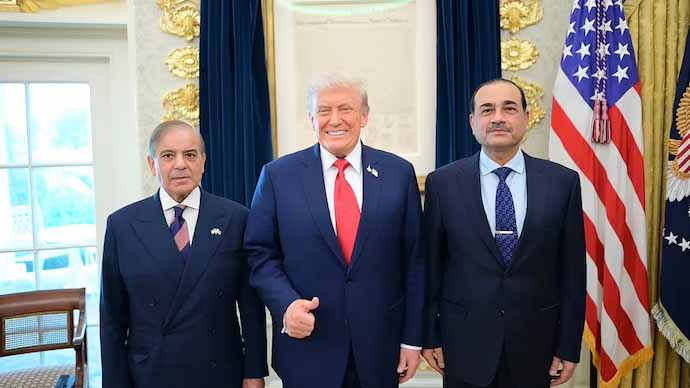
After Operation Sindoor, Pakistan launched a Washington reset via lobbyists, blending diplomacy and signaling, pitching partnership to US officials, addressing FATF concerns, and paving for Asim Munir’s White House visit.
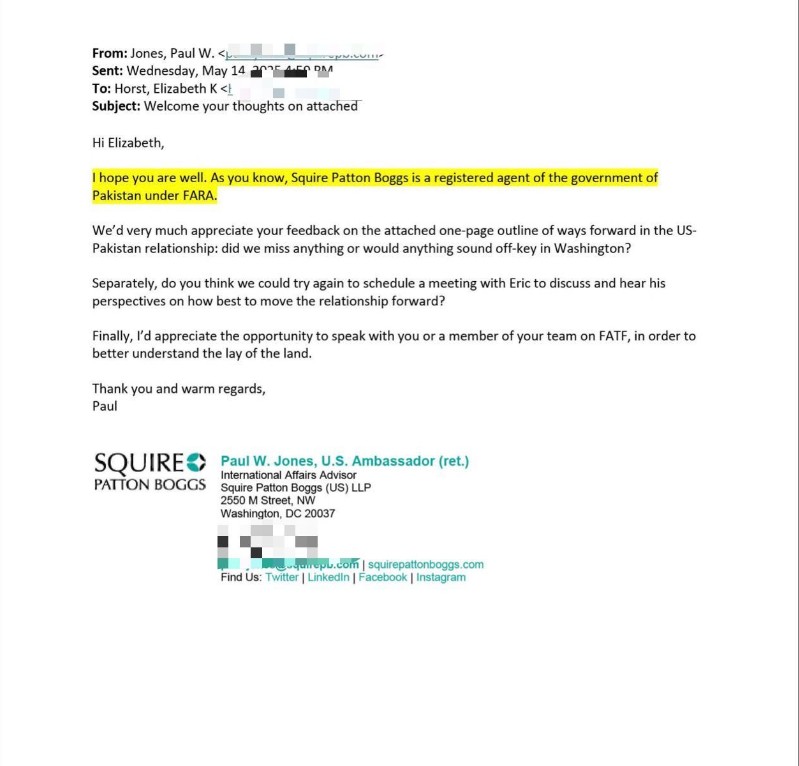
On May 14, 2025, at 4:59 pm, four days after Operation Sindoor, a senior US State Department official received an email from Paul W. Jones, a former US ambassador now serving as an international affairs adviser at the Washington-based law and lobbying firm Squire Patton Boggs. Pakistan, after thanking US President Donald Trump publicly, set in motion another formal effort to reset its relationship with Washington — one that blended lobbying, diplomacy, and military signalling, and would later culminate in Army Chief General Asim Munir’s visit to the White House and announcements on minerals and energy cooperation.
Jones made clear at the outset that his firm was acting transparently and legally. Squire Patton Boggs, he noted, is a registered agent of the Government of Pakistan under the Foreign Agents Registration Act (FARA).
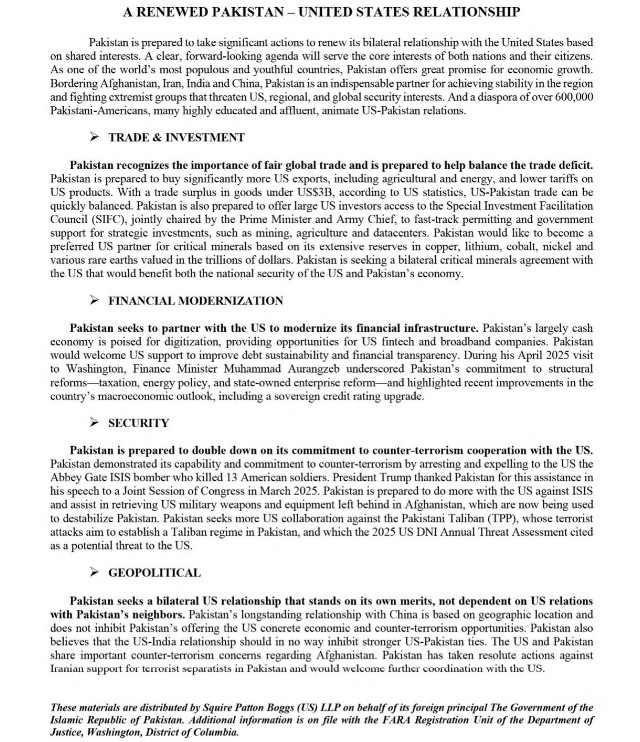
Attached to the email was a one-page policy document titled “A Renewed Pakistan–United States Relationship” — a tightly constructed pitch offering Pakistan as an economic, security, and geopolitical partner at a moment of renewed regional volatility.
THE MESSENGER
Jones is a seasoned Washington operator. A former US Ambassador to Kazakhstan and Poland, he now advises foreign governments navigating US policymaking. His role in this outreach underscored Pakistan’s decision to use trusted American intermediaries to re-engage the State Department.
In his email, Jones asked whether the attached proposal “missed anything” or might “sound off-key in Washington.” He also suggested rescheduling a meeting with Eric. Experts believe this person to be Eric Myers, a career diplomat, currently serving as Charg d’Affaires, at the US Mission to Norway, and former Senior Bureau Official for the Bureau of South and Central Asian Affairs overseeing 21 diplomatic posts throughout South and Central Asia, highlighting Pakistan’s awareness that its US outreach would inevitably be viewed through the prism of US–India relations and South Asian region.
THE RECIPIENT
The email was addressed to Elizabeth K. Horst, a senior career diplomat and former US Ambassador to Sri Lanka, then serving in a key State Department role overseeing aspects of South and Central Asia policy.
Horst’s background is particularly relevant. As ambassador to Sri Lanka, she dealt firsthand with debt distress, China-linked financing, and economic reform—issues that loom large over Pakistan’s own economic narrative.
FATF SHADOW LOOMED OVER PAKISTAN’S OUTREACH
Jones also requested a separate discussion with Horst or her team on FATF, signalling Pakistan’s concern over financial compliance, terrorism financing scrutiny, and reputational risk. The reference to the Financial Action Task Force was telling. Placement on FATF’s grey list has long sweated Pakistan’s political and military leadership, constraining access to global finance, raising borrowing costs, and reinforcing international concerns over terror financing. Quiet engagement with the State Department on FATF issues has therefore remained a priority for Islamabad’s Washington outreach.
In May 2025, India launched a diplomatic campaign across several countries to spotlight Pakistan’s role in financing and supporting terrorism. As part of this initiative, India was preparing to submit a detailed dossier of verifiable evidence to the Financial Action Task Force (FATF), urging the global watchdog to re-list Pakistan on its grey list.
THE OFFER: EXPORTS, INVESTMENT, ACCESS
Much has been talked about what Pakistan offered in terms of getting back on the good side of Washington. The attached document in the email clearly lays out Pakistan’s offer in unusually transactional terms.
On trade, Pakistan said it was prepared to:
- Buy significantly more US exports, including agricultural and energy products
- Lower tariffs on US goods
- Move quickly to rebalance bilateral trade, noting that Pakistan’s trade surplus with the U.S. stood at under $3 billion, a gap it argued could be closed rapidly.
On investment, Pakistan offered:
- Fast-track access for US companies through the Special Investment Facilitation Council (SIFC) — explicitly described as jointly chaired by the Prime Minister and the Army Chief, a rare acknowledgement of the military’s central role in economic decision-making.
- Government-backed support for large strategic projects in mining, agriculture, energy, and data centres
- Preferential treatment for U.S. firms in sectors deemed strategically sensitive
The document went further, positioning Pakistan as a potential critical mineral hub, citing reserves of copper, lithium, cobalt, nickel, and rare earths — resources it said were valued in the trillions of dollars and essential to US national security and supply-chain resilience.
Pakistan explicitly sought a bilateral critical minerals agreement with the United States.
SECURITY AND LEVERAGE
On security, Pakistan emphasised:
- Its role in counter-terrorism, including the arrest and expulsion of the ISIS operative behind the Abbey Gate bombing
- Willingness to expand cooperation against ISIS and the Pakistan Taliban (TTP)
- Assistance in recovering US weapons left behind in Afghanistan
The document noted that Pakistan’s actions had been publicly acknowledged by President Donald Trump in a joint session of Congress in March 2025, reinforcing the message that Islamabad remained a capable security partner.
The GEOPOLITICAL SUBTEXT
The pitch also addressed Pakistan’s relationships with China, India, Iran, and Afghanistan.
It argued that:
- Pakistan’s ties with China were geographic and pragmatic, not exclusionary.
- The U.S.–India relationship should not inhibit stronger US–Pakistan ties.
- The two countries shared overlapping concerns in Afghanistan and counter-terrorism
The message was carefully calibrated: Pakistan was offering itself not as an ideological ally, but as a strategic asset.
FROM LOBBYING TO THE WHITE HOUSE
Within weeks, the arc outlined in the May 14 email appeared to move from paper to practice.
Pakistan’s Army Chief, General Asim Munir, was invited to the White House, where he met President Trump on June 18th. Soon after, cooperation on critical minerals and oil—themes explicitly flagged in the lobbying document — was publicly announced.
For Washington, the engagement reflected a familiar calculus: in Pakistan, the military remains the institution capable of executing strategic commitments.
For Islamabad, the sequence — from Operation Sindoor, to formal lobbying, to a White House meeting — marked a deliberate attempt to reassert relevance in US strategic thinking.
A TRANSACTIONAL RESET
Taken together, the email, the policy document, and the subsequent engagement reveal a coordinated effort to reposition Pakistan in Washington—not through sentiment or history, but through exports, investments, resources, and security deliverables.
It was Pakistan offering itself again—explicitly, legally, and strategically—back into the American conversation.