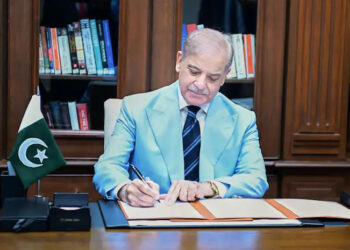

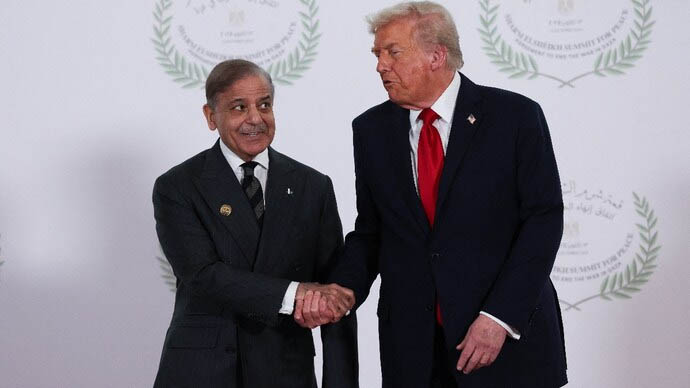
US President Donald Trump has reportedly urged Pakistan and several Muslim-majority nations to join the Abraham Accords after the Iran war ends, placing Shehbaz Sharif in a difficult spot as he balances growing US pressure with Pakistan’s deeply sensitive public stance on Palestine.
“To be, or not to be, that is the question.”
The famous line from Hamlet appears to have returned to haunt Islamabad after US President Donald Trump’s high-level conference call with Pakistan and several Arab nations over the weekend. According to Axios, Trump pushed for more Muslim-majority countries to join the Abraham Accords after the Iran war ends. In simpler terms, formally recognising Israel.
For a country that has tried to play peacemaker between Iran and the US, Donald Trump’s latest demand is not something Pakistan had hoped for as payback. More importantly, the offer is bound to put Pakistan in a bind.
The Palestine issue remains an emotive topic for the Pakistani public. Officially recognising Israel without any clarity on Palestine is akin to a powder keg waiting to explode.
Both the military establishment and the Shehbaz Sharif government know that formally establishing ties with Israel could amount to political annihilation.
Back in 2020, the Abraham Accords were signed during Trump’s first term. Standing alongside Trump on the White House balcony were Israeli Prime Minister Benjamin Netanyahu and the foreign ministers of the United Arab Emirates and Bahrain, unveiling the accords and signalling what they called “the dawn of a new Middle East.”
However, then Pakistan Prime Minister Imran Khan decided against joining the accords, arguing that doing so would go against Pakistan’s long-standing support for a two-state solution.
In an interview with Middle East Eye, Khan said, “I have no second thought about recognising Israel,” while in another interview with a local TV channel, he was quoted as saying, “My conscience will never allow me to accept Israel, which is responsible for so many atrocities against the Palestinian people.”
Two months after the Abraham Accords were signed, Khan claimed that his administration had come under repeated pressure from the US and other countries to normalise ties with Israel. However, he insisted that he would not make any deal with the “Zionists”, knowing such a move could trigger massive domestic protests led by religious and fundamentalist groups.
It is also well documented that many Pakistanis would view such a move as a betrayal of the country’s founding principles. Pakistan’s founder Muhammad Ali Jinnah had famously opposed the creation of Israel, calling it “a dagger thrust into the heart of the Arab world.”
Experts point out that Pakistan, which has often drawn parallels between Palestine and Kashmir, is also wary that abandoning the two-state solution could appear hypocritical while continuing to oppose India over Kashmir. They believe such a move could dilute Pakistan’s position on the Kashmir issue.
Months after being ousted in 2022 and replaced by Shehbaz Sharif, Imran Khan declared that he would continue to raise his voice until the “imported government imposed on the people through an international conspiracy” was removed. He also claimed that the Sharif government had been “tasked with recognising Israel.”
Khan’s imprisonment and his party’s growing popularity as the main opposition will also serve as a stark warning for the Sharif government before it considers taking any step towards joining the Abraham Accords.
The Shehbaz Sharif administration has indeed trodden carefully so far. When Pakistan joined Trump’s Board of Peace in early 2026 — tasked with post-war governance and reconstruction in Gaza — it came under heavy criticism. However, Pakistan’s Foreign Office quickly dismissed any connection to the Abraham Accords, saying the initiative was focused solely on humanitarian efforts.
Now, with the latest push over the weekend to join the Abraham Accords, how Pakistan can choose to ignore such a proposition when it is already deeply involved in playing peacemaker for the US is something bound to give its leaders sleepless nights.
Additionally, after Trump’s call urging Muslim-majority countries, including Pakistan, to join the Abraham Accords, a Republican US senator Lindsey Graham warned Saudi Arabia, Pakistan and other Muslim nations that have yet to normalise ties with Israel.
“If you refuse to go down this path as suggested by President Trump, it will have severe repercussions for our future relationships and make this peace proposal unacceptable,” she said.
Now, with the prospect of officially recognising Israel looming large, Pakistan’s establishment finds itself trapped in a Shakespearean dilemma.
For the Sharif government, “to be or not to be” is no longer just literature — it is the political question defining its balancing act between Washington and its own electorate.