
At a formal state summit this week, Prime Minister Modi mentioned K-pop and K-dramas before semiconductors and shipbuilding. That single moment tells you everything about how completely, and how quietly, South Korean culture has rewritten the imagination of millions of young Indians and why that deserves a clear-eyed look at what India is gaining, what it is losing, and what it must absolutely refuse to copy.
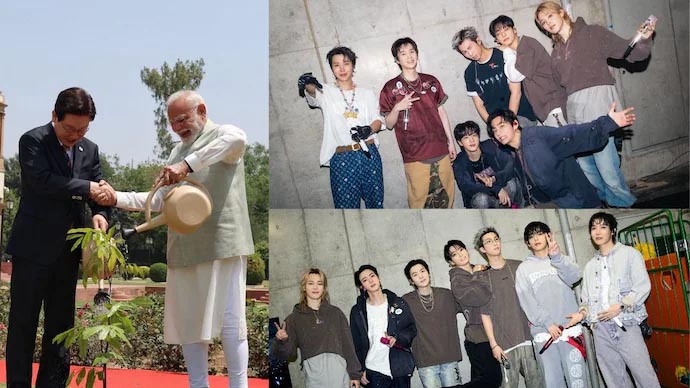
When Prime Minister Narendra Modi stood beside South Korean President Lee Jae-myung at their joint press statement in New Delhi on April 20, he said something that stopped the room. Not about trade. Not about semiconductors or shipbuilding, though those conversations happened too. He said: “K-pop and K-dramas are getting extremely popular in India. Similarly, the recognition of Indian cinema and culture is growing in Korea too.”
A Prime Minister. At a bilateral summit. Leading with pop music and television dramas.
That is not a throwaway line. That is an acknowledgement that a cultural revolution has already happened, quietly and rapidly, on the phones of 300 million young Indians. And it deserves a clear-eyed look at what that revolution has given India, what it has taken, and what India must absolutely refuse to import along with it.
The numbers tell the story
According to the Overseas Hallyu Survey published by the Korea Foundation for International Cultural Exchange, Indian fans spend an average of 18.6 hours per week consuming Korean content, including K-dramas, K-pop and Korean variety shows. That figure makes India one of the heaviest consumers of Korean content anywhere in the world, ahead of countries far closer to the Korean peninsula.
The content itself is not difficult to understand. K-dramas like Crash Landing on You, Squid Game, Vincenzo, Bloodhounds and Business Proposal, all of them available dubbed in Hindi, Tamil and Telugu, cracked something that Indian television had been trying to crack for decades. Tight writing. High production values. No filler episodes. Stories that actually end. These shows did not merely entertain Indian audiences. They rewired viewing expectations entirely.
Netflix understood this before most governments did. It invested aggressively in Korean content and the returns were global. The recently released Made in Korea on Netflix, a Tamil-language coming-of-age drama, is a piece of soft power packaged as entertainment and delivered to 300 million Indians already primed to receive it. Korea did not need a diplomatic strategy to get inside Indian living rooms. It sent a streaming platform instead.
The language numbers are perhaps the most striking. Korean is now one of the fastest growing languages being learned in India, with Duolingo reporting it among the top trending languages for Indian users, driven largely by K-pop and K-dramas. Millions of people globally are learning Korean on Duolingo, and India, alongside Brazil and France, is one of the fastest growing markets. A generation that grew up treating French as the language of aspiration is now learning Hangul because of a Netflix show.
What the wave actually produces
Sriya Lenka from Rourkela, Odisha was eighteen years old during the Covid lockdown when she auditioned for a K-pop group from her rooftop because the studios were shut. Selected from over 4,000 applicants globally, she became the first Indian K-pop idol when she joined the group Blackswan. She taught herself Korean by watching K-dramas on her phone.
Gauthami from Kerala, who performs as Aria, debuted in 2023 as the fifth and final member of the K-pop style girl group X:IN, becoming the second Indian to make it into the Korean pop industry. She speaks English, Korean, Malayalam and Hindi.
Two Indian women. One from a small town in Odisha, one from Kerala. Both pursuing a dream in an industry on the other side of the world, in a language they taught themselves, inspired by content they consumed on their phones. That is not a trivial thing. That is what happens when soft power works exactly as intended.
Indian BTS Army: The fandom that donates
India has one of the largest BTS fanbases in the world. And this is a fandom that does something most Indian celebrity fanbases simply do not. It donates.
In 2020, when floods ravaged Assam and mainstream media had largely moved on, the Indian BTS Army fan page @btshelpsindia raised hundreds of thousands of rupees in under 24 hours for Assam flood relief. The money reached communities in 27 of Assam’s 33 flood-affected districts.
In 2021, as India’s second Covid wave overwhelmed hospitals and oxygen supplies ran out, the Indian BTS Army raised over 20 lakh rupees in under 24 hours through the crowdfunding platform Milaap, funding oxygen cylinders, medical supplies and community kitchens across Delhi and Maharashtra, with thousands of individual donors contributing in a single day.
When was the last time fans of an Indian celebrity pooled their own money, in under 24 hours, for a national crisis?
And then in 2025, during Operation Sindoor, when misinformation was flooding social media at a rate that outpaced official fact-checking, K-pop fan communities in India, with their established networks for coordinating rapid information campaigns online, were documented actively flagging and countering fake content. A fandom that had built its mobilisation muscles through birthday fundraisers and charity drives turned those same muscles toward a national security moment. That is an extraordinary thing to be able to say about a pop music fandom.
The side that deserves to be said
But there is another side to this wave. Across the world, the parasocial intensity of K-pop fandom has driven fans to spend money they do not have, or money that is not theirs to spend, chasing proximity to artists who will never know their names. In one widely reported case, a teenage fan in the Philippines stole the equivalent of 36,000 US dollars from her grandmother’s business to buy K-pop merchandise. India is not immune to this. The fandom is too large and the emotional investment too high for it not to have consequences in a country where many of these fans have very little disposable income. As The Print noted in a 2024 report, most Indian K-pop fans lack the money to spend on concert tickets and albums, and even travelling to another state to attend an event can be financially out of reach.
The thing India must not copy
And here is the aspect of South Korean cultural life that India should look at most carefully. Not the music. Not the dramas. Not the skincare. The media and fandom culture. Because South Korean entertainment media has a specific and troubling pattern. It treats its celebrities as products, not people. It demands perfection at all times. And it punishes deviation from that perfection with a ferocity that has no proportionality whatsoever.
In August 2024, BTS member Suga, whose real name is Min Yoongi, was stopped by police after riding an electric scooter on a pavement. His blood alcohol level was 0.227 per cent, significantly above the legal limit. He was fined and had his licence revoked. He issued several public apologies.
What followed was a national media storm. South Korean broadcaster JTBC released blurry CCTV footage alleging he had been speeding on a motorised scooter, footage that was later proven to depict someone else entirely. Other outlets reported he could face two to five years in prison. The story ran for weeks. JTBC eventually apologised on live television for broadcasting false footage. The police confirmed no property or person had been harmed. Suga was fined and the matter ended.
A fine for riding a scooter while drunk became a national crisis. And this from a media culture that had, years earlier, processed something genuinely criminal in a fraction of the time.
The Burning Sun scandal began in 2019 when former BigBang member Seungri was implicated in running a nightclub that facilitated drug use, hidden camera crimes and the procurement of sexual services for investors. The crimes included drugging and assaulting women, illegally filming victims and distributing those recordings in group chats that included other celebrities and senior police officials. Seungri was convicted on nine charges, including sex trafficking facilitation, illegal filming, embezzlement and habitual gambling. He served one year and six months in prison. He was released in February 2023. By 2024 he was appearing as a special guest at club events in Indonesia. By 2025 he was reportedly planning a nightclub in Cambodia.
A scooter fine got more sustained national outrage than sex trafficking. That is a sentence that deserves to sit with the reader for a moment.
South Korean media and fan culture has a tendency to focus enormous energy on the personal lives, dating histories and minor infractions of celebrities, while serious crimes inside the same industry get processed, punished lightly and then quietly absorbed. India already has enough of this. The Indian media already spends more time on who is dating whom in Bollywood than on the structural problems of the industry. Indian fan culture already has a tendency toward aggression and entitlement. The one thing India absolutely does not need to import from South Korea is a media culture that treats a celebrity’s electric scooter as a national emergency while a nightclub sex trafficking scandal becomes yesterday’s news.
The honest reckoning
The Korean Wave has given India something real. Sriya Lenka from Rourkela learning Korean during a pandemic and making it into a K-pop group is a story worth celebrating. Lakhs of rupees raised in 24 hours for Covid relief by a fandom is something India should be proud of. Korean drama’s insistence on good writing and emotional honesty has raised the bar for what Indian audiences expect from content. That is genuinely valuable.
But South Korea’s entertainment industry is not a model. It is a machine. A highly profitable, highly pressurised, government-backed machine that produces extraordinary cultural export while extracting an enormous human cost from the artists inside it.
India has a civilisation of stories. Classical traditions in 22 languages. A film industry that reaches every continent. A cultural depth that no other country can match in sheer scale.
Prime Minister Modi and President Lee agreed this week to establish a Mumbai-Korea Centre that will serve as a K-pop performance venue and hub for Korean culture, alongside a 2026 to 2030 cultural exchange agreement and an India-South Korea Friendship Festival planned for 2028. That is a diplomatic acknowledgement of a cultural reality that already exists.
The question worth asking now is not whether India should love Korean content. The question is why India has not yet built a space that makes the world love Indian content the way Seoul made the world love Korean content. Because that space is entirely possible. We just have not built it yet.