
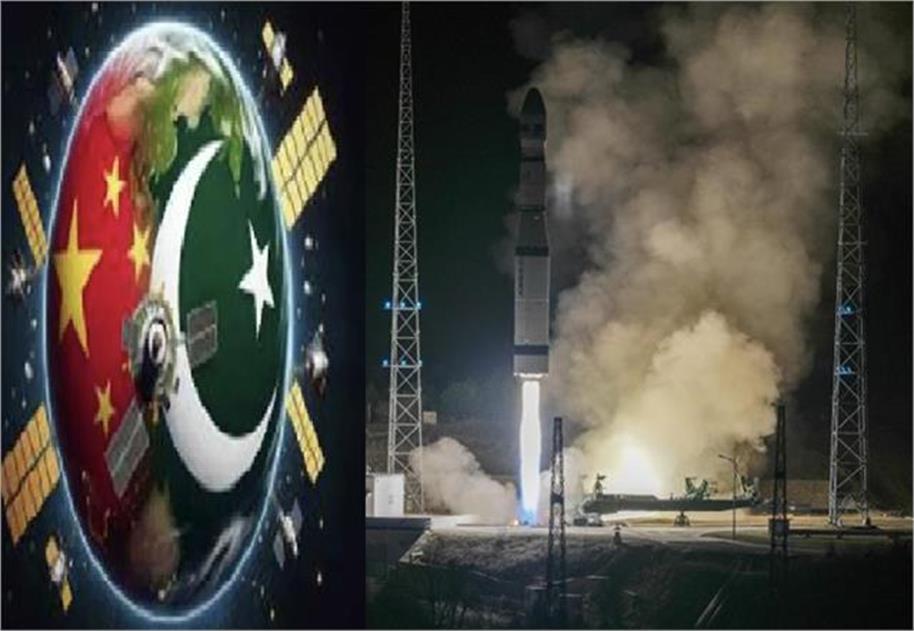
China has launched Pakistan’s PRSC-EO3 satellite, marking the fourth such mission within just a year—an aggressive pace that is raising eyebrows across strategic circles. The deepening China–Pakistan space partnership is no longer being seen as purely scientific, but increasingly as a vehicle for expanding surveillance and military capabilities.
International Desk: Pakistan has stepped up its push into space, but largely as a dependent partner riding on China’s technological and logistical support. The latest satellite launch underscores how Islamabad’s ambitions are being enabled—and shaped—by Beijing. The launch took place late Saturday night from the Taiyuan Satellite Launch Centre in northern Shanxi province.
According to China’s state-run Xinhua agency, the PRSC-EO3 satellite was launched at 8:15 pm (Beijing time) aboard a Long March-7 rocket and successfully placed into orbit. This marks the fourth Pakistani satellite China has launched within a year, highlighting a rapidly intensifying collaboration. Over the past few years, China has effectively become the backbone of Pakistan’s space programme.
The cooperation goes beyond satellites. Two Pakistani astronauts recently arrived in Beijing to join China’s human spaceflight training programme. After completing training and evaluations, one is expected to participate in a future mission as a “payload specialist”—a move that further cements Pakistan’s reliance on Chinese expertise.
However, experts caution that these developments cannot be viewed in isolation. Satellites like PRSC-EO3 often have dual-use potential, meaning they can serve not only civilian purposes but also intelligence gathering, surveillance, and military coordination. This raises serious concerns about how such capabilities might be deployed in a region already fraught with tensions.
With China steadily bolstering Pakistan’s technological reach, this growing nexus is being closely watched as a factor that could disturb the regional strategic balance and heighten security risks.