
A report by research firm Kpler has revealed that Iran is running out of space to store its oil. If storage reaches its limits within weeks, Iran might have to shut down its oil production operations. The fuel crisis can deepen as oil exports have been choked by the US naval blockade near the Strait of Hormuz.
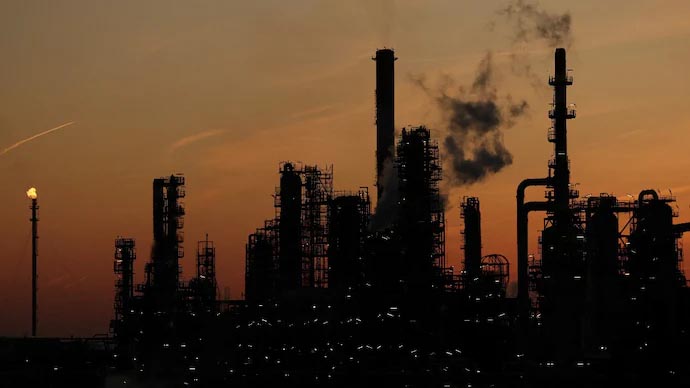
Amid the war with the US and Israel, Iran is heading towards a critical oil storage crunch as its crude exports remain choked by the US naval blockade near the Strait of Hormuz. With shipments collapsing and oil continuing to flow from its fields, storage tanks and floating facilities are filling up quickly. As there is a looming storage space runout, Iran might have to scale back its oil production. Analysts warn that this could force deeper output cuts in the coming weeks, potentially shutting its oil wells and disrupting long-term production capacity, as excess crude has nowhere to go amid the export blockade.
According to a report by the research firm Kpler, Iran has just 12 to 22 days of unused storage capacity left, raising the risk of forced production shutdowns.
The storage crunch is a direct result of the sharp fall in Iran’s crude exports. The report reveals Iran’s oil exports were unaffected as the Strait of Hormuz was under the control of Iran’s armed forces, the IRGC. The exports of Iran have drastically dipped after the US President Donald Trump imposed a naval blockade targeting Iranian ports and shipping near the Strait of Hormuz on April 13.
The blockade has disrupted tanker movements and effectively curtailed Iran’s ability to ship oil to global markets. To counter the growing oil storage crisis, Iran has also revived its 30-year-old oil tanker Nasha.
As exports plunged, oil that would typically be shipped abroad by Iran is now being diverted into domestic storage tanks and floating storage on vessels. However, this temporary solution is reaching its limits quickly. The report by Kpler notes that loadings of Iranian crude onto tankers have dropped sharply, significantly reducing outbound flows.
Iran has reduced its crude oil production by as much as 2.5 million barrels per day, reflecting the pressure from collapsing exports, while regional producers, including Saudi Arabia, Iraq, Kuwait, and the United Arab Emirates (UAE) have also been forced to curb output since the conflict erupted on February 28, according to Bloomberg News, citing a report by Investment banking company, Goldman Sachs Group Inc.
US Treasury Secretary Scott Bessent on Tuesday warned that Iran’s oil production will be shut down soon and cited the US naval blockade as the reason behind this. “While the surviving IRGC Leaders are trapped like drowning rats in a sewage pipe, Iran’s creaking oil industry is starting to shut in production thanks to the US blockade,” Bessent posted on X.
He further added that there will be a “Gasoline (petrol) shortage in Iran in the coming days.”
Despite the worsening outlook for production, Kpler notes that the financial impact on Iran will take time to materialise. Tehran’s oil exports have dropped sharply since early April, when a US-led naval blockade restricted activity around the Strait of Hormuz. Iranian crude oil and condensate loadings averaged 2.1 million barrels a day between April 1 and April 13. Only five cargoes have been observed since the blockade, bringing the average down to 567,000 barrels a day between April 14 and April 23.
In February, before the war, Iran exported on average 2 million barrels a day.
Production cuts typically begin well before storage capacity is fully exhausted, as operators need to maintain buffer space and prevent system bottlenecks. According to Kpler, Iran’s crude output could drop by more than half—falling to around 1.2 to 1.3 million barrels per day by mid-May—if the blockade continues.
Iran’s onshore crude inventories have risen by about 4.6 million barrels to nearly 49 million barrels under the blockade, according to Kpler. While total storage capacity is estimated at around 86 million barrels—potentially extending to 90–95 million barrels if additional northern refinery tanks are included—operational constraints, safety limits, and geographic factors mean a significant portion of this capacity may not be practically usable.
However, Tehran’s revenue losses are expected to lag by three to four months. Kpler report explains that Iranian crude typically takes about two months to reach key buyers, primarily in China, often via hidden sea channels designed to bypass sanctions, followed by an additional two months for payment settlements.
Iran is also attempting to reroute crude shipments to China via rail, in a sign of mounting export constraints, The Wall Street Journal (WSJ) reported, citing Hamid Hosseini, spokesperson for Iran’s oil exporters’ union. Rail links connect Tehran to Chinese cities such as Yiwu and Xi’an, but the journey can still take weeks.
However, rail transport remains significantly more expensive than shipping by tanker, particularly for China’s smaller refineries termed as ‘teapots’ that are key buyers of Iranian oil. As a result, the shift to rail is seen less as a viable alternative and more as an indication of stress within Iran’s oil export system, according to WSJ.
Kpler also noted that it has not detected any Iranian tankers successfully evading the blockade, with crude loadings plunging by nearly 70% since restrictions around the Strait of Hormuz tightened.
With just weeks of storage capacity left, Iran’s oil sector is nearing a tipping point where falling exports could begin to choke production.