
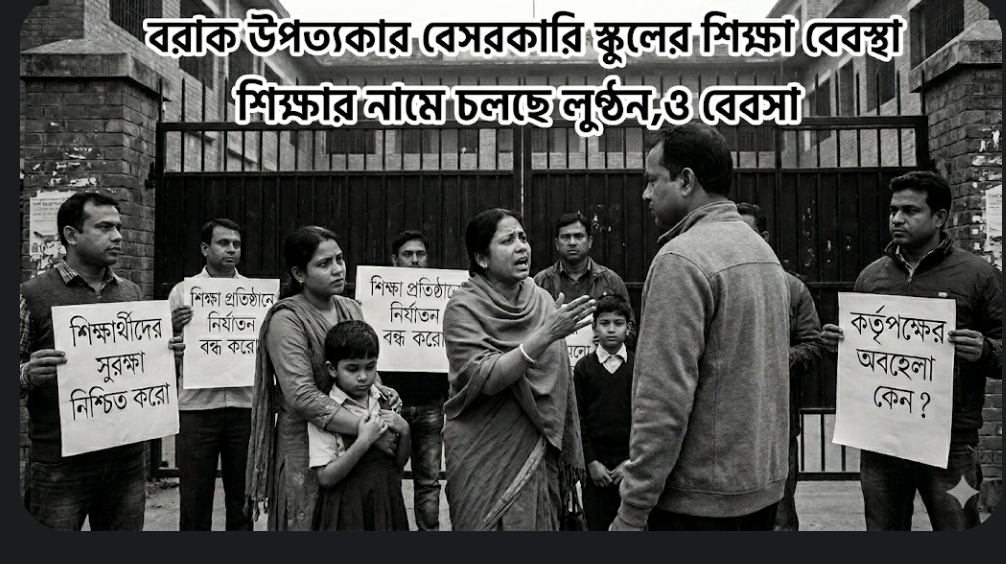
SARIMUL LASKAR, SILCHAR,:- Barak Valley: In the green landscape of Barak Valley, across cities like Silchar, Hailakandi, and Karimganj, the light of education was meant to spread. However, in reality, many private educational institutions have abandoned the ideal of education, becoming unbridled commercial ventures focused on profit. Parents are being crushed by unregulated fee hikes, mandatory annual “re-admission” charges, exorbitant prices for books and uniforms, and various other unnecessary fees. Complaints are met with threats: “Withdraw your child.” This undeclared syndicate operates by flouting government rules and regulations.
In 2018, the Assam Government enacted the Assam Non-Government Educational Institutions (Regulation of Fees) Act in an attempt to regulate private school fees. According to this law, the maximum fee was set at 27,000 INR from pre-primary to class five, 32,000 INR from class six to ten, and slightly higher for the higher secondary level. However, five years later, parents allege that the law exists only on paper. In reality, additional collection through re-admission fees, development charges, maintenance fees, and activity fees continues unchecked. Many schools set book set prices multiple times higher than market value and mandatory cash payments, avoiding transparency.
In this situation, a crucial proposal has emerged. To ensure student safety, transparency in teacher-student relations, and to preserve evidence of any wrongdoing, CCTV cameras must be made mandatory in every classroom of private educational institutions. The Central Board of Secondary Education (CBSE) has already directed the installation of high-quality audio-video capable cameras in classrooms, corridors, entry-exit points, and other locations. Implementing this rule in Barak Valley would reassure parents and help prevent irregularities.
Another important issue is the rule regarding distance between government and private schools. According to the Right to Education (RTE) Act, there are rules for establishing new schools within one kilometer of a government school at the primary level and within three kilometers at the upper primary level. For the higher secondary level, guidelines require a ten-kilometer distance in rural areas and a five-kilometer distance in urban areas. However, questions are arising regarding whether these rules are being followed in reality.
As an example from a Barak Valley constituency, similar instances exist in hundreds of places. This pattern of irregularities is especially evident in the Kalain area, under the Katigorah assembly constituency in Cachar district. Local parents and conscious citizens allege that nearly 20 to 25 educational institutions have mushroomed within just 5 kilometers. This density of institutions, rather than improving educational quality, is fueling business competition and fee exploitation. Under whose protection is this possible? Whose influential approval and shielding allow such dense clustering of institutions?
Furthermore, there are many government teachers who themselves are involved in running private educational institutions as businesses. Despite enjoying government job security, they participate in the ownership or management of private schools, creating a conflict of interest and increasing frustration among ordinary parents.
The incident at Holy Cross School in Silchar is a glaring example of this anarchy. Recently, serious allegations of mental torture were raised by a parent against the principal and a class teacher, Kumkum Nath. Even after filing written complaints with the District Magistrate and the Education Department, no solution was found. Forced by circumstances, they approached the law and filed a case at the Rangirkhari police station. However, justice remains elusive. After filing the complaint, suggestions are coming from all quarters to “settle it mutually.” Will a mother then never receive justice for her child? This reality deepens the wounds of the education system in Barak Valley.
Most concerning is the role of the Education Department. Despite so many irregularities, complaints, and violations of government laws, why does the Education Department remain a silent spectator? The Fee Regulatory Committee exists, but complaints are not resolved quickly. Many parents question whether there is an invisible “cut-and-commission” for the Education Department in this business. How do institutions that do not follow land, infrastructure, teacher-student ratio, and other rules get government permission? Under whose protection does this syndicate operate? Political influence, corruption, or administrative inefficiency? Many believe that the greed of some government employees is tarnishing the government’s image. Is allowing these irregularities knowingly only possible in exchange for money? Or is it simply administrative negligence?
In Barak Valley, complaints about fee hikes, re-admission exploitation, infrastructural deficiencies, and non-adherence to the RTE’s 25 percent seat reservation are heard regularly. Yet, a lack of government investigation is evident. With fewer alternatives for quality education, middle-class families are forced to endure silently. The family budget is disrupted by the education of just one child. Even during the COVID period, many institutions collected fees for online classes, although the quality was poor.
If this anarchy continues, both the education of the future generations of Barak Valley and the financial security of parents will be endangered. Education can never be a business; it is the foundation of a nation. The government must strengthen the Fee Regulatory Committee, conduct regular audits, mandate online payments, ensure active Parent-Teacher Associations (PTA) in every school, and take strict action against violating institutions. Installing CCTV cameras, strictly enforcing distance rules, and quality control are steps that can improve the situation.
Many parents on social media have raised a clear demand that the government immediately enact a law prohibiting government employees and government teachers from enrolling their children in any private educational institution. If anyone violates this rule, they should be dismissed from their government job and legally punished. According to parents, enacting this law will significantly reduce the dual role and conflict of interest among government officials and employees, bringing transparency back to the education system.
According to conscious circles, if the government can break this syndicate, a real transformation will come to the education system. Otherwise, this darkness will continue. It is the expectation of all conscious citizens that the education of Barak Valley will not be overshadowed by business.
Now, it remains to be seen what steps the government takes after seeing this report