
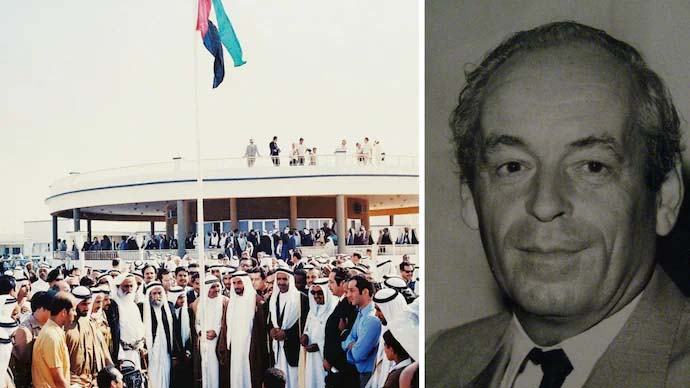
The UAE, which is under Iranian fire, existed as seven unmarked Trucial States till the 1970s. It was a British diplomat, Julian Walker, who drew the UAE’s map by driving across the desert in his Land Rover and plotting tribal loyalties on paper.
“In a world of raiding parties every stranger was suspect. Shots would often greet one’s approach to a village. Only if one was patently no threat, walking ahead of one’s Land Rover and obviously unarmed, or came in the company of friendly tribesmen, would the traditions of hospitality and curiosity prevail over fear… In some cases, I came with the wrong companions and was detained and threatened,” recalled Julian Walker in 1994.
As a “green young diplomat” posted to the Trucial States, as the United Arab Emirates (UAE) was called in the 1950s, Walker toured swathes of the Arabian desert in his Land Rover. His contribution to mapping the borders of the pre-UAE Trucial States helped put them on the world map as a modern Arabian nation with defined boundaries.
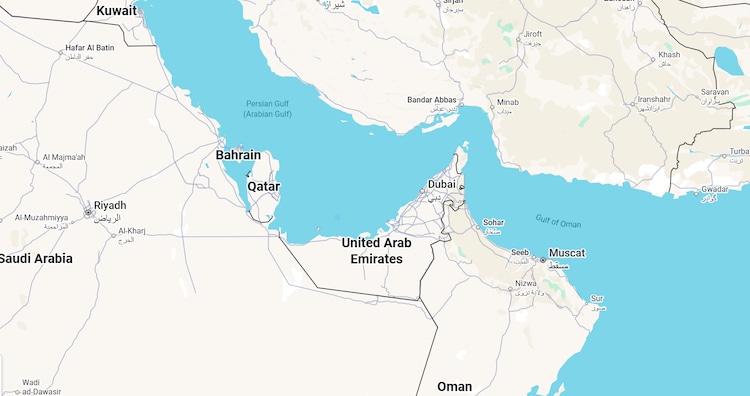
The modern-day UAE is seen and known through its skyscrapers, airports and oil wealth. But before the birth of the UAE in the early 1970s, the seven emirates were loosely defined tribal territories. Loyalties shifted, territorial claims overlapped and there were no fixed borders in the region where the UAE is today.
In many places, the boundaries between emirates like Abu Dhabi, Dubai, Sharjah, Ras Al Khaimah and others depended on tribal allegiances, rather than clear maps drawn on paper. This is when Walker toured the region, spoke to Bedouins he came across, and drew boundaries on the fluid Arabian lands.
Once, a group of men deep in the desert who had never seen a car asked Julian Walker whether his Land Rover was male or female, and whether they could feed it, according to Arab News, the Saudi Arabia-based English daily.
The story of the marking of the boundaries of the UAE and its formation is being narrated now as Gulf countries say that Iran’s attacks on the regional nations were an “existential threat”. The UAE is the Gulf state which has been at the receiving end of Iranian fire more than other nations in the region. And so, at a moment when the Gulf states are talking about existence, Walker’s story reveals how the UAE was stitched together from seven separate Trucial States.
Walker, however, said decades later that fixed borders was largely a Western concept imposed on the Arabian Peninsula.
HOW WERE TRUCIAL STATES PUT TOGETHER TO FORM MODERN UAE?
In the 1950s, the Trucial States that later united to form the UAE were ruled by local sheikhs. The Al Nahyan family ruled Abu Dhabi and the Al Maktoum family treated Dubai as their base.
Britain controlled foreign affairs, defence and security under a series of treaties. The name “Trucial States” for the Emirates came from truces signed between the rulers and Britain. First the General Maritime Treaty was inked in 1820 and later the Perpetual Maritime Truce was signed in 1853, to end conflicts, wars and piracy in the Gulf region.
But why did the tribal Trucial States, sparsely dotted in the Arabian desert, need borders?
WHY DID THE TRUCIAL STATES OF THE UAE NEED BORDERS?
Before the UAE was formed in 1971, the region was known as the Trucial States.
The seven emirates under the British, had rulers, tribes and spheres of influence. But they did not have modern international borders.
Territory was often defined by which tribe lived where, who paid zakat to which ruler and which sheikh people considered themselves loyal to. These loyalties could shift over time. A village could owe allegiance to one sheikh in one decade and another later.
The British became interested in fixing these borders because oil companies needed certainty. Oil exploration could not move forward if nobody knew where one emirate ended and another began. Julian Walker later said that the pressure to settle boundaries came because of oil.
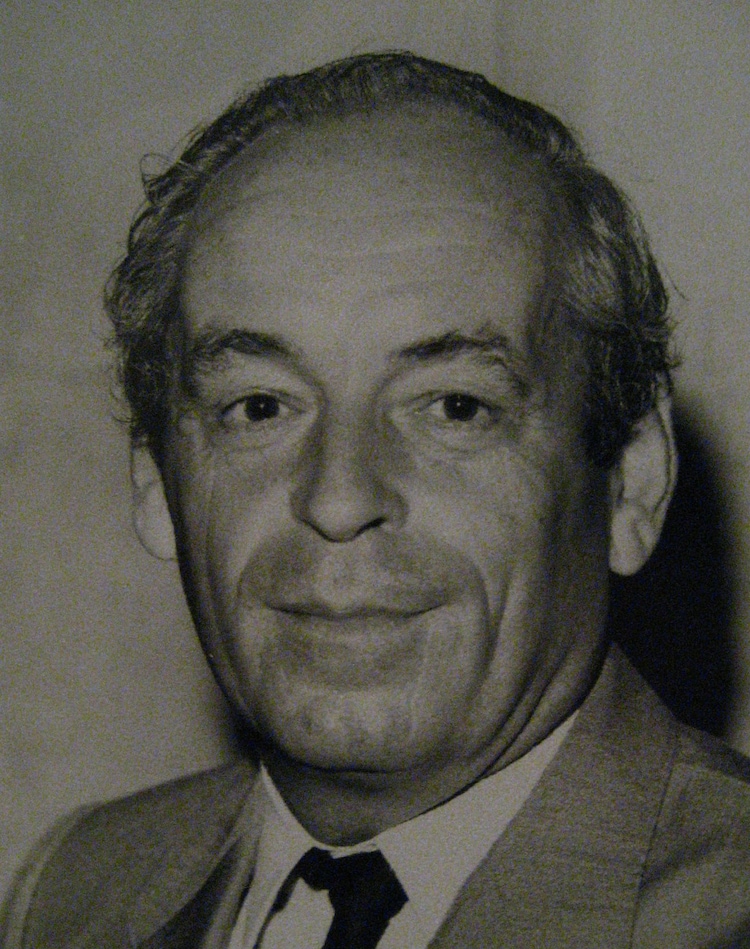
WHO WAS BRITISH CARTOGRAPHER-DIPLOMAT JULIAN WALKER?
Julian Walker first arrived in the Trucial States in 1953 after studying Arabic in Lebanon. He was sent to Sharjah and later to Dubai as a junior British political officer.
His superior initially tried to handle the border work. But after spending only a few hours in the desert, he gave up and handed the task to Walker. “After about eight hours in the desert he gave up,” Walker later recalled. “He decided he was too busy to do frontier work and decided that I should start to do frontier settlement work,” Walker was quoted as saying by the UAE-based The National newspaper.
“I thought I was going to Bahrain and was looking forward to some golf and sailing. But, here I was in the Trucial States mapping the borders, a job not as easy as the British initially thought it would be. There were large areas of dispute and no maps, just naval charts and a map of Abu Dhabi made by Wilfred Thesiger during his travels,” Walker told Riyadh-based Gulf News in 2019.
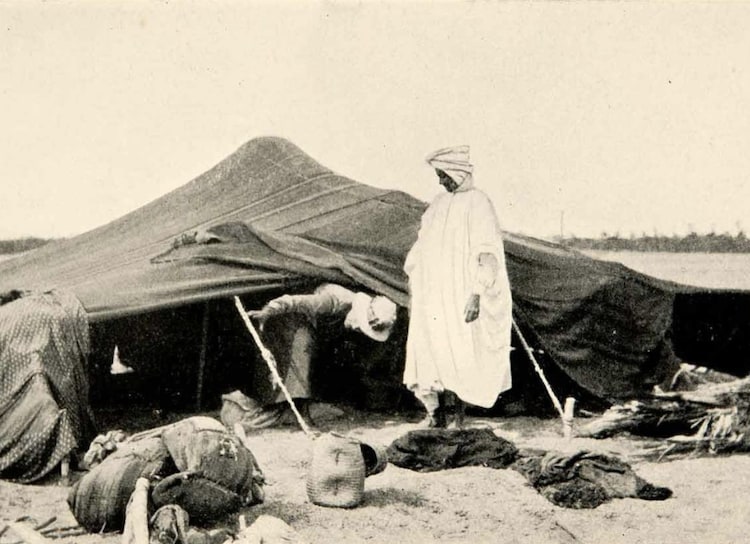
Walker spent years travelling through the desert in a battered government Land Rover. He interviewed tribesmen, consulted rulers and drew his own maps because no reliable maps existed. His colleagues later nicknamed him “Boundary Walker”.
HOW BRITAIN’S WALKER MAPPED THE UAE?
Walker had to begin almost from scratch. He later recalled that he had to climb mountains to sketch the countryside because there were no maps in many places.
“I spent a lot of time in the desert, where it was easy to get lost,” Walker said in a 2002 interview. “We had to map the whole place as no maps existed”.
Walker borrowed surveying tools, travelled in harsh desert heat and relied heavily on tribal testimony. He wanted to know who controlled a village, who collected taxes there, which tribe lived there and which ruler people obeyed.
“I purloined the largest paper available on the Coast from the oil company accountant, took names from any knowledgeable local tribesman I met and, with the help of my compass, my Land Rover mileometer and the back of my fountain pen, plotted them [frontiers] on the paper,” Walker told the Gulf News in 2018.
“I would then map the line and the place around their claim. I would then meet another ruler who had a different interpretation and I would map the area around their idea of where the frontier line should be,” Walker added.
His work was difficult because tribal boundaries were fluid. The same tribe could live in different areas and support different rulers.
“Once the Fujairah Ruler had to rescue me and another time, entering Wahalah, south of the Oman border, I just walked up alone into the tribe without my Land Rover or guide to get their confidence and that I meant no harm,” Walker later revealed in an interview.
Walker argued that the idea of fixed borders was largely a Western concept imposed on the Arabian Peninsula.
HOW WALKER’S MAPS SHAPED THE UAE?
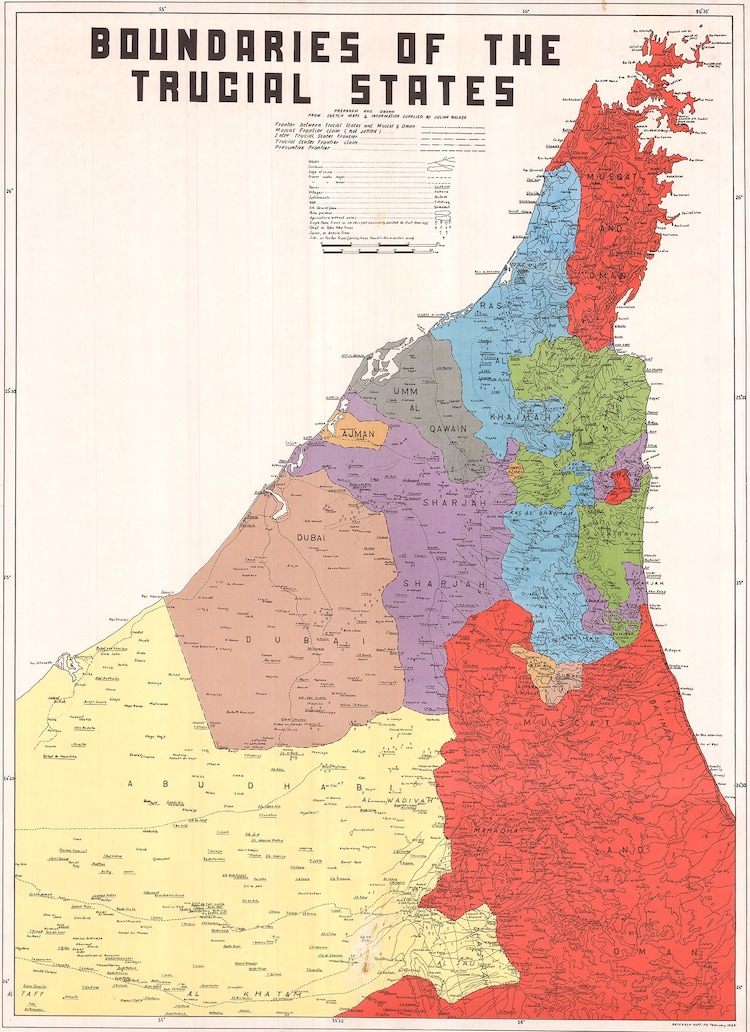
Walker eventually created 31 hand-drawn maps. These later became the basis for official British maps of the Trucial States.
In 1963, the British Foreign Office used his work to prepare the first official map of the emirates’ internal boundaries.
The seven emirates were marked out, but they were broken into around 22 separate territorial areas because of tribal loyalties and enclaves. Some emirates had small pockets of land entirely surrounded by another emirate, just like the Chhitmahal enclaves that India and Bangladesh had. That is why Walker’s maps were jokingly called “Mr Walker’s Jigsaw Puzzle”.
Walker ended his mapping assignment in the early 1960s.
The result was still close to the UAE that exists today. Walker’s maps shaped not only the internal boundaries of the Trucial States or the emirates but also parts of the UAE’s borders with Oman.
WHAT ROLE DID WALKER PLAY IN THE UAE’S BIRTH?
Almost two decades later, Walker returned to the Gulf in 1971 as Britain’s last political agent in Dubai.
Britain, under PM Harold Wilson, had announced it would withdraw from the Gulf by the end of that year, and there were fears that the Trucial States might fragment or become vulnerable to outside pressure.
Walker worked closely with Emirati rulers such as Sheikh Zayed and Sheikh Rashid during the final negotiations before the formation of the federation. His knowledge of tribal politics, local disputes and boundaries made him one of the few people who could help navigate the transition.
He later said Dubai had initially hoped it could survive as an independent city-state. But Sheikh Zayed pushed for a union to avoid conflict among the emirates and prevent interference by larger Gulf powers.
After the declaration of the independence of the UAE in December 1971, Walker was appointed as the first British Consul-General of the UK to the UAE. Walker was among the three British diplomats in Dubai who witnessed the birth of the UAE and the signing of a Treaty of Friendship with Britain.
Walker held the position until he was transferred to West Germany in 1972.
Julien Walker did not create the UAE on his own. But without Boundary Walker’s maps, surveys and negotiations, the federation of the UAE might have become independent without knowing exactly where one emirate ended and another began.