

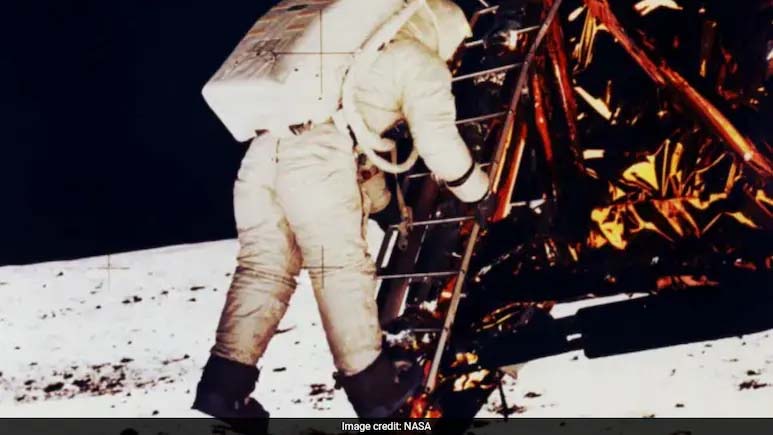
Twelve astronauts walked on the Moon during NASA’s Apollo missions from 1969 to 1972.
New Delhi: In the coming days humans are set to return to the moon. Initially on a flyby NASA mission named Artemis-2, four astronauts will fly as early as April 1 to the farthest point humans have ever gone in outer space. This ten-day moon mission will pave the way for the USA setting up a permanent moon base near the South Pole of the Moon. But before this new leap, a dozen humans, all Americans, have already walked on the moon.
Between 1969 and 1972, a total of twelve human beings walked on the surface of the Moon, an achievement that remains unmatched more than half a century later. NASA’s official Moon Walkers record preserves the names, missions, and historical context of these explorers, all of whom flew as part of the United States’ Apollo programme during a brief but extraordinary era of human spaceflight.
The moonwalkers were not merely astronauts; they were pioneers of a new planetary frontier. Their journeys transformed the Moon from a distant celestial object into a place where humans could stand, work, experiment, and return safely to Earth. In all, 24 American astronauts travelled from Earth to the Moon, but only half of them descended to the lunar surface. The others orbited above, supporting the missions from the command module.
“One Small Step”
The story begins with Apollo 11 in July 1969. As the lunar module Eagle touched down in the Sea of Tranquility, Neil Armstrong became the first human to set foot on another world. His words, spoken as he descended the ladder, have become the most quoted sentence in the history of space exploration, “That’s one small step for a man. One giant leap for mankind.”
Moments later, Edwin “Buzz” Aldrin joined Armstrong on the Moon, making Apollo 11 the first mission to turn science fiction into lived human experience. Their moonwalk marked the beginning of direct human interaction with the lunar surface, conducted under Earth’s gravity reduced to one-sixth, in spacesuits designed to sustain life in a vacuum.
Expanding The Lunar Frontier
Apollo missions that followed did far more than repeat the first landing. Apollo 12 demonstrated pinpoint landing accuracy, touching down near the robotic Surveyor 3 spacecraft that had arrived on the Moon two years earlier. Astronauts Charles “Pete” Conrad and Alan Bean not only walked on the Moon but also examined and photographed earlier unmanned hardware, symbolising the handoff from robotic precursors to human explorers.
After the aborted landing of Apollo 13, NASA returned to the Moon with renewed determination. Apollo 14 saw Alan Shepard, America’s first astronaut in space, and Edgar Mitchell conduct extended surface operations. Shepard famously swung a golf club on the Moon, an iconic image underscoring how human presence had begun to feel more confident, even playful, on the lunar surface.
Science Takes Center Stage
The later Apollo missions transformed lunar exploration into a serious scientific enterprise. Apollo 15, Apollo 16, and Apollo 17 carried astronauts trained for geology and long‑duration exploration. David Scott and James Irwin of Apollo 15 were the first to use the Lunar Roving Vehicle, vastly expanding the distance humans could travel on foot from their landing site.
Apollo 16’s John Young and Charles Duke explored the Moon’s highlands, while Apollo 17, the final human landing, featured Eugene Cernan and Harrison “Jack” Schmitt. Schmitt remains the only professional geologist to have walked on the Moon, a reflection of how NASA’s priorities had shifted from proving the feat could be done to understanding what the Moon could teach about planetary history.
As Commander Cernan prepared to leave the lunar surface in December 1972, he became the last human to walk on the Moon, so far. His footprints remain preserved in the airless lunar environment, untouched by wind or weather.
Who Flew, Who Walked
NASA’s Moon Walkers Hall of Fame draws a clear and important distinction between walking on the Moon and travelling to the Moon. In total, 24 astronauts made the journey from Earth to lunar orbit, but only the twelve lunar module pilots and commanders descended to the surface.
Three astronauts-James Lovell, John Young, and Eugene Cernan-made the trip to the Moon twice, underscoring how small and elite this group of explorers truly was.
Today, only four Moon walkers are still alive: Buzz Aldrin, David Scott, Charles Duke, and Harrison Schmitt. They are living links to an era when humans last explored another world firsthand.
A Legacy That Endures
The Apollo programme remains the only time in history that humans have travelled beyond low Earth orbit and walked on another celestial body. NASA’s Moon Walkers archive emphasises how concentrated this achievement was: six successful landings, twelve explorers, and just a few years that permanently reshaped humanity’s relationship with space.
Now NASA’s Artemis program, which is named after Apollo’s twin sister in Greek mythology, is set to give humanity its first permanent place outside Earth.
Looking Forward, Back To The Moon
NASA’s inclusion of Artemis in its lunar exploration signals a renewed commitment to the Moon as humanity’s next destination. The legacy of the twelve moonwalkers now serves as both a technical foundation and an inspirational benchmark for future astronauts who will follow their path back to the lunar surface.
What Apollo proved was not just that humans could reach the Moon but also that they could work, explore, and return safely. That achievement, compressed into a single historic decade, continues to define what is possible as NASA prepares for a new era of lunar exploration as it races China to land a human on the lunar surface in the 21st century.