
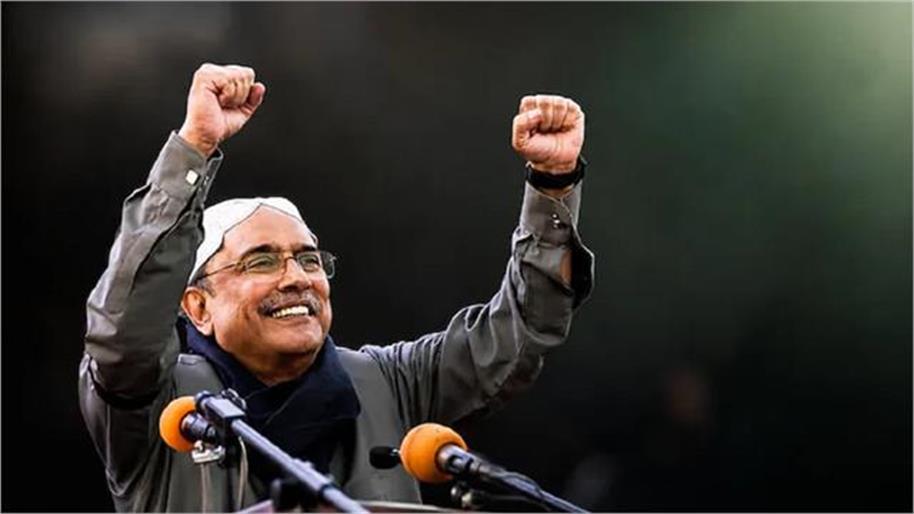
ISLAMABAD: Pakistan President Asif Ali Zardari has triggered a fierce backlash with a controversial remark about the country’s Hindu minority, saying that Muslims are a community that “tolerates” around 3–4 per cent Hindus.
The remark, delivered during an Independence Day ceremony in Islamabad, has drawn sharp criticism in India and renewed scrutiny of Pakistan’s record on minority rights. Zardari also used the occasion to accuse India of pursuing an ‘Akhand Bharat’ agenda, portraying the two countries as having fundamentally different outlooks.
The ceremony was held at the Yadgar-e-Fatah victory monument, established by Pakistan to commemorate what it describes as its victory in the 2025 ‘Marka-e-Haq’ conflict with India.
Pakistan’s Own Census Undercuts Zardari’s Figure
Zardari’s estimate of a 3–4 per cent Hindu population does not match Pakistan’s official 2023 census figures. Government data puts the country’s Hindu population at around 5.21 million, or approximately 2.17 per cent of the total population.
The Pakistan Bureau of Statistics categorises the population into around 3.868 million people listed as ‘Hindu caste’ and approximately 1.349 million classified as Scheduled Castes.
Beyond the numerical discrepancy, the President’s use of the word ‘tolerate’ has drawn particular attention. Critics argue that describing a constitutional minority as a community to be ‘tolerated’ raises serious questions about Pakistan’s claims of equal citizenship and protection of minority rights.
Rights Record Casts Shadow Over ‘Freedom’ Claim
Zardari also claimed that Hindus in Pakistan enjoy complete freedom and would prefer to remain in Pakistan rather than move to India.
Human rights organisations, however, have repeatedly documented concerns involving religious minorities in Pakistan. Hindus, Christians and Ahmadis have faced allegations of discrimination, violence and religious persecution.
Sindh and Punjab have, in particular, witnessed repeated reports concerning the abduction of Hindu and Christian girls, alleged forced conversions and forced marriages. Rights groups have also raised concerns over the misuse of Pakistan’s blasphemy laws and the resulting threat of mob violence against minority communities.
Against this backdrop, Zardari’s assertion of complete freedom for minorities has come under renewed scrutiny.
India Reacts Sharply
The Pakistani President’s remarks have also prompted strong reactions in India.
Kerala High Court advocate Rohit Madasseril criticised the statement in strong terms, describing it as a disturbing manifestation of ‘psychosis’. Amit Krishnakant Paul, a researcher and author associated with the Observer Research Foundation, called the remarks deeply unfortunate, arguing that Pakistan’s leadership continues to invoke India and divisive themes even on an occasion meant to celebrate its own independence.
The controversy has also fuelled political speculation in Pakistan, with questions being raised over the country’s internal power dynamics and the reported ambitions of powerful military chief Field Marshal Asim Munir.
For critics, however, the central issue remains Zardari’s choice of words: a President describing millions of citizens belonging to a religious minority as people who are merely ‘tolerated’ has once again put Pakistan’s claims of equality and minority protection under the spotlight.