
• About Us
  • Contact
  • Privacy Policy
  • Terms and Conditions
Friday, October 16, 2026
  • Login
  • Register
Page3News Worldwide
  • Home
  • E-Paper
  • Subscriptions
  • Countries
    • USA
    • Canada
    • India
    • Balochistan
    • Thailand
    • UK
    • Australia
  • Language Wise News
    • Thai News
    • Punjabi News
    • Hindi News
  • Other News
    • World News
    • Latest Movie Reviews
    • Culture
    • Finance
    • Hollywood
    • Business
    • Entertainment
    • Sports
    • Lifestyle
    • Fashion
    • food
    • Health
    • Travel
    • Politics
    • Science
    • Tech
  • Multilingual Editorial
    • English Editorials
    • Thai Editorials
    • Hindi Editorials
    • Punjabi Editorials
    • Page3News Special
No Result
View All Result
  • Home
  • E-Paper
  • Subscriptions
  • Countries
    • USA
    • Canada
    • India
    • Balochistan
    • Thailand
    • UK
    • Australia
  • Language Wise News
    • Thai News
    • Punjabi News
    • Hindi News
  • Other News
    • World News
    • Latest Movie Reviews
    • Culture
    • Finance
    • Hollywood
    • Business
    • Entertainment
    • Sports
    • Lifestyle
    • Fashion
    • food
    • Health
    • Travel
    • Politics
    • Science
    • Tech
  • Multilingual Editorial
    • English Editorials
    • Thai Editorials
    • Hindi Editorials
    • Punjabi Editorials
    • Page3News Special
No Result
View All Result
Page3News Worldwide
No Result
View All Result
Home Breaking News

Using thunderquakes to X-ray Earth: Study shows urban seismology in action

by Page 3 News International Desk
August 23, 2026
in Breaking News, World News
0
Using thunderquakes to X-ray Earth: Study shows urban seismology in action
0
SHARES
6
VIEWS
Share on FacebookShare on TwitterShare on WhatsappShare on TelegramShare on LineShare on Email

Scientists used ordinary telecom fibre-optic cables to detect seismic waves generated by thunder, opening a new way to study groundwater, sinkholes and underground structures

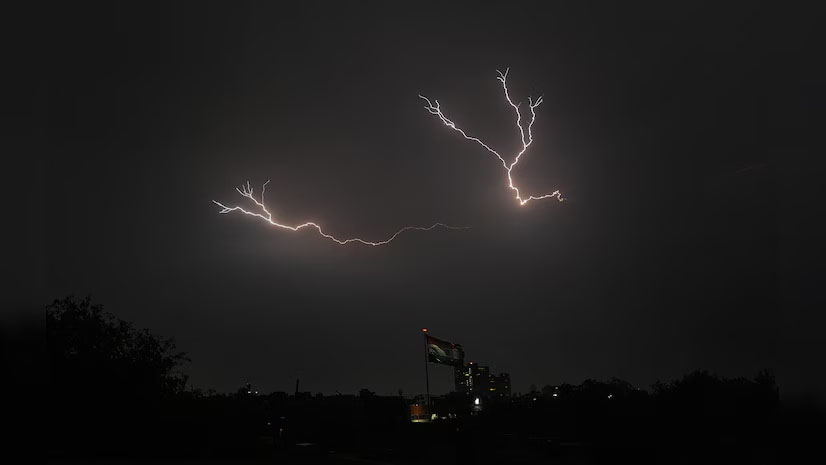
When lightning strikes, it superheats the air around it and creates a shock wave that we hear as thunder. But thunder doesn’t just travel through the atmosphere to our ears.

When that energy reaches the ground, some of it is converted into seismic waves that ripple through the soil and rock beneath. The resulting vibrations are known as “thunderquakes.”

Until now, scientists haven’t understood these signals well enough to make practical use of them. Our team’s research shows that thunderquakes can be used to map the structure beneath the Earth’s subsurface – such as groundwater movement, environmental contamination, sinkholes, or for evaluating building sites and foundations – just like X-rays image inside the human body.

RelatedPosts

‘Finding Khalistan’: Daniel Bordman’s Documentary Examines the Global Khalistan Movement After Hindu Temple Attack

Pakistan Mob Torches Christian’s Home, Shop After Blasphemy Claim; 35 Families Flee

EU-GCC summit in Saudi Arabia postponed amid Houthi missile attacks

We discovered this by listening to thunder with something found in communities around the world but unusual as a seismic measuring instrument: fiber-optic cable.

Turning fiber optics into vibration sensors

Using a technique called distributed acoustic sensing, we turned an ordinary fiber-optic cable, the kind used for internet or phone service, into a string of thousands of vibration sensors.

A laser-pulsing computer, called an interrogator, sends light through the cable and measures tiny changes caused by vibrations along its length. In our experiment, part of the Penn State FORESEE project, we used a cable that is over 2 miles (more than 4 kilometers) long. That gave us more than 2,100 sensors, spaced only a few feet apart, all listening to the ground at once.

Over two years, we used an old telecom fiber to record and identify 458 clear, high-quality thunderquakes.

The enormous amount of detail captured by this process has allowed us to see something that had been difficult to observe before: specific types of seismic waves produced when sound from the atmosphere interacts with the ground.

The most important of these seismic waves are what we call air-coupled Rayleigh waves. They are measurable at the surface but can be used to study the subsurface far below, even down 300 feet (around 100 meters).

How a thunderquake ‘X-rays’ the ground below

The trick to this technique is known as seismic dispersion: Waves of different frequencies travel at different depths. By measuring how the thunderquake’s wave speeds changed with frequency, we could reconstruct the seismic wave speed at different depths, which allows us to interpret the properties of the ground beneath the fiber.

The result was the equivalent of an X-ray of the subsurface extending roughly 300 feet underground, without drilling a single hole. Imaging the subsurface typically requires specialized equipment, such as truck-mounted vibration sources or arrays of sensors that have to be installed for surveys. These approaches can be expensive and difficult to deploy over large areas.

Thunderstorms offer a naturally occurring source of seismic energy that is already spread across the landscape. And fiber-optic cables are buried beneath cities and towns around the world.

Instead of bringing a seismic source to the ground, we can listen to the storms passing overhead. That could eventually make it possible to monitor the shallow subsurface continuously, using infrastructure that is already in the ground and seismic energy that is already coming from the sky.

What we found at our test site

In State College, Pennsylvania, where we conducted the tests, the geology is mostly limestone and dolomite, rocks that can slowly dissolve as groundwater moves through them. Over time, this process creates fractures, caves and sinkholes.

Our thunderquake study revealed four distinct areas where seismic waves traveled much more slowly than through the surrounding rock. These “weak zones” could be caused by fractured or weathered rock or the presence of water or air. Two of them coincide with areas where satellite radar shows that the ground is actively subsiding. The depths of all four are consistent with fractures and voids documented at nearby sites. These results matter because karst landscapes like the one beneath State College are widespread. They cover roughly 20% of the world’s continental land area and affect nearly a quarter of the global population. Sinkholes, groundwater contamination and other hazards associated with these landscapes can threaten buildings, infrastructure and public safety. Knowing where these hazards are allows for better construction and planning.

Not just for thunder, and not just on Earth

Our results demonstrate a fundamental process: Sound waves in the atmosphere can be converted into useful seismic waves in the solid Earth. But thunder is only one example.

Sonic booms, volcanic eruptions and meteor airbursts can produce similar atmospheric shock waves, potentially creating other natural seismic sources.

The idea may even extend beyond Earth. Earth-like tectonic earthquakes are not expected to be common on some other planets and moons, but atmospheric disturbances may still be present.

Titan, Saturn’s largest moon and the destination of NASA’s upcoming Dragonfly mission, is one intriguing possibility. If lightning and thunder occur there as models predict, atmospheric energy could potentially provide another way to investigate its subsurface.

Back on Earth, the atmosphere is constantly interacting with the ground beneath our feet. Our work suggests that this interaction could be a source of information about the hidden world below us.


Get real time update about this post categories directly on your device, subscribe now.

Unsubscribe
Page 3 News International Desk

Page 3 News International Desk

The Page 3 News is a Multilingual Worldwide daily newspaper founded in 2021. It is published in Bangkok, Thailand by the Page 3 News Thai Limited Partnership. Page 3 News is available to the world in all the three formats i.e. e-Paper, digital and print. The Page 3 News is having offices in many countries like Thailand, India, Canada, USA, etc. and is currently published in English, Thai, Hindi and Punjabi languages.

Related Posts

‘Finding Khalistan’: Daniel Bordman’s Documentary Examines the Global Khalistan Movement After Hindu Temple Attack

‘Finding Khalistan’: Daniel Bordman’s Documentary Examines the Global Khalistan Movement After Hindu Temple Attack

by Page 3 News International Desk
October 16, 2026
0
15

Two-year international filming journey follows the attack on Hindu Sabha Mandir in Canada, bringing renewed attention to concerns surrounding Khalistani...

Pakistan Mob Torches Christian’s Home, Shop After Blasphemy Claim; 35 Families Flee

Pakistan Mob Torches Christian’s Home, Shop After Blasphemy Claim; 35 Families Flee

by Page 3 News International Desk
October 16, 2026
0
9

Islamabad: More than 35 Christian families have fled a village in Pakistan’s Punjab province after a mob allegedly set fire...

EU-GCC summit in Saudi Arabia postponed amid Houthi missile attacks

EU-GCC summit in Saudi Arabia postponed amid Houthi missile attacks

by Page 3 News International Desk
October 16, 2026
0
3

The EU and Gulf Cooperation Council have postponed their October 24 summit in Riyadh amid Houthi attacks on Saudi Arabia,...

Peshawar school roof collapse kills 35 as global security concerns mount

Peshawar school roof collapse kills 35 as global security concerns mount

by Page 3 News International Desk
October 16, 2026
0
4

A school roof collapse in Peshawar killed at least 34 children and a teacher. The tragedy led a day marked...

Go home: Dressed in all black, UK vigilantes bar Indian students from park

Go home: Dressed in all black, UK vigilantes bar Indian students from park

by Page 3 News International Desk
October 16, 2026
0
3

Self-styled vigilantes confronted three Indian students in Meriden Park in UK and ordered them to leave. The group later defended...

Israeli firm used ads on 120,000 websites to spy on users, deploy spyware: Report

Israeli firm used ads on 120,000 websites to spy on users, deploy spyware: Report

by Page 3 News International Desk
October 16, 2026
0
5

Citizen Lab and Confiant linked Discover-Tech advertisements to user tracking and spyware delivery. The findings expose surveillance risks embedded within...

Facebook Twitter Youtube Instagram Tumblr Pinterest

Page 3 News Multilingual Worldwide

The Page 3 News is a Multilingual Worldwide daily newspaper founded in 2021. It is published in Bangkok, Thailand by the Page 3 News Thai Limited Partnership. Page 3 News is available to the world in all the three formats i.e. e-Paper, digital and print.

The Page 3 News is having offices in many countries like Thailand, India, Canada, USA, etc. and is currently published in English, Thai, Hindi and Punjabi languages.

Category

Calanderwise News

October 2026
MTWTFSS
 1234
567891011
12131415161718
19202122232425
262728293031 
« Sep    

© 2024 Page 3 News - First Multilingual Worldwide Newspaper based in Thailand.

Welcome Back!

Login to your account below

Forgotten Password? Sign Up

Create New Account!

Fill the forms below to register

*By registering into our website, you agree to the Terms & Conditions and Privacy Policy.
All fields are required. Log In

Retrieve your password

Please enter your username or email address to reset your password.

Log In

Add New Playlist

No Result
View All Result
  • Home
  • Subscriptions
  • E-Paper
  • World News
  • Balochistan
  • USA
  • India
  • Thailand
  • Canada
  • UK
  • Australia
  • About Us
  • Contact
  • Privacy Policy
  • Terms and Conditions
  • Disclaimer

© 2024 Page 3 News - First Multilingual Worldwide Newspaper based in Thailand.

This website uses cookies. By continuing to use this website you are giving consent to cookies being used. Visit our Privacy and Cookie Policy.