
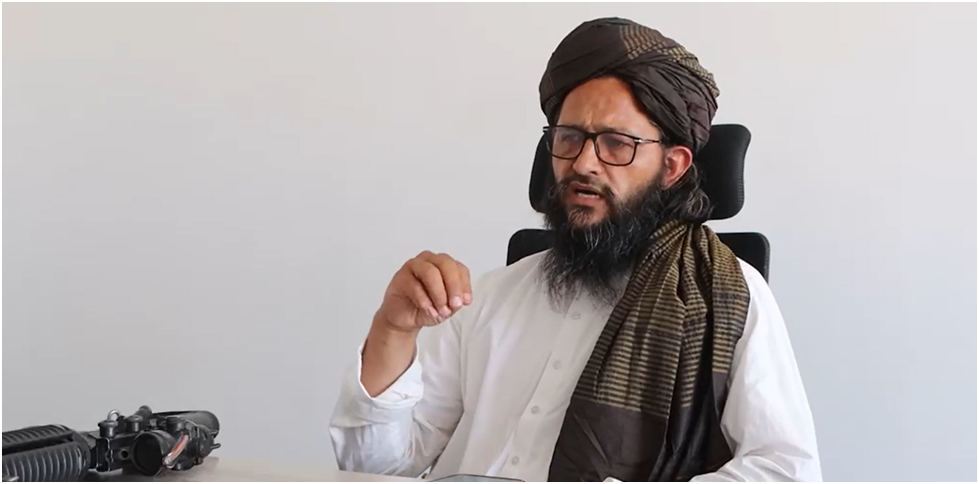
Kabul: Pakistan’s repeated allegations that the Tehreek-e-Taliban Pakistan (TTP) is using Afghan territory to wage war against Islamabad have come under a sharp counterattack from senior TTP leader Mufti Ghafran, who dismissed the claims as an attempt to shift blame for Pakistan’s mounting security challenges.
In a recent Pashto-language interview with Afghanistan’s Rana TV, Ghafran flatly rejected accusations by Pakistan’s government and military that TTP fighters cross the Afghanistan-Pakistan border to conduct attacks inside Pakistan. He claimed Islamabad had failed to produce concrete evidence demonstrating that the group’s fighters were being deployed from Afghan territory.
Ghafran instead claimed that the TTP’s organisational and military infrastructure is located inside Pakistan, asserting that its structures operate across at least 39 districts.
His remarks directly challenge Pakistan’s narrative that Afghanistan is being used as a launchpad for TTP attacks and place the spotlight on Islamabad’s own security apparatus and its ability to prevent militant movement across a heavily fortified frontier.
‘How Can Fighters Cross an Armed Border Unnoticed?’
Ghafran questioned how TTP fighters could allegedly enter Pakistan from Afghanistan when Pakistan has constructed fencing and established extensive surveillance infrastructure along the frontier.
He pointed to security posts, lighting systems, alarms and landmines, arguing that Pakistan’s own border controls make its repeated claims of large-scale militant infiltration difficult to reconcile with the security arrangements it says are in place.
He also cited TTP operations in areas such as Hangu, southern and northern Punjab, Karachi and Balochistan, arguing that several of these locations are far from the Afghan frontier.
According to Ghafran, Pakistan’s allegations are therefore being used to conceal what he described as failures on the domestic security front.
TTP Denies Afghan Fighters in Its Ranks
Ghafran further claimed that TTP recruitment is conducted through a strict internal process and that its fighters are Pakistanis operating within Pakistan.
He rejected the suggestion that Afghan nationals form part of the organisation, saying the TTP’s military and administrative structures are allegedly based within Pakistani territory.
The claims, however, come from a senior representative of the TTP and could not independently be verified from the interview material.
India Allegations Dismissed
On Pakistan’s allegations that India supports the TTP, Ghafran accused Islamabad of repeatedly portraying its opponents as foreign agents.
He claimed the TTP’s conflict with Pakistan was independent of foreign assistance and rejected the allegation that India was directing or financing the group.
Ghafran also claimed that the TTP’s activities had already extended into areas beyond the Pashtun belt and warned that its operations could expand further into Punjab and Sindh if Pakistani military pressure increased.
Sharp Attack on Pakistan’s Afghanistan Claims
Ghafran also rejected Pakistani claims that military strikes inside Afghanistan have targeted TTP personnel.
He alleged that TTP members had not been killed or wounded in Pakistani strikes in Afghanistan and claimed that civilians, including women and children, had instead been among those affected.
Those allegations were not independently verified.
The TTP representative further accused Islamabad of using the Afghan issue to justify military action while portraying Pakistan as the victim of a conflict that, according to his account, is largely being fought within Pakistan itself.
Negotiations and the Durand Line
Ghafran accused Pakistan of repeatedly abandoning negotiations when it considered talks politically inconvenient. He said the TTP remained willing, in principle, to engage in negotiations under what he described as Islamic and Sharia-based principles.
He also rejected Pakistan’s position on the Durand Line, arguing that Pashtun and Baloch communities had never accepted the frontier.
The status of the Durand Line has long been a major source of tension between Afghanistan and Pakistan, with successive Afghan governments disputing aspects of Pakistan’s position.
Ghafran additionally alleged that Pakistan’s intelligence agency, the ISI, has been involved in targeted killings. He offered no independently verifiable evidence for the allegation.
Pakistan Faces Renewed Questions Over Security Narrative
The TTP leader’s remarks amount to a direct challenge to Islamabad’s explanation of the militant threat and its repeated focus on Afghanistan.
Pakistan has consistently accused the Afghan Taliban authorities of allowing TTP militants to operate from Afghan soil, while Kabul has rejected such accusations. Pakistan’s military has also ruled out negotiations with the TTP and demanded action against the group.
The TTP, meanwhile, remains a banned militant organisation responsible for attacks in Pakistan, and its claims must be viewed in the context of its armed campaign against the Pakistani state.
Ghafran’s interview therefore represents the TTP’s own version of the conflict rather than independently established evidence. Nevertheless, his central challenge to Pakistan is pointed: if the TTP’s attacks are being planned and executed from Afghanistan, Islamabad must substantiate that claim with verifiable evidence rather than repeatedly shifting responsibility across the border.