

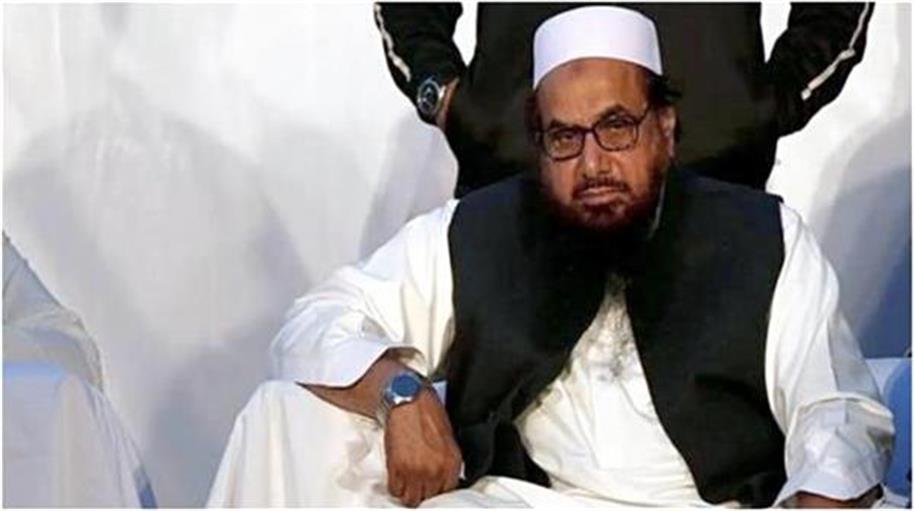
Islamabad: India is moving to tighten the legal noose around Pakistan-based terrorist Hafiz Saeed, the founder of Lashkar-e-Taiba and an accused in the Pahalgam terror attack case. With a non-bailable warrant already issued by the Jammu NIA court, India is now preparing to send a court summons to Saeed through the Ministry of External Affairs.
The move puts Pakistan under fresh scrutiny over its handling of individuals accused of involvement in terrorism directed against India. Saeed, who remains in Pakistan, could face proceedings even if he refuses to appear before the Indian court.
The National Investigation Agency (NIA) has named Saeed as an accused in the Pahalgam terror attack case and filed a supplementary chargesheet against him. The next legal step is the issuance of summons requiring him to appear for trial. Since Saeed is in Pakistan, the summons is expected to be transmitted through diplomatic channels.
The Jammu NIA court has already issued a non-bailable warrant against him. If he ignores the summons and remains absent, proceedings could potentially continue in his absence under Section 365 of the Bharatiya Nagarik Suraksha Sanhita (BNSS), 2023. The provision allows the legal process to move forward in circumstances where an accused remains unavailable, preventing a case from being stalled indefinitely simply because the accused is outside India.
Pahalgam Attack Brings Pakistan-Based Terror Network Under Spotlight
On 22 April 2025, terrorists targeted tourists in Pahalgam’s Baisaran Valley, killing innocent people and triggering nationwide outrage in India. The NIA subsequently investigated the wider conspiracy and the terrorist network allegedly connected with the attack.
The naming of Hafiz Saeed as an accused has further intensified attention on Pakistan-based terror infrastructure. India has repeatedly maintained that individuals accused of sponsoring or facilitating terrorism cannot be allowed to evade accountability by remaining on Pakistani soil.
Pakistan’s Water Threat Claims Face India’s Tough Stand
Meanwhile, Pakistan’s Planning Minister Ahsan Iqbal has raised alarm over India’s decision to keep the Indus Waters Treaty in abeyance, warning that Pakistan faces the possibility of water being used as a weapon.
Iqbal claimed that India’s geographical position, with several rivers flowing towards Pakistan from upstream areas, gives New Delhi the ability to exert pressure on Islamabad.
India’s position has remained firm: Pakistan must take effective action against cross-border terrorism. New Delhi has repeatedly made clear that terrorism and normal relations cannot go hand in hand.
Pakistan, meanwhile, continues to describe India’s decision on the Indus Waters Treaty as unilateral and unlawful. The latest developments underline the widening confrontation between the two countries, with India’s legal action against a Pakistan-based terror accused adding another layer of pressure on Islamabad.