

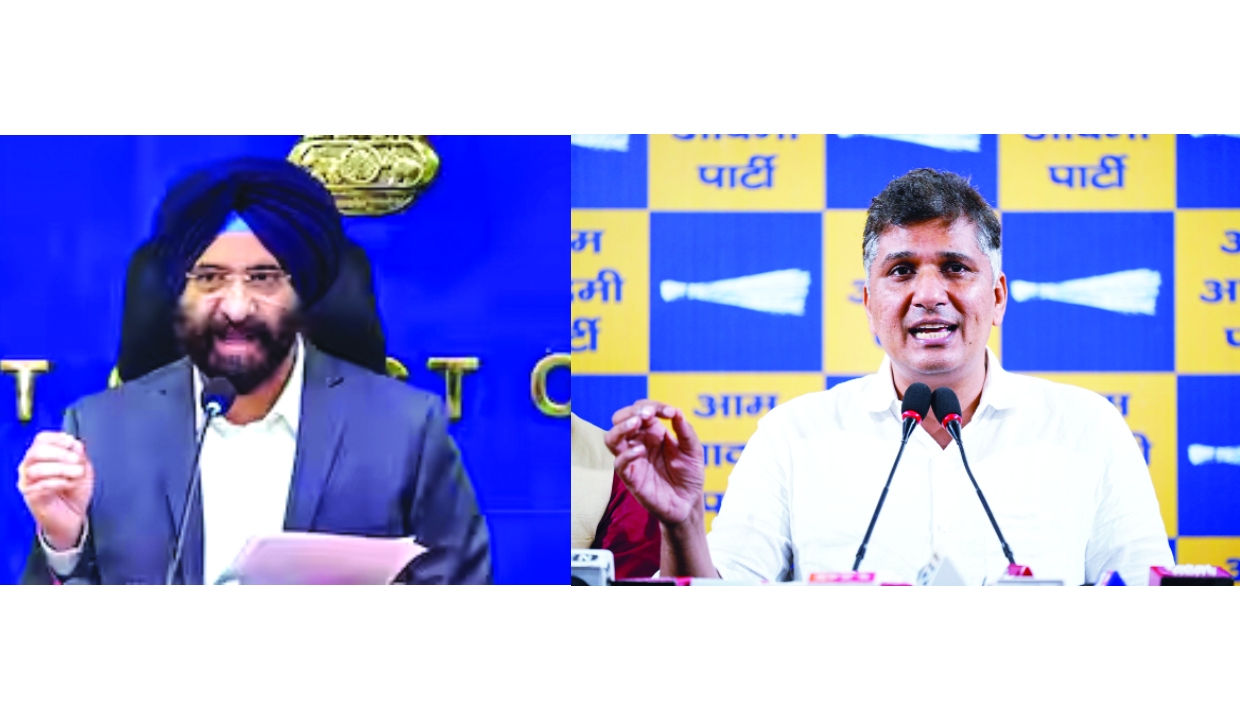
AAP leaders Saurabh Bharadwaj and Sanjeev Jha challenged to produce documentary evidence as Delhi Government and BJP reject what they call politically motivated claims
By Chandan Singh | Page 3 News Worldwide | New Delhi
New Delhi: The political row over the alleged “Delhi Government scam” has exposed a basic but crucial question: where is the evidence?
An assessment of the material cited in the controversy finds no judicial or legal determination establishing that a “scam” has been proved against the Delhi Government. What exists at present is a familiar political battle of allegations and counter-allegations, with Aam Aadmi Party (AAP) leaders Saurabh Bharadwaj and Sanjeev Jha making claims that have been strongly rejected by the Delhi Government and BJP leaders.
The distinction matters. In a democracy governed by the rule of law, a political accusation cannot automatically become a proven case of corruption simply because it is repeated at a press conference or amplified on social media.
‘Show the evidence, not just the accusation’
The central challenge to the AAP allegations is straightforward: produce the documents that establish the alleged wrongdoing.
If a scam has occurred, where is the financial trail? If public money has been misappropriated, where are the records? If procurement rules were violated, where are the tender documents and official decisions demonstrating the violation?
Without such material, branding a government’s functioning as a “scam” risks turning a political allegation into an apparent fact without the evidentiary process required to establish it.
Opposition parties unquestionably have the democratic right to scrutinise governments, question expenditure and demand investigations. But that right does not eliminate the distinction between raising a suspicion and proving wrongdoing.
Delhi Government and BJP hit back
Delhi Government Minister Sardar Manjinder Singh Sirsa has categorically rejected the allegations against the government and warned Saurabh Bharadwaj and Sanjeev Jha against what he described as false and misleading claims, indicating that legal action could follow if such allegations continue.
Delhi BJP spokesperson Praveen Shankar Kapoor has similarly challenged the AAP leaders to substantiate their accusations or withdraw them, arguing that the claims are politically motivated.
The BJP and Delhi Government’s position is clear: political rhetoric cannot replace evidence.
At the same time, the absence of a finding establishing wrongdoing does not, by itself, prove that every government action is beyond scrutiny. The decisive test remains whether credible evidence can withstand examination by the competent authorities.
From political slogan to legal claim
The controversy also highlights the legal boundary between legitimate political criticism and potentially actionable allegations.
Article 19(1)(a) of the Constitution protects freedom of speech and expression, while Article 19(2) permits reasonable restrictions on specified grounds, including defamation.
A politician can legitimately say that a government should explain a financial decision or that an alleged irregularity requires investigation. That is fundamentally different from asserting, without substantiating evidence, that a particular person has committed a “scam”.
The legal consequences of any particular statement would depend on its precise wording, context, target, factual basis and other circumstances.
The current criminal-law provision on defamation is contained in Section 356 of the Bharatiya Nyaya Sanhita, 2023, while civil remedies may also be available in appropriate cases.
A press conference is not a court of law
One of the strongest points emerging from the assessment is that a political press conference is not an investigation, and an X post is not a judicial verdict.
The political temperature may rise with every new allegation, but the legal standard does not change.
If AAP leaders possess documentary evidence, financial records, audit findings, tender documents, government orders or other substantive material, they can put it before the competent authorities.
If they cannot substantiate their claims, continuing to present them as established facts risks misleading public discourse.
For the Delhi Government and BJP, the appropriate response is equally clear: rebut specific allegations with records and allow competent authorities to determine whether any wrongdoing has actually occurred.
BJP’s challenge: Put the evidence on the table
The controversy ultimately comes down to evidence.
The AAP has the political right to question the government. The Delhi Government has the right to defend its record. The BJP has the right to challenge what it considers unfounded allegations.
But none of the political parties can substitute rhetoric for proof.
If there has been corruption, evidence should establish it. If public funds have been diverted, a financial trail should exist. If rules have been breached, official records should demonstrate the breach.
And if the allegations cannot be substantiated, repeatedly describing them as an established “scam” risks giving an unproven political narrative the appearance of fact.
‘No verdict can be delivered through political rhetoric’
The material reviewed does not establish a judicial or legal finding proving the alleged “Delhi Government scam”.
That does not mean allegations should be ignored. It means they must be tested rather than presumed true.
For the Delhi Government and BJP, the issue is therefore not simply political defence. It is a demand for the same standard that should apply to every allegation of corruption: credible evidence, proper investigation and due process.
In a democracy, neither a ruling party nor an opposition party can declare someone guilty merely by repeating an accusation.
The AAP leaders have the right to make their allegations. The Delhi Government and BJP have the right to reject them. But ultimately, neither side gets the final word — evidence does.
Until credible evidence and due legal process establish wrongdoing, the phrase “Delhi Government scam” remains an allegation, not an established fact.