
By Mehr Jan Gidaan TV
Nawab Marri had a deep understanding of the totality of human values and knew the importance of all aspects. Therefore, he advocated for total human freedom through national liberation.Similarly, he was well-aware of his own worth and value. Following Socrates’ maxim, he knew himself intimately, thus resisting transient whims, shallow popularity, and manufactured attractions.
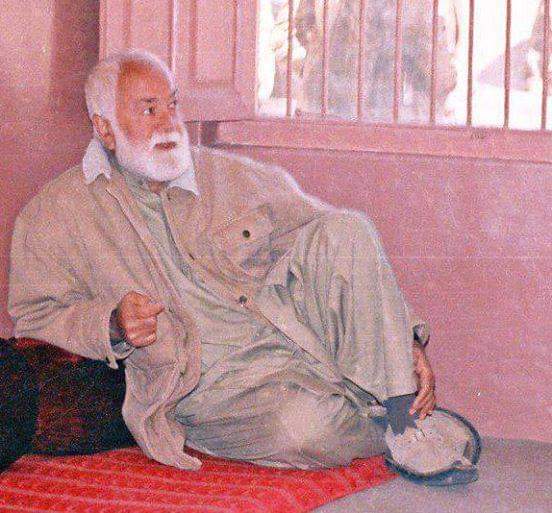
He remained serene amidst life’s extremes, his thinking governed by strict logic, and patience was his defining trait. According to Nawab Marri, his sons once used to think that he wished to soar but he had no interest in fleeting flights. Instead, like a political philosopher, he saw political events in the context of historical dynamics, analyzing their impact and consequences, rather than just seeking temporary gains.
He didn’t view political and war-related events superficially, nor did he accept to distort facts to the extent that truth and falsehood, political propaganda, and clamor became indistinguishable. Thus, his intellectual maturity had reached such heights that political groupings, political adhocism, and political expediency couldn’t at all influence him. He ardently believed that political adventurism lacks a clear destination.
Moreover, the journey to freedom is incompatible with the concurrent existence of individualism, groupthink, tribalism, egoism, and selfish desire. He would not have considered it less than a tragedy in any society in which nobleness and showmanship always go side by side. According to Mukhtar Hussain, he used to keep away from platitudes and publicity. A crowd, no matter how large it was, could not impress him. If seen in the light of Enescu’s words, he was a philosophical intellectual whose moral character was so high that he never needed a stage. In Heidegger’s parlance, he was referred to as an authentic and genuine being.
He did not accept any powerful positions while compromising on existence and freedom. Benazir Bhutto had to come without prior notice, because she knew that Baba Marri would refuse to meet her, and according to Baloch traditions, guests who come home are never turned back at the door. When a delegation from the American Consulate, which is considered to be the axis of power in countries like Pakistan, came to meet Baba Marri, was forced to say after the meeting, he does not even speak openly.
Once a huge political gathering was taking place in a certain area of Makran and Baba Marri was asked to address it by telephone from Karachi. He declined with a tinge of innocence, ” what do I have to say that I would like to share with the crowd?” Similarly, during the interviews, he used to say philosophically, “I don’t think this (my words) will benefit people.” This may have been regressive for modern-day writers, educated intellectuals and professors, but Baba Marri, along with a handful of people, continued to sow the seeds of resistance for Baloch motherland in the Haq Tawar Study Circle, where he remained underground, and watered them with his thoughts and actions.
In Nietzsche’s words, his loneliness (which encompassed Baloch motherland, nation, history and traditions and freedom) eventually became his strength, he was aware of the secret of power that Robert Green introduced as the fourth principle of power. This fifth phase of Baloch national resistance is due to those seeds.
He used to say that from the Haq Tawar Study Circle, “I was trying to have four Baloch sit down and understand the Baloch national issue through discussion. In this way, I can put in the minds of the Baloch the quest اion of their ownership and authority and the thought of practical struggle, and those four Baloch would understand my point and build courage for the struggle for Baloch national independence.” He linked the independence of the Baloch nation to the struggle as a rational requirement; expressing his capabilities in a rational manner instead of the noise of Poonam (an alliance of parliamentary parties in Balochistan).
Thus his every action passed through consciousness when he was speaking, it seemed as if he was thinking, as if he had a tongue in his mind. He was so proficient in his choice of words that, like one of Haruki Morkami’s characters, “sometimes he spoke as if he was looking for the right words to express his thoughts.” At times, his silence was as potent as any battle. His character possessed a distinct resilience.
Nawab Marri never tried to be a so-called humanist or champion of human rights, nor did he was into building castles in the air, but he, like a true political philosopher, realized the humanitarian elements in the policies of imperialism and its internal contradictions. He was well aware that Europe had made humans the center of gravity, but according to Sartre, “they killed them wherever they saw them”. Even in today’s era, Baba Marri remained discontent with France’s situation regarding human freedoms.He strongly believed that the Baloch could not be subdued without the patronage of imperialism, calling the state of Pakistan a puppet of imperialism.
Regarding America, he repeatedly used to say “America is most afraid of democracy.” And according to him, the world has never seen the United States play an effective role for the independence of an oppressed nation. He considered the United Nations to be America’s employee in this regard. And he was well aware that today the United States and its multinational companies are taking control of the trade of nations by obstructing their civilization, culture and traditions. He believed Milan Kundera to be right that “the institutions of the modern world are concerned with the interests of powerful nations rather than human interests.” In this context, he was asked whether it would not be a more correct decision if the war crimes of the state in Balochistan were presented in the United Nations? So he said that he does not believe in the United Nations, yes, but the case of the Baloch nation will definitely be preached there. He was closer to the Nietzschean philosophy in this regard and wanted the Baloch to rely on their strength. In any case, today in the real world, where power has taken precedence over significance, there have been millions of demonstrations and protests from Iraq to Palestine, but for America and Europe, the rights of their animals are more important than the human beings of the colonized nations and their entire history is the history of colonization.
There is no denying that the preaching of human rights for the colonized undoubtedly brings up a fundamental case, but the main role of the freedom struggle is a rational and necessary act to enter the battlefield along with having a narrative. So that instead of giving priority to power and significance (truth), the closeness of power and significance can increase. As per Alain Badiou, the role of the philosopher is more important in increasing this closeness. As far as propagating the basic case is concerned, instead of “harmony” with the colonizer, it requires effective diplomacy at the global level as well as highlighting the “fundamental contradiction” between the colonizer and the colonized in order to determine what Mao calls true friends and real enemies.
According to Nawab Marri, human rights claimants in the state of Pakistan who believe in the integrity of an imperialist state like Pakistan in their own right can never be a “champion of human rights”. In this context, Baba Marri recalls the incident of Kabral when some colonial journalists ask him that we are also writing something for you people, on which Kubral says that when we get freedom, we will write eight articles for you people in exchange for your four articles. Therefore, it is very important to understand that today Pakistani colonial state intellectuals; whether they belong to the left or the right, or the advocates of human rights, or the constitution, the law, they never sympathize with the Baloch in the name of humanity, but out of fear that another Bangladesh will not be formed. He thinks of his generations whose future is secure in Pakistan, and remaining Pakistanis.