
By Chandan Singh | Page 3 News Worldwide | New Delhi
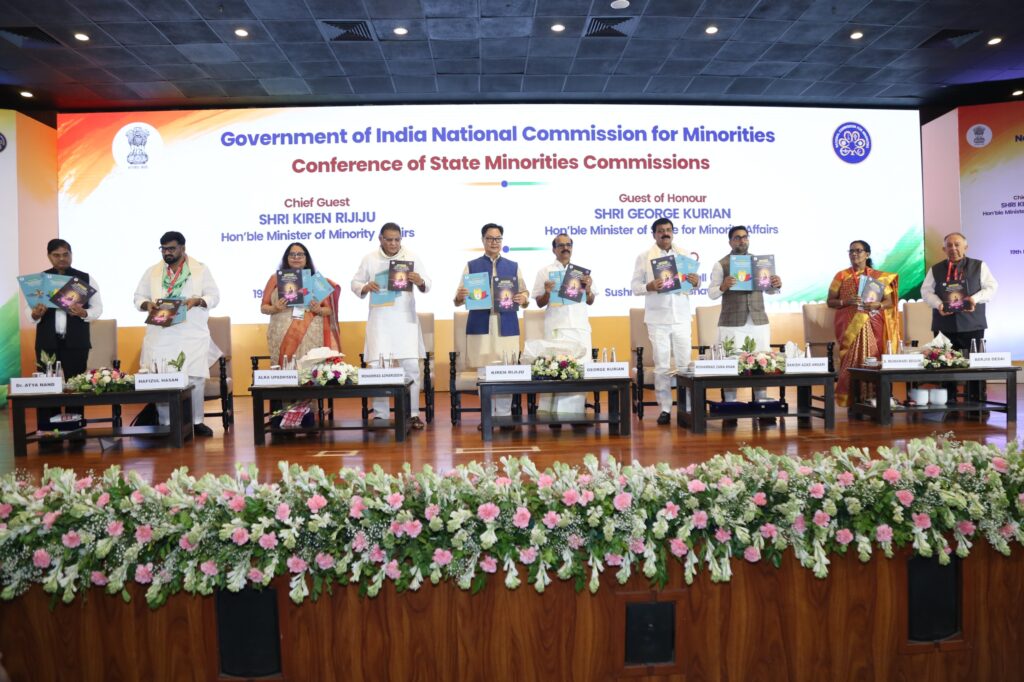
New Delhi: The National Commission for Minorities (NCM) on Wednesday convened a high-level Conference of State Minorities Commissions in the national capital, focusing on institutional strengthening, welfare delivery and inclusive development for minority communities across India.
Addressing the gathering at Sushma Swaraj Bhawan, Union Minority Affairs Minister Kiren Rijiju said India remains “one of the safest and most inclusive homes for minorities,” highlighting the contribution of Parsis, Christians, Muslims, Buddhists, Jains and Sikhs to the country’s economic, educational and cultural growth.
Minister of State for Minority Affairs George Kurian underlined the role of welfare schemes such as PMJVK in empowering minority communities through infrastructure and development initiatives aimed at achieving the vision of Viksit Bharat by 2047.
NCM Secretary Alka Upadhyaya said the Commission received 9,558 petitions between 2021-22 and 2025-26, disposing of 9,230 complaints through its grievance redressal mechanism. She also highlighted outreach programmes and seminars focused on Buddhist, Jain and Parsi communities.
The conference brought together representatives of State Minorities Commissions, senior officials from states and Union Territories, policymakers and community leaders for deliberations on minority rights, welfare schemes and institutional challenges.
During technical sessions, speakers from Muslim, Sikh, Buddhist, Jain and Parsi communities highlighted their historical role in nation-building and called for greater inclusive opportunities and policy support. Another session focused on operational challenges faced by State Minorities Commissions, including staffing shortages, administrative coordination and legal constraints.
Representatives from Bihar, Assam, Kerala, Meghalaya and Tamil Nadu also showcased best practices in scholarship support, skill development, livelihood promotion and welfare outreach for minority communities.
The conference concluded with a renewed push for stronger coordination between the Centre and states to improve minority welfare mechanisms and ensure more effective protection of minority rights across the country.