
Can the Badr Pact lay the foundation for an Islamic military-industrial complex? Turkey, Pakistan, Indonesia and Qatar want to pool their defence capabilities and reduce dependence on the West and Russia and China for arms.
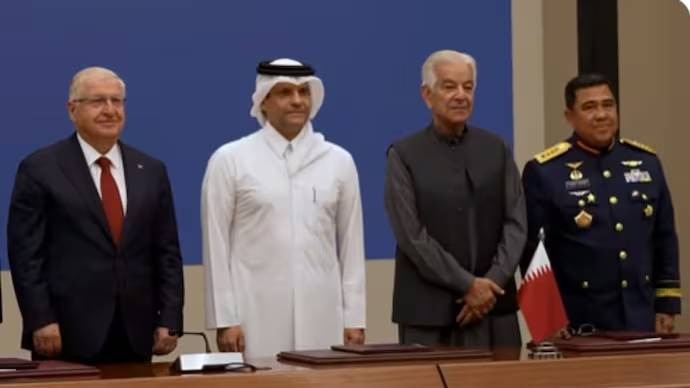
The four Islamic nations of Turkey, Pakistan, Indonesia and Qatar signed the Badr Defence Cooperation Pact, officially known as the Badr Memorandum of Understanding. Coming only months after the signing of the Mecca Defence Alliance, the Badr Pact that was signed in Doha, the capital of Qatar, is not a self-defence agreement. However, it may just be laying the foundation for a one-of-a-kind Islamic Military Industrial Complex (MIC).
The Badr Pact, signed on October 21, seems to be named after the Arabic word for full moon (symbolising how the complementary strengths of the four nations merge to form a complete circle), and is also a reference to the Battle of Badr, one of the most significant battles in early Islamic history.
Speaking to India Today Digital, senior journalist and defence expert Sandeep Unnithan describes the pact as “a ‘Quad’ framework for defence industrial cooperation among four Islamic countries.” Unlike the previous Mecca pact, the Badr pact aims to “integrate the defence industrial base of the four countries”, says Unnithan.
For context, even though all the four signatories have pretty significant armed forces of their own, they are all dependent on foreign suppliers. Pakistan’s Air Force, for instance, is made up entirely of Chinese and American jets, Indonesia buys its planes from Russia, the US, France, China and South Korea, while Qatar buys its weapons from the US, France and the rest of Europe. Even Turkey, which boasts a highly capable defence industry, also operates US and European aircraft and tanks.
The Badr Pact is hardly the first defence cooperation agreement its signatories have signed among themselves. Turkey, Pakistan, Indonesia and Qatar already have several pre-existing defence cooperation arrangements and joint development programmes. So, what makes the Badr Pact so important? And could it be the foundation for what Unnithan describes as a “Halal standard for military hardware”,reducing its members’ dependence on the West, Russia and China for arms?
WHY IS THE BADR PACT IMPORTANT?
The four signatories of the Badr Pact, Pakistan, Turkey, Indonesia and Qatar, already have significant armed forces of their own. But there’s just one problem: they remain heavily dependent on foreign suppliers for critical weapons, including fighter jets, tanks and warships.
Pakistan’s Air Force, for instance, is a combination of American, Chinese and French fighters and support aircraft, including the F-16, J-10 and C-130. Even its homegrown JF-17 remains heavily dependent on Chinese supplies of critical components such as engines and avionics.
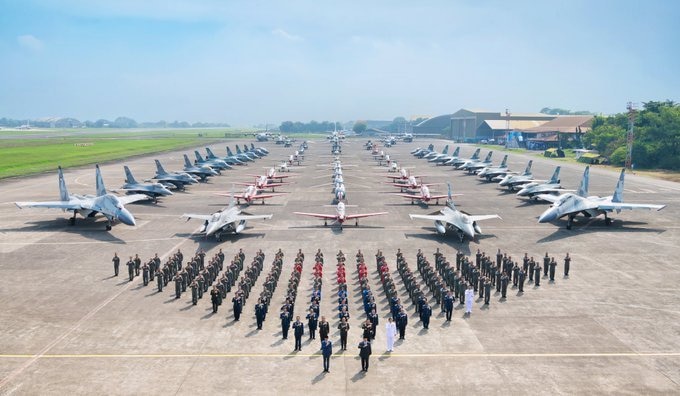
The problem is even more pronounced in the militaries of Indonesia and Qatar. The latter lacks a domestic military defence industry. Meanwhile, Jakarta’s military, especially its Air Force, is famous (or infamous) for operating and ordering aircraft from around the world, flying American F-16s, Soviet/Russian Sukhois, South Korean T-50s and French Rafales, while potentially looking to buy Chinese jets like the J-10.
Even Turkey, which boasts of an advanced defence industry of its own, remains dependent on foreign equipment such as the American F-16 and the Eurofighter Typhoon.
Foreign suppliers may be more than happy to provide deadly toys for cash, but this also means that buyers risk being cut off at any moment. Ankara learnt that lesson the hard way, when it was removed from the F-35 Lightning II programme after purchasing the Russian S-400 system. Jakarta learnt a similar lesson when US arms embargoes disrupted supplies of American-made spares for its F-16s between 1999 and 2005.
Reducing this dependence on foreign suppliers requires a self-sustaining military-industrial complex (MIC) capable of designing new equipment and producing it at scale. And that is precisely what the countries appear to be aiming for with the Badr Pact.
HOW WILL THE BADR PACT BUILD AN ISLAMIC DEFENCE INDUSTRY?
According to defence expert Unnithan, the signatories of the Badr Pact already have several pre-existing joint development programmes, some of which have produced military equipment now fielded by their armed forces.
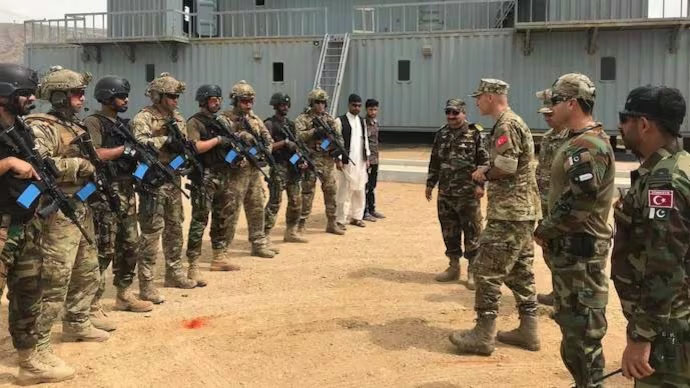
These include the Kaplan/Harimau medium tank, jointly developed by Turkey and Indonesia and in service with both countries, Pakistan’s Babur-class corvettes, based on Turkey’s MILGEM design, with two built in Turkey and two in Karachi, and Turkey’s Bayraktar TB2 combat drones, which have been acquired by Pakistan.
Turkey has also exported around 400 Ejder Yalcin armoured vehicles to Qatar, while Indonesia has acquired Turkey’s Atmaca anti-ship missile.
So, will the four nations be able to set up an MIC among themselves, independent of foreign suppliers? Speaking to India Today Digital, Unnithan listed out several factors that might enable such a thing.
“Qatar has substantial capital, Pakistan has a developed military industrial complex (PAC Kamra and Karachi shipyard), Indonesia is a large market and a growing economy with a focus on indigenisation,” Unnithan added. These, combined with Turkey’s “mature defence industrial base (most advanced of the four) with substantial defence exports” could just be what’s needed, according to Unnithan, to create a self-sustaining MIC capable of turning out jets, tanks, guns, radars and other deadly tools of war among themselves.
One programme the four countries could potentially collaborate on is Turkey’s indigenous Kaan fifth-generation stealth fighter. As Unnithan pointed out, “Indonesia has signed up for around 48 Kaans. Pakistan is also interested. This is a project where Qatari capital could prove crucial”.

Whether the Badr Pact can translate this potential into a functioning defence-industrial ecosystem remains to be seen. But the prospect of Turkish technology, Pakistani industrial capacity, and Qatari and Indonesian capital and markets coming together opens up several possibilities.
“This is a comprehensive agreement for land, sea and air systems which will help all four countries diversify from Western and Eastern military hardware suppliers and create the first template for a pure Islamic military industrial complex, a halal standard for military hardware,” says Unnithan.
Of course, the project could also falter. Other countries have attempted to build indigenous defence industries with mixed results. In the 1950s and 1960s, for instance, Gamal Abdel Nasser’s Egypt sought to develop a range of domestic military capabilities, including jet fighters, trainers and ballistic missiles.
If successful, the Badr Pact could eventually attract additional partners, such as Saudi Arabia and Egypt, and lay the groundwork for a defence industry unlike any other. Whether it can deliver on the promise of a ‘Halal’ defence industry, however, will depend on how effectively its signatories pool their resources, share technology and turn existing cooperation into sustained joint production.