
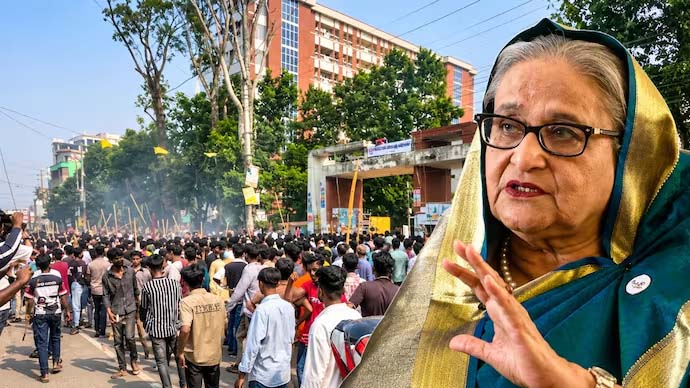
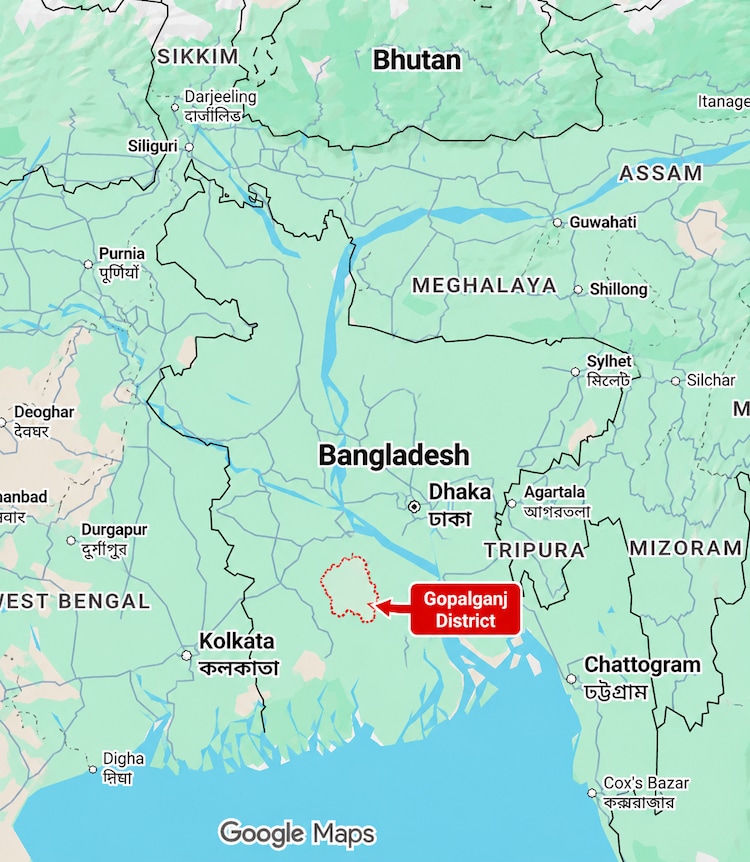
Awami League supporters set fire to public facilities in Gopalganj, the home district of party chief Sheikh Hasina, during violent protests. While desisting from using force against them, the Tarique Rahman-led government isn’t rebuilding the burnt-down facilities and has frozen funds to the district as part of a strategy.
The Tarique Rahman-led BNP government in Bangladesh has decided to withhold financial allocations to local bodies and keep public services suspended indefinitely in Gopalganj, the home district of ousted PM and Awami League chief Sheikh Hasina. This comes after Awami League supporters burnt down public facilities, as part of their protest, ahead of Hasina’s planned return to Bangladesh. The strategy, it seems, is to desist from using force, while making the Awami League backers bear the consequences for unprovoked acts of violence.
On November 15, hundreds of armed Awami League supporters took to the streets, and the demonstrations escalated into attacks on public infrastructure, police stations and properties belonging to leaders of Tarique Rahman’s BNP.
The violence was not confined to Gopalganj. Incidents of arson and sabotage have been reported across Bangladesh, including Dhaka. In Chattogram, unidentified individuals torched an unused part of the former chief of the interim administration, Muhammad Yunus’s ancestral home, while a BNP office was burnt down in Tarique Rahman’s hometown, Bogura.
“It obviously looks as though there is a strategy in whatever is being done,” Shafquat Rabbee, a Bangladeshi-American political commentator, told India Today Digital, suggesting that the government was deliberately avoiding the use of force against protesters while allowing the consequences of the unrest to play out.
“The government has two options, either to deal with force, or let the people of Gopalganj reflect and realise that they have hurt their own interests without any provocation,” Rabbee said, adding that the government had decided to choose the latter.
The remarks come amid speculation over Dhaka’s decision to suspend financial allocations and keep train services and police stations in Gopalganj following a series of violent incidents and demonstrations by members and supporters of the Awami League. The violence comes ahead of Hasina’s announced return from exile from India on December 16, two years after nationwide protests forced her to flee the country.
The decision has raised concerns over whether the entire district is being made to pay for the actions of a section of its residents, particularly amid escalating political tensions across Bangladesh.
What is interesting is that, with the Awami League banned, Tarique Rahman’s Bangladesh Nationalist Party (BNP) won the three Gopalganj seats in the February general elections.
FROZEN FUNDS, SUSPENDED TRAINS AND SHUTTERED POLICE STATIONS
According to a November 25 report by the Dhaka-based Prothom Alo, the government has decided to withhold the third instalment of financial assistance to Gopalganj’s district council, upazila councils, municipalities and union councils.
The instalment, covering January to March 2027, is part of the four instalments through which financial assistance is generally provided to these local government bodies. The Prothom Alo report, citing multiple government sources, said the funds would remain suspended for the time being.
BBC Bangla reported that the allocation of around five billion taka, which was “already allocated for the development activities of the district”, has also been frozen.
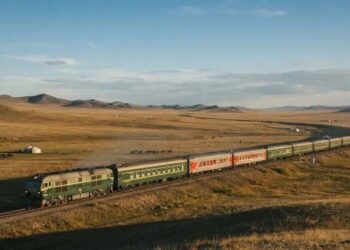
Alongside the financial freeze, at least five train services connecting Gopalganj with other parts of Bangladesh have been suspended since November 15. Bangladesh’s Railway and Home ministry sources have told the Prothom Alo that the government was not considering restoring them immediately because of fears of sabotage.
And on Thursday (November 26), The Daily Star reported that authorities of Bangladesh Railway’s western zone as having proposed new rail services between Dhaka and Khulna that would bypass Gopalganj entirely.
Operations at two police stations, Tungipara and Muksudpur, have also remained suspended after their buildings were set on fire on November 17 and 19, respectively. Their functions are currently being handled by Gopalganj Sadar Police Station.
The shutdowns have directly affected residents. Prothom Alo reported that people were unable to register general diaries or file cases at the two police stations. The suspension of train services has also caused difficulties for commuters, many of whom depend on trains for cheaper and quicker journeys to and from Dhaka, the capital city.
While the government has cited security concerns for keeping these services suspended, Shafquat Rabbee’s remarks to India Today Digital remarks suggest that the approach towards Gopalganj seems to be geared towards making residents reflect on the consequences of the violence.
WHY IS DHAKA HOLDING BACK AGAINST THE AWAMI LEAGUE?
The administration’s decision not to use force appears to be part of a broader calculation to avoid giving the Awami League an opportunity to portray itself as a victim of state repression.
Bangladeshi-American political commentator Shafquat Rabbee told India Today Digital that the government had deliberately chosen not to respond with force, even in situations involving attacks on political establishments.
“Even after Awami League hooligans burnt down multiple BNP offices in Hasina’s ancestral hometown of Gopalganj, and in Tarique Rahman’s hometown in Bogura, one of the two seats from where Tarique Rahman was elected, the government has refrained from acting with force,” Rabbee said.
Rahaman had won the Dhaka-17 and Bogura-6 seats in general elections back in February this year. He retained the Dhaka-17 seat and vacated the one at Bogura,
Multiple residences of sitting BNP MPs have also been set on fire, including a hospital owned by a BNP MP in Gopalganj, yet the government chose not to use force, leading to some BNP local leaders resigning from the party fearing for their safety — an absolute political rarity in Bangladesh’s contentious political theatre.
Prothom Alo separately reported that a senior official at the Home Ministry said the government would not use force against future activities of the banned Awami League. Dhaka’s approach, therefore, appears to involve allowing the consequences of the unrest to become visible to people of Gopalganj rather than immediately resorting to a forceful crackdown.
However, the suspension of public services and financial assistance raises a different question. How much of the burden of this approach will fall on ordinary people who may have had no involvement in the Awami League-linked violence?
HASINA’S RETURN ADDS TO TENSIONS
With December approaching, Sheikh Hasina’s home district and the Awami League fortress Gopalganj witnessed repeated incidents of violence. The ousted PM said she intends to return to Bangladesh on December 16, celebrated as Victory Day, marking the surrender of Pakistani forces led by Lt Gen AAK Niazi in the 1971 war against India.
On November 15, hundreds of Awami League supporters took to the streets carrying locally made weapons, including machetes, sticks and oars. The demonstrations escalated into attacks on public establishments, police infrastructure and properties belonging to BNP leaders.
A police armoured vehicle was damaged, while two police stations were subsequently torched. The government responded by deploying additional security personnel, including Border Guard Bangladesh (BGB) personnel, and transferring senior district officials and police officers.
Further clashes were reported on November 23, leaving at least 20 people injured, including four with gunshot wounds, according to Prothom Alo.
Hasina, who flew to India following her ouster in August 2024, has repeatedly spoken about returning to Bangladesh in December. Her proposed return has become a major political flashpoint, with the Awami League attempting to demonstrate its street muscle despite being barred from political activities.
For Tarique Rahman’s BNP-led government, Gopalganj presents a difficult political and security challenge. A forceful crackdown could provide the Awami League with an opportunity to claim victimhood, while allowing the current restrictions to continue risks placing the burden of the confrontation on the district’s wider population.