

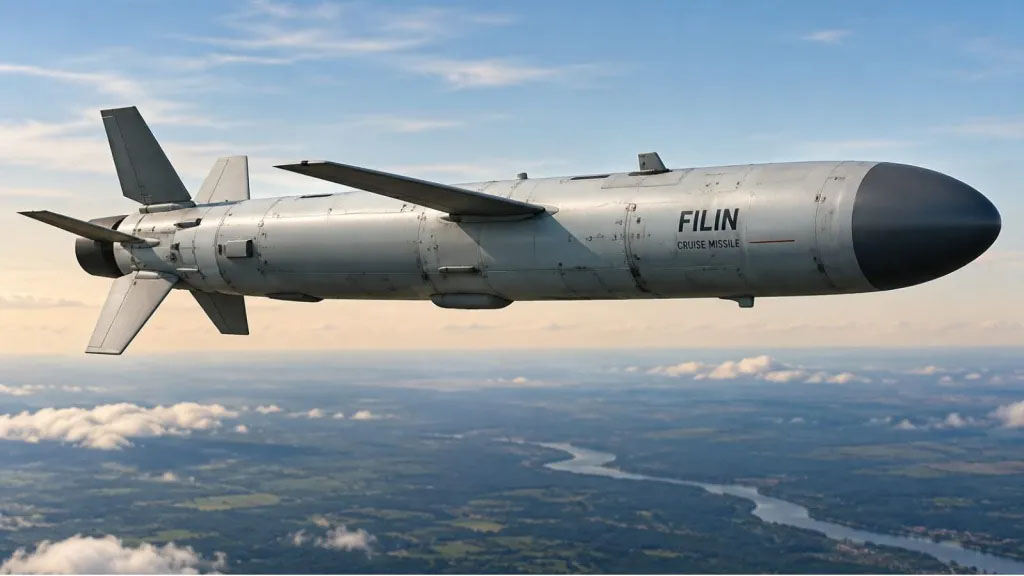
Two Ukrainian drone experts say Russia’s cheap Filin cruise missile is faster and hits harder than its jet-powered Shaheds, and could soon be used in large numbers.
Russia has a new missile that can have a bearing on the long-drawn Ukraine war, causing a fresh headache for Kyiv’s military experts and the government, according to military intelligence. This killing machine boasts speeds of nearly 500 mph, is partly 3D-printed, and reportedly can be launched from drones and helicopters.
Some of its components have been found to have US and Chinese origins and the cruise missile, known as Filin, is cheap. Its estimated price of $150,000 per unit is about a sixteenth the cost of a traditional Kh-101 cruise missile, making it easier to mass-produce.
Two Ukrainian drone experts have warned that Filin could pose a bigger challenge to Ukraine than Moscow’s jet-powered attack drones. Serhii “Flash” Beskrestnov and Serhii Sternenko, both former drone advisers to Ukraine’s defence ministry, say the missile is faster, more agile and carries a heavier warhead. They believe Russia’s next step in air warfare will be to fire cheap cruise missiles in large numbers.
“The mass use of this type of aerial attack weapon is what awaits us very soon,” Sternenko wrote on Telegram on Thursday, according to global financial and business news website Business Insider. “Then we will remember the jet Shaheds only as a small problem compared to this,” Sternenko wrote.
FILIN’S SPEED, RANGE AND WARHEAD
Ukraine’s military intelligence agency, HUR, published details of the Filin. It said the 11-foot missile is launched from the ground and that Russian forces began using it at the end of summer 2026. It carries a 100kg warhead. Russia claims the missile flies at close to 500 mph and has a range of 745 miles.
That is faster than Russia’s most advanced jet-powered drone, Geran-5, which clocks a maximum speed of 370 mph. HUR said the Filin can fly at very low altitudes or climb to 3.7 miles. Its body is made of carbon and fibreglass, and some parts are 3D-printed.
Beskrestnov said such weapons are also easier to deploy. “They do not need drone ports, many of them can be launched from helicopters and UAVs,” he wrote, adding that they can be built from Russian parts. He said Russia is putting cheap missiles ahead of jet-powered Shaheds in its plans.
RUSSIAN ENGINE, FOREIGN PARTS
GUR said the Filin has a Russian-made engine, unlike many Russian jet drones, which use Chinese engines. The same engine has been found in the newly revealed Kover and Monochrome air-launched missiles.
The agency also found many foreign parts inside the Filin, including in its flight controller, inertial navigation system, equipment control unit and anti-jamming hardware. It listed 35 components from the US, 22 from China and 13 from Japan, Switzerland, Taiwan and the Netherlands. Commercial engines and parts have helped Russia cut the cost of its newer cruise missiles. No price was given for the Filin.
PRESSURE ON UKRAINE’S AIR DEFENCES
The Banderol, another Russian missile that uses civilian technology, shows the strain these weapons can put on Ukraine’s air defences. It was first seen in spring 2025. It has a shorter range and lower speed than the Filin, but it can still reach 435 mph, which makes it hard for drones to intercept. Its estimated cost is $150,000, about one-sixteenth of a standard Kh-101 cruise missile.
Frequent Banderol attacks this summer have raised fears that Russia will fire more cheap missiles at Ukrainian air defences. Sternenko asked whether Ukraine’s air force command is preparing counter-measures before the new weapons are used more widely.
(With inputs from agencies)