
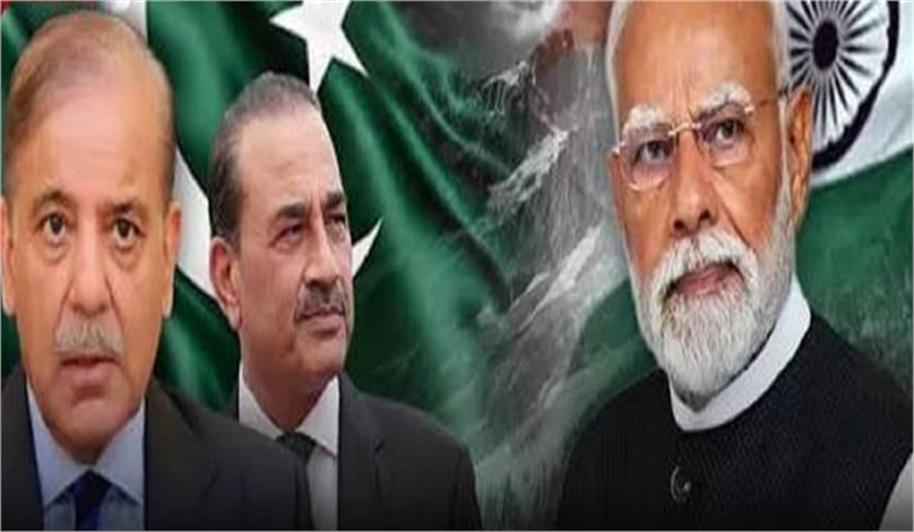
Washington: Turkey and Pakistan have come under scrutiny over alleged attempts to influence India’s Muslim community through provocative statements and disinformation campaigns. An article by American businessman and commentator Michael Rubin, published in The Sunday Guardian on 31 October 2026 and featured on the Jihad Watch website, claims that Turkish President Recep Tayyip Erdogan and Pakistan’s military leadership could be encouraging separatist sentiments among Indian Muslims.
The article raises concerns that such efforts could extend beyond Kashmir and potentially fuel demands for a separate homeland. However, these allegations and assessments have not been independently established by publicly available evidence.
Imran Khan and Asim Munir’s Statements Cited
Rubin refers to historical political positions in Turkey and Pakistan concerning the relationship between religious and national identity, arguing that certain ideological narratives portray Indian Muslims as a separate political community.
The article cites a statement made by former Pakistan Prime Minister Imran Khan on 6 August 2019, when he said that Pakistan’s founder, Muhammad Ali Jinnah, had supported the Two-Nation Theory because he wanted Muslims in India to have a separate homeland.
It also refers to remarks by Pakistan’s Army Chief, Field Marshal Asim Munir, on 16 April 2025. Munir said that his ancestors believed Hindus and Muslims differed in every aspect of life and constituted two separate nations.
Rubin interprets these statements as reflecting Pakistan’s ideological approach towards India.
Erdogan’s Comments on India and Kashmir
The article also examines Turkish President Recep Tayyip Erdogan’s public comments on India.
During the United Nations General Assembly in September 2019, Erdogan raised concerns about attacks on Muslim youths in India over their consumption of beef.
According to Rubin, Erdogan again expressed concern about the condition of Muslims in India in September 2025 while addressing young members of his political party. The article alleges that he accused Hindus of committing genocide against Muslims.
Rubin criticises Erdogan for what he describes as a selective presentation of communal violence in India, arguing that attacks committed by Muslims were not acknowledged in his remarks.
Social Media and Concerns Over Radicalisation
The commentary warns that inflammatory narratives and extremist material could be circulated through the internet and social media to influence sections of India’s Muslim population.
It specifically mentions Uttar Pradesh, Bihar and West Bengal, suggesting that attempts to mobilise communities along religious lines could create challenges for India’s internal security.
Rubin cautions that the spread of separatist and extremist narratives could aggravate communal tensions. However, the article does not provide publicly available concrete evidence of an organised uprising being planned in India or establish that Turkey and Pakistan are jointly conducting such an operation.
Questions Over Religious Freedom in Pakistan and Turkey
Rubin also questions the religious policies of Pakistan and Turkey, particularly in the context of their comments on India’s domestic affairs.
His article refers to allegations of discrimination against Hindus and Christians in Pakistan, incidents of communal violence and the reported misuse of blasphemy laws.
He argues that countries facing criticism over religious tolerance within their own borders should also be scrutinised when they comment on the religious and social affairs of other nations.
India’s Internal Security in Focus
The article concludes by urging India to remain attentive to foreign narratives and the possible spread of extremist ideologies through digital platforms.
Rubin argues that raising religious issues internationally while allegedly encouraging tensions within another country could become a means of exerting external pressure.
The central concern raised in the commentary is whether statements by foreign political and military leaders, combined with online propaganda, could influence India’s domestic social environment. These concerns remain the author’s assessment rather than independently verified evidence of a coordinated campaign.