
By Ravindra Arya
The story of India’s independence is not confined to major cities, capitals, and political movements. It is also the story of the forests, hills, and remote regions where heroes took up arms against British rule and sacrificed their lives.
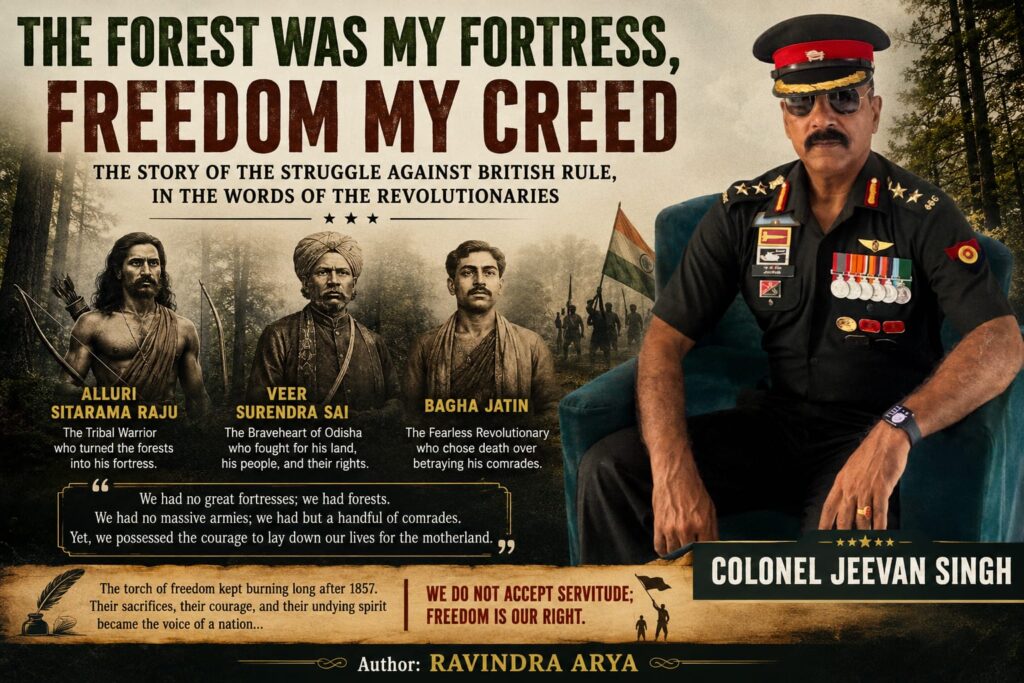
At different times, warriors like Veer Surendra Sai, Bagha Jatin, and Alluri Sitarama Raju challenged British authority. Some turned the forests into their fortresses, others embraced death to protect their comrades, and some organized tribal communities to launch rebellions against colonial rule.
“The British thought they would conquer the forests… but little did they know that the fire of freedom was burning within them.”
“For me, the forest was my fortress…”
The story of Alluri Sitarama Raju is a remarkable example of this. He led the struggle against the policies of British rule in the tribal regions of Andhra Pradesh. For his comrades, the forests were not merely a place to live, but a base for their struggle.
These warriors, who challenged British authority armed only with bows, arrows, and local weapons, faced a British army equipped with modern weaponry; yet, they possessed a power that no gun could defeat—the yearning for freedom.
“The British thought they would break our spirit…”
Veer Surendra Sai waged a long struggle against British rule in the Odisha region. Using the forests and hilly terrains as his base, he challenged British authority.
His fight was not merely for power; it was a battle to protect his land, his traditions, and his rights.
The British captured him and held him captive for years, yet his struggle became indelible in the history of Indian independence. “Death stared him in the face, yet he did not betray his comrades’ secrets…”
Bagha Jatin—Jatindranath Mukherjee—was one of the great figures of the Indian revolutionary movement who planned an armed challenge to British rule.
His life exemplified the immense value revolutionaries placed on the safety of their organization and their comrades. Despite pressure from the British police and the constant threat of arrest, he never wavered in his resolve.
His most famous confrontation took place near Balasore, where he and his comrades clashed with the British police. Even after sustaining severe injuries, his courage remained undiminished.
“Our story was greater than the gun…”
If the story of these revolutionaries were told in a fictional first-person voice, it would sound something like this—
“We told the British: India is ours. Your rule may stand on the strength of guns, but our resolve is far stronger.
We had no great fortresses; we had forests. We had no massive armies; we had but a handful of comrades. Yet, we possessed the courage to lay down our lives for the motherland.
The British could capture us, imprison us, and destroy our bodies—but they could not kill the spirit of freedom that had once taken root within millions of Indians.”
The torch of freedom kept burning long after 1857
The Revolt of 1857 was a major milestone in the Indian struggle for independence. Even after that event, resistance against British rule continued across various parts of the country. Warriors from different eras and backgrounds carried this struggle forward.
Therefore, linking the story of Alluri Sitarama Raju to July 4, 1857, is historically inaccurate—Alluri Sitarama Raju was born in 1897. Yet, from the flames of the 1857 struggle to the revolutionary movements that followed, one idea remained constant: India must be liberated from foreign rule. This very sentiment is reflected in various forms across the lives of figures ranging from Surendra Sai to Bagha Jatin and Alluri Sitarama Raju.
The stories of these heroes remind us that freedom was not an achievement attained on a single day; it was the result of generations of struggle, sacrifice, and indomitable courage.
That voice, which rose from the forests, eventually became the voice of all of India—
“We do not accept servitude; freedom is our right.”