
Police opened fire on protesters in Pakistan’s north-western province of Khyber Pakhtunkhwa on 13 October, injuring more than a dozen people and killing a 13-year-old boy, according to eyewitness accounts, hospital records and video footage obtained by Drop Site. The incident took place amid escalating tensions following the imposition of emergency rule and the removal of the province’s elected government, led by Pakistan Tehreek-e-Insaf (PTI), the party of former Prime Minister Imran Khan.
Two days after emergency rule was imposed on 11 October, 27-year-old Irfanullah and his three brothers joined hundreds of demonstrators in the town of Bara to protest against the federal government’s decision. According to the newspaper Dawn, four police officers were injured and 50 people were arrested during the clashes. The unrest has fuelled demonstrations across the province, alongside arrests of party leaders and activists and disruptions to communications.
Protesters Demand Their Rights and Peace
“It was a peaceful protest,” Irfanullah told Drop Site News.
His 19-year-old younger brother, Munir, was shot in the left leg, according to hospital records obtained by the publication. “Khyber police fired at the protesters, as a result of which my brother and several others were injured,” Irfanullah said.
A PTI activist like his brothers, Irfanullah remained at the hospital with Munir. He insisted that the demonstrators had neither caused unrest nor intended to create chaos.
“We are not thinking of leaving the PTI,” he said. “We are simply demanding our rights and peace here, and raising our voices. Nothing else.”
13-Year-Old Boy Dies After Being Shot
Habil Khan, the 13-year-old boy killed during the protests, worked at a food stall in the local market and was caught in the gunfire. His uncle told Drop Site that Habil was initially taken to a hospital where he did not receive treatment. He was subsequently transferred to another hospital in Peshawar, where doctors operated on him. He died four days after the protest.
The hospital’s death summary recorded a gunshot wound to the abdomen that caused severe intestinal injuries, with an exit wound in his lower back. The recorded causes of death included the gunshot injury, cardiac arrest and septic shock.
“He worked to earn money because of poverty when he was a child. Otherwise, at his age, he should have been at school,” his uncle said.
Another young boy, whom Drop Site could not contact, was reportedly selling bread in the market when police shot him.
Video footage obtained by the publication shows a teenage boy lying on a hospital stretcher with a deep, bleeding gunshot wound to his thigh. He says local police shot him, describing them as “terrorists” and “oppressors”.
Several residents interviewed by Drop Site said injured protesters were unable to obtain treatment at health centres in Bara because they feared arrest. Others were reportedly turned away because healthcare workers were concerned about police raids.
Munir initially remained at home after being shot. According to Irfanullah, he twice attempted to seek treatment at a local hospital but was sent away because staff feared police would arrive to arrest him. He eventually received treatment at a hospital in Peshawar.
Human Rights Concerns as Police Raids Continue
Maheen Pracha, a spokesperson for the independent Human Rights Commission of Pakistan, said the organisation had received reports of police raids in Peshawar, Swat and Khyber, the dispersal of small gatherings, the imposition of curfews and the deployment of the army.
“Whether the PTI is in power now or someone else is, the laws being made today will create problems for the next government that comes to power in the future,” Pracha said.
Drop Site sent questions to Khyber Pakhtunkhwa police but received no response before publication. The Pakistan embassy also did not respond to a request for comment.
Police Accuse Protesters of Violence
Two first information reports (FIRs) filed during the protests accuse demonstrators of attacking and injuring police officers, holding officers hostage and damaging government property.
An FIR dated 12 October sought the arrest of local PTI leaders and approximately 85 unidentified individuals. It described the alleged demonstrators as “agitated and extremist PTI activists” carrying “slingshots, wooden sticks, stones and weapons”. The report alleged that they attacked police and fired weapons with the intention of killing officers.
A second FIR, filed on 13 October, named PTI leaders and local residents. It alleged that a crowd of around 300 PTI supporters raised provocative anti-government slogans, delivered inflammatory speeches, encouraged arson, blocked roads, damaged government property and assaulted and detained police officers.
According to the second FIR, police used batons and fired shots into the air to disperse the crowd.
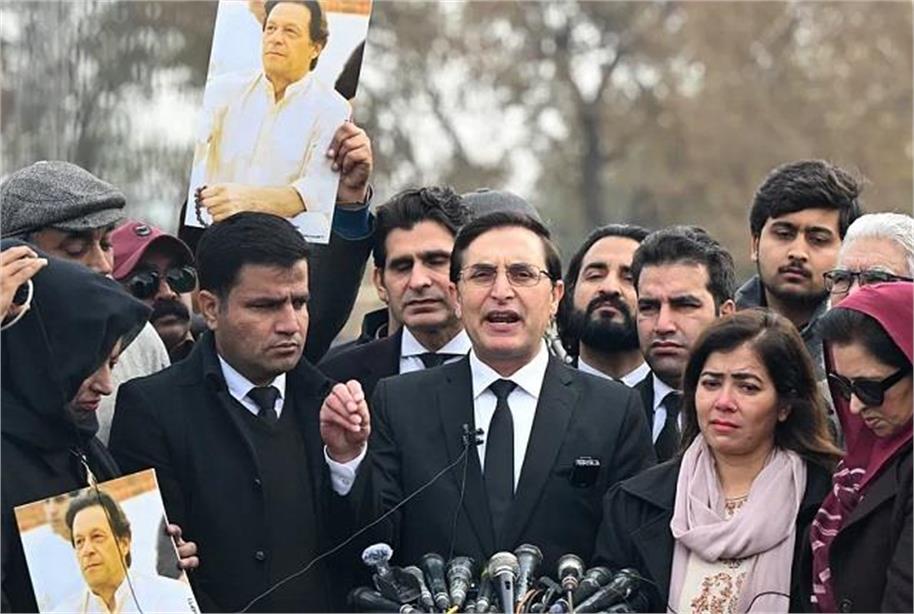
PTI chairman Gohar Ali Khan and his legal team have challenged the emergency measures in the Peshawar High Court, arguing that the imposition of emergency rule and removal of the provincial government are unconstitutional.
Federal Government Takes Control of Khyber Pakhtunkhwa
The clashes in Bara form part of a wider confrontation between the federal government and the PTI, which had governed Khyber Pakhtunkhwa for the previous 13 years.
Protests erupted following Khan’s arrest in May 2023 and later escalated into attacks on government buildings and military installations. Thousands of people were detained during the unrest. Khan, who was removed from office in April 2022, has faced multiple legal cases and has been imprisoned since August 2023, including periods of solitary confinement.
More recently, reports of his deteriorating health prompted party leaders, relatives, supporters and human rights organisations to demand better prison conditions and access to medical treatment.
Negotiations between the PTI and the federal government over Khan’s medical care and release from prison subsequently stalled. On 4 October, thousands of PTI supporters set off from Khyber Pakhtunkhwa towards Islamabad to press their demands.
Prime Minister Shehbaz Sharif responded by convening an emergency Cabinet meeting. On 11 October, President Asif Ali Zardari, acting on Sharif’s advice, imposed emergency rule and governor’s rule in the province, suspending its elected government. The federal government cited rising terrorism and political instability to justify the measures.
Chief Minister Sohail Afridi, provincial PTI president Junaid Akbar, provincial assembly speaker Babar Saleem Swati and several other party leaders were detained. The Pakistani army was also deployed in the province and is expected to remain there for the duration of emergency rule.
A senior PTI leader, speaking to Drop Site on condition of anonymity for security reasons, said the government claimed Afridi was being held in “protective custody” but had refused to produce him before a court or provide evidence of his whereabouts.
“This is the chief executive of a province with a population of 45 million,” the leader said.
Six days after governor’s rule was imposed, Governor Faisal Karim Kundi announced plans to extract and sell the province’s mineral resources, specifically mentioning deposits in Lakki Marwat, Tank and Bannu. He also called for joint ventures with domestic and foreign companies to develop oil and gas reserves.
Khyber Pakhtunkhwa possesses substantial natural resources, including natural gas, copper, chromite, lead, emeralds, marble, limestone and coal. The province also accounts for 50 per cent of Pakistan’s total daily domestic crude oil production.
PTI Challenges the Constitutional Basis of Emergency Rule
PTI leaders and constitutional experts have questioned the legality of the federal government’s intervention.
Asad Jamal, a Lahore-based lawyer specialising in constitutional law, argued that Zardari’s proclamation did not meet the constitutional requirements for imposing emergency rule. He said citing terrorist incidents alone was insufficient to justify such measures.
“I am not a supporter of the PTI,” Jamal said. “So I would like to reiterate that constitutional provisions are being used very dishonestly against a province, violating its autonomy. Essentially, this is discriminatory.”
Article 232 of Pakistan’s Constitution allows emergency rule to be imposed in certain serious emergencies, including circumstances in which internal disturbances become so severe that a provincial government cannot control them.
Article 234 provides for governor’s rule, allowing the President to transfer a provincial government’s executive powers to the governor and authorise Parliament to exercise the powers of the provincial assembly.
Jamal questioned whether the government had demonstrated that the constitutional threshold had been met.
“They allege that the provincial government lacks the political will to fight terrorism,” he said. “But how can you measure a government’s political will in a concrete and impartial way to justify the use of these powers?”
On 15 October, Pakistan’s Parliament approved governor’s rule for an initial two-month period. Any extension requires further parliamentary approval, and the arrangement cannot remain in force for more than six months in total.
Jamal also argued that the Constitution contains no provision requiring the dissolution of a provincial government during an emergency. Although certain provincial powers may be withdrawn, he said, the chief minister and elected government should remain in place.
“The chief minister has been picked up. Under what constitutional or legal provision has he been arrested?” he asked.
He further questioned the legal basis for what he described as a “governing secretariat”, arguing that no such concept existed in the Constitution or in federal or provincial law.
Jamal said the proclamation had been issued at a politically sensitive moment, when the provincial government was leading a protest march towards the capital.
“That was what the federal government was afraid of,” he said.
On 14 October, the PTI legal team filed a petition in the Peshawar High Court on behalf of Gohar Ali Khan, challenging the constitutional validity of emergency rule and governor’s rule.
Jamal said the court could declare the measures unconstitutional and reverse the actions taken under them.
Sameer Khosa, representing Gohar in the case, told Drop Site that the PTI wanted the government to disclose the evidence used to justify the proclamation, including the governor’s report.
“We are asking the court to require the production of the material on the basis of which the President issued the proclamation,” Khosa said. “This will allow the court to examine what evidence was used to justify it.”
A Wider Test for Pakistan’s Democracy
The federal government’s takeover has raised concerns extending beyond Khyber Pakhtunkhwa, particularly over human rights, civilian authority and the military’s influence on Pakistan’s political system.
Aqil Shah, a political scientist at Georgetown University and author of The Army and Democracy: Military Politics in Pakistan, described emergency rule and governor’s rule as a significant turning point in the country’s longstanding struggle between civilian institutions and the military.
“This is a major blow, because the PTI has been weakened at almost every level and its organisational structure has been dismantled,” Shah said.
He argued that the measures had not only removed the PTI from power but also deprived the people of Khyber Pakhtunkhwa of their political representation. The province is now governed by a governor and technocrats who, according to Shah, effectively act as proxies for the military.
Shah said the military’s political ambitions extend beyond personal grievances involving army chief Asim Munir, including Khan’s decision to remove Munir as head of the Inter-Services Intelligence (ISI). More broadly, he argued, the military seeks to prevent civilian leaders from challenging its influence over national security, internal security and electoral politics.
Shah described Khan as an “existential threat” to military rule.
“The only political challenge is Imran Khan and the PTI government in Khyber Pakhtunkhwa, and both of these have been brought under control,” he said.
A senior PTI leader told Drop Site that the party would probably participate in the next elections. Shah, however, questioned whether future polls would be free and fair.
The current coalition of the Pakistan Muslim League-Nawaz (PML-N) and the Pakistan Peoples Party (PPP) took power amid allegations of electoral rigging. Pakistan’s Election Commission rejected the allegations, although a senior official acknowledged involvement in attempts to manipulate the results.
According to Shah, the military has little incentive to assume direct responsibility for governing the country when it can exercise power through political allies. With Khan in prison and other parties willing to co-operate with the military, it can retain effective control without taking direct responsibility for the administration.
Pakistan’s 27th Constitutional Amendment, passed last year, grants lifetime immunity to the President and the army chief. The provision currently applies to Munir and other senior officials.
Shah said the measure demonstrated the military’s determination to avoid accountability to civilians.
“Accountability is always imposed on civilians, and it is a form of punitive and vindictive accountability,” he said. “[Munir] wants to remain free from any form of accountability for the rest of his life. This is not limited to the time he wears the uniform; it is permanent.”