
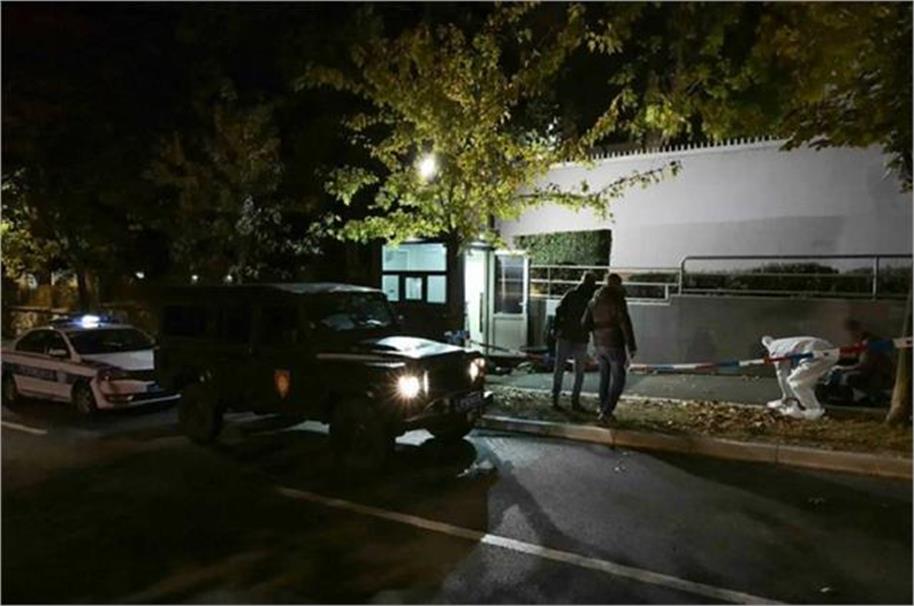
Belgrade: A police officer guarding the Israeli Embassy in Belgrade, the capital of Serbia, was attacked with two knives by an assailant who allegedly shouted ‘Allahu Akbar’. The attacker was shot dead by the officer in self-defence, while the injured policeman sustained minor injuries. Serbian authorities are investigating the incident as a suspected terrorist attack.
Serbian Interior Minister Ivica Dačić confirmed that the attacker had not yet been formally identified. According to the minister, the assailant was a minor who attacked a member of the gendarmerie stationed outside the Israeli Embassy.
The officer responded by firing at the attacker, killing him at the scene. The incident prompted an immediate security response, with authorities stepping up protection at key locations across the country.
Suspected Islamic State Links Under Investigation
Interior Minister Dačić said Serbia’s security agencies had previously been monitoring the attacker, who was allegedly a supporter of the Islamic State (ISIS) terrorist organisation.
The minister also claimed that the suspect had displayed a black flag associated with Islamic State on his Instagram account. However, the attacker’s identity and alleged links to the extremist group remain subject to investigation.
Authorities have classified the incident as a suspected terrorist attack and are examining the circumstances surrounding the assault. No definitive conclusions about the suspect’s motives or affiliations have been established publicly.
Serbia Raises Terrorist Threat Level
Following the attack, Serbia raised its terrorist threat level to the highest category. Police deployments have been increased at key locations, and security measures have been tightened across the country.
Special attention is being given to sensitive sites, including diplomatic missions such as the Israeli Embassy. The incident has renewed concerns about the security of diplomatic establishments and the potential threat posed by extremist activity.
Attack Comes Amid Political Uncertainty
The incident comes against the backdrop of political uncertainty in Serbia, which has experienced nearly two years of protests.
The country recently held snap parliamentary elections on Sunday, following a prolonged period of demonstrations. According to a report by the Associated Press (AP), a youth-led movement challenged the political establishment associated with long-serving President Aleksandar Vučić.
A new government has yet to be formed, while Vučić and his allies continue to exercise control over the police.
The investigation into the embassy attack remains ongoing as Serbian authorities work to establish the suspect’s identity, determine his motive and verify the alleged links to Islamic State.