
Joint Vision for ‘Viksit Bharat and Samunnat Nepal’ adopted; rail, energy, trade and infrastructure cooperation take centre stage
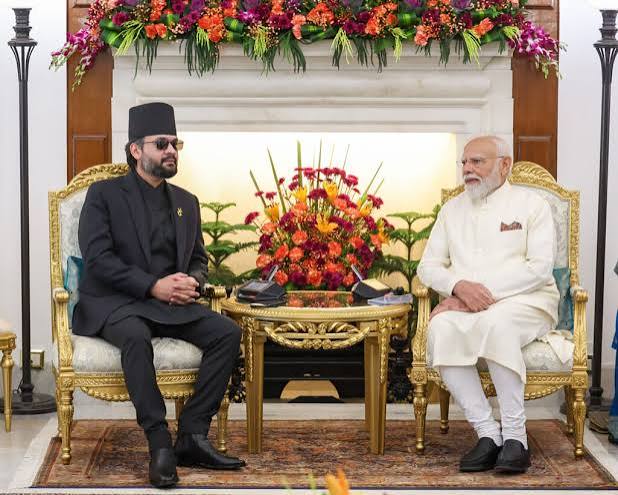
NEW DELHI: India has pledged development assistance worth ₹15,000 crore to Nepal, including grants for post-disaster reconstruction and infrastructure projects and a line of credit for the energy sector, as Prime Minister Narendra Modi and his Nepalese counterpart Balendra Shah agreed to deepen bilateral cooperation across key sectors during the latter’s first State Visit to India on November 22-23.
The two leaders adopted a Joint Vision for “Viksit Bharat and Samunnat Nepal”, outlining an ambitious roadmap for future cooperation in economic development, connectivity, energy, water resources, climate resilience, disaster management, digital services, space, innovation and people-to-people exchanges.
The assistance package comprises ₹3,500 crore in grant support for post-disaster reconstruction and new infrastructure projects, and ₹11,500 crore in rupee-denominated lines of credit for energy projects. The specific projects and implementation arrangements will be finalised through mutual consultations.
During the visit, Prime Minister Shah acknowledged India’s humanitarian and technical assistance following the devastating Rasuwa-Bhotekoshi floods, which caused significant loss of life and property damage in Nepal. Modi reaffirmed India’s continued support for Nepal’s development as a close friend and neighbour.
The two leaders also reviewed ongoing development projects, including the construction of Nepal’s National Police Academy and High Impact Community Development Projects. They welcomed India’s grant-assisted plan to establish an Agro-Industrial Park in Chitwan.
Major push to cross-border connectivity
Connectivity emerged as a major pillar of the discussions, with both countries agreeing to strengthen transport and trade links through railway networks, roads, bridges, integrated check posts and petroleum pipelines.
Modi announced a new transit route for Nepal’s trade through Deendayal Port at Kandla in Gujarat. Access to Paradip Port in Odisha will also be provided once the necessary infrastructure is in place.
The leaders flagged off the inaugural Sarayu-Kamala Express rail service between Ayodhya and Janakpur, expected to promote religious and cultural tourism along the Ramayana Circuit and strengthen the historic civilisational links between the two countries.
They also agreed to explore similar rail connections to develop Buddhist and Shiv-Shakti religious tourism circuits.
The two sides announced the completion of the Field Location Survey for the proposed Raxaul-Kathmandu electrified broad-gauge railway line and agreed to cooperate in developing Nepal’s East-West Railway.
In another connectivity initiative, the existing one-way B345 Kathmandu-Bhairahawa-Lucknow air route will be made bidirectional, subject to technical consultations and finalisation of operational arrangements.
The leaders also virtually laid the foundation stone for a new Integrated Check Post at Banbasa and welcomed progress on similar facilities at Bhairahawa, Sunauli and Dodhara-Chandani. Three integrated check posts between the two countries are already operational.
A new motorable cross-border bridge connecting Dharchula in India with Darchula in Nepal was also inaugurated to improve direct connectivity with western Nepal.
Energy partnership gets fresh momentum
India and Nepal agreed to accelerate cooperation in hydropower, electricity transmission and petroleum infrastructure.
The two Prime Ministers virtually laid the foundation stone for the 669 MW Lower Arun Hydroelectric Project, while reaffirming their commitment to expediting hydropower projects being developed by Indian companies in Nepal.
They directed the Pancheshwar Development Authority and the Joint Committee on Water Resources to finalise the Detailed Project Report of the Pancheshwar Multipurpose Project at the earliest. They also called for faster progress on the DPRs of the Saptakoshi and Sunkoshi multipurpose projects to utilise water resources and reduce flood-related risks.
Both sides welcomed progress towards joint ventures for two high-capacity cross-border electricity transmission lines connecting Inaruwa with New Purnea and Dododhara with Bareilly.
In the petroleum sector, the leaders dedicated Phase II of the Motihari-Amlekhgunj pipeline to the people of Nepal. They also virtually laid the foundation stone for a petroleum terminal at Jhapa and stressed the early commencement of work on the Siliguri-Jhapa pipeline. Cooperation on cross-border gas pipelines will also be explored.
India to establish IIT campus in Nepal
In a significant step towards educational and technological cooperation, India agreed to establish an offshore IIT campus in Nepal.
The proposed institution is expected to strengthen Nepal’s higher education ecosystem and support employment generation. The leaders also welcomed expanding collaboration in start-ups, digital services, financial connectivity and technological innovation.
Both countries agreed to facilitate smoother access to banking and telecommunications services for their citizens residing across the border.
Eight MoUs exchanged
During the visit, the two countries exchanged eight Memoranda of Understanding covering academic research, security training, public administration, traditional medicine, satellite communications, urban development, healthcare, and livestock and fisheries development.
The agreements involve institutions including India’s National Forensic Sciences University, Rashtriya Raksha University, National Centre for Good Governance and the Indian Space Research Organisation, alongside their Nepalese counterparts.
The agreements are aimed at expanding institutional cooperation, strengthening capacity-building and promoting knowledge-sharing across key sectors.
Shah invites Modi to visit Nepal
Prime Minister Shah thanked Modi for the hospitality extended to him and his delegation and formally invited the Indian Prime Minister to visit Nepal.
Modi accepted the invitation, with the dates of the proposed visit to be finalised through diplomatic channels.
The joint statement said the visit had reaffirmed the longstanding partnership between India and Nepal, founded on mutual trust, friendship, respect and understanding, with strong people-to-people connections and close economic and development cooperation.
The two sides reiterated their commitment to maintaining regular high-level exchanges and advancing their partnership across traditional and emerging areas of cooperation.