
Patna: Amid rising climate concerns and growing pressure on water resources, the Bihar government on Saturday underscored the urgent need for sustainable groundwater management, even as it showcased major gains in rural drinking water coverage.
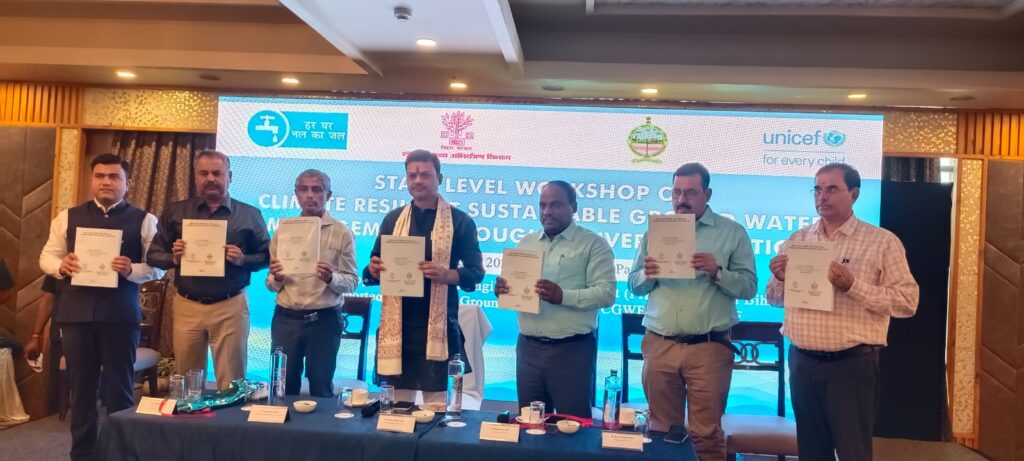
At a state-level workshop on climate-resilient groundwater management, organised by the Public Health Engineering Department (PHED) in partnership with the Central Ground Water Board and UNICEF, policymakers and experts raised alarm over declining groundwater levels, erratic rainfall and seasonal drying of sources across districts.
Addressing the gathering, PHED Minister Sanjay Kumar Singh stressed that while Bihar’s “Har Ghar Nal Ka Jal” scheme has expanded piped water supply to over 1.8 crore rural households, heavy reliance on groundwater poses a long-term risk. He called for a shift towards aquifer-based planning, stronger inter-departmental coordination and greater community participation.
“Water supply must go hand in hand with groundwater sustainability to ensure long-term access,” the minister said, while releasing the Annual Report of Dynamic Ground Water Resources of Bihar 2025.
Officials highlighted the scale of Bihar’s water infrastructure, with over 1.20 lakh piped water schemes and 6.5 lakh handpumps currently operational. However, declining groundwater levels during summer remain a persistent challenge.
Engineer-in-Chief-cum-Special Secretary Abhay Kumar Singh said efforts are underway to ensure uninterrupted supply through continuous monitoring, timely repairs and coordination with technical agencies. He added that PHED, along with the Central Ground Water Board, is working on developing “water-secure panchayats” as a sustainable model.
Additional Secretary Arvind Kumar outlined a proactive approach to tackle seasonal shortages, including groundwater monitoring across 8,000 gram panchayats, a statewide handpump repair drive, and deployment of technical teams. Emergency measures such as water tankers, water ATMs and 24×7 control rooms have also been put in place.
Regional Director Rajeev Ranjan Shukla noted that groundwater accounts for over 80% of rural drinking water supply in India and remains nearly the sole source in Bihar, warning that over-extraction and climate change could severely impact future availability.
From UNICEF, WASH specialist Prabhakar Sinha emphasised the need to integrate climate resilience into water systems, linking sustainable water access to improved public health and child well-being.
The workshop featured technical sessions on groundwater status, aquifer mapping under the NAQUIM programme, field-level conservation models, and the need for improved coordination among departments.
Experts concluded with a call for actionable strategies, including integrating groundwater sustainability into local planning frameworks and strengthening institutional convergence to ensure long-term water security.
With climate pressures intensifying, officials said sustained collaboration between government bodies, scientific institutions and development partners will be critical to safeguarding Bihar’s groundwater resources.