
By Chandan Singh | Page 3 News Worldwide | New Delhi
Vijender Gupta pitches minimum 30 annual sittings, gender-neutral rules and stronger scrutiny of Bills; paperless meeting saves 18,252 sheets of paper
NEW DELHI, October 27, 2026: Delhi Legislative Assembly Speaker Vijender Gupta has called for comprehensive parliamentary reforms, emphasising that a common framework for legislative procedures must respect the constitutional autonomy and institutional distinctiveness of different legislatures across India.
“Uniform Rules must not mean identical rules,” Gupta said while presenting Delhi’s recommendations at a meeting of the Committee on Formulation of Model Rules for Uniformity in the Procedure and Conduct of Business in Legislative Bodies in India.
He advocated gender-neutral legislative rules, a minimum of 30 sittings annually for State Legislatures, wider adoption of digital parliamentary procedures and stronger scrutiny of Bills before their passage.
Delhi Speaker Seeks Gender-Neutral Rules, Greater Legislative Autonomy
Gupta said parliamentary rules must reflect contemporary democratic realities, calling for the replacement of masculine expressions retained under conventions associated with the General Clauses Act, 1897. He maintained that the recognition of Nari Shakti should extend to the rules governing the country’s democratic institutions.
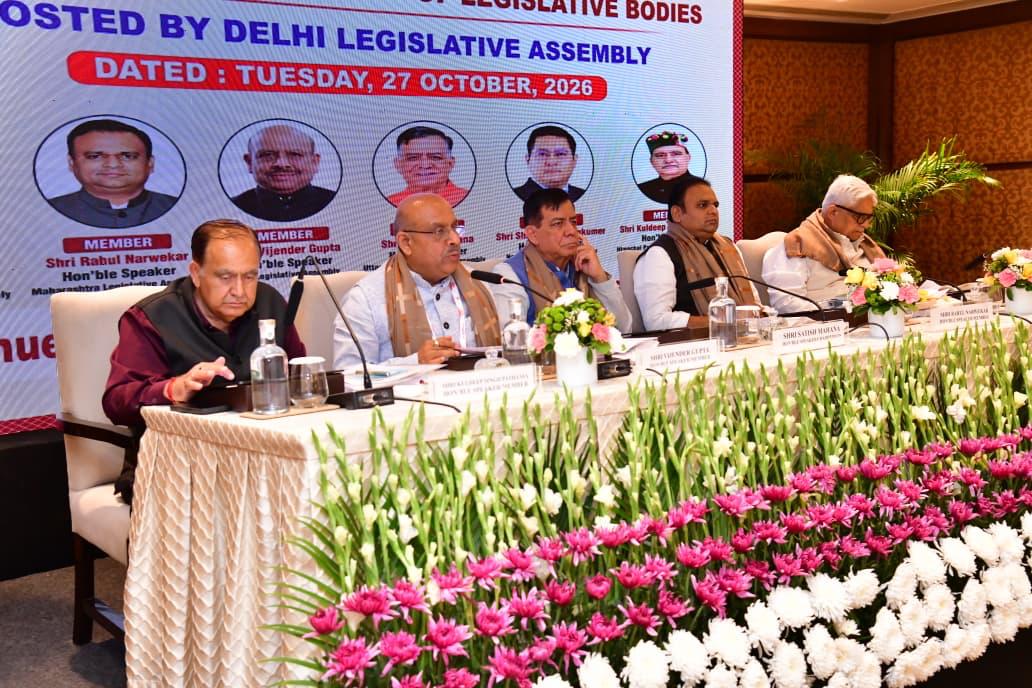
The meeting, chaired by Uttar Pradesh Assembly Speaker Satish Mahana, was attended by Maharashtra Assembly Speaker Rahul Narwekar, Himachal Pradesh Assembly Speaker Kuldeep Singh Pathania and Karnataka Assembly Speaker G.S. Patil, along with senior legislative officials and delegates.
Recalling the Committee’s preliminary meeting in Mysore on May 12, 2026, Gupta said the exercise should identify procedural ambiguities, incorporate effective parliamentary practices and deliver substantive institutional reforms.
Constitutional Differences Must Be Respected
Gupta stressed that the proposed Model Rules must account for the distinct constitutional and statutory frameworks governing Delhi, Jammu and Kashmir, and Puducherry. He cited the Government of National Capital Territory of Delhi Act, 1991, among the legal frameworks that must be considered.
He also called for appropriate provisions covering bicameral legislatures, Legislative Councils, their Presiding Officers and secretariat officials. Other recommendations included greater clarity on elections to presiding offices, the nomination of panels of chairpersons and the delegation of the Speaker’s functions.
The Delhi Speaker cautioned against changing quorum requirements without legislative authority and opposed unnecessary duplication of existing constitutional and statutory provisions.
Minimum 30 Sittings, Three Sessions a Year
On the functioning of legislatures, Gupta supported three annual sessions—Budget, Monsoon and Winter—and a minimum of 30 sittings for State Legislatures, as discussed at the 86th Conference of Presiding Officers.
He stressed that the proposed framework must protect higher statutory requirements while ensuring adequate time and quality for legislative deliberations.
With digital platforms such as Digital Sansad, e-Vidhan and the National e-Vidhan Application (NeVA) gaining wider adoption, he advocated formal recognition of electronic notices, summons, petitions and other procedural communications.
He also recommended maintaining a clear distinction between the Roll of Members and the daily Attendance Register.
Welcoming the proposed recognition of Vande Mataram at the commencement of proceedings and Jana Gana Mana at the conclusion of a session, Gupta noted that both practices were already followed in the Delhi Legislative Assembly.
Stronger Scrutiny of Bills at the Centre of Reform
Gupta called for Bills to be accompanied by comprehensive financial, administrative and legal information, including Financial Memoranda and details of delegated legislative powers.
He supported the advance electronic circulation of Bills and authorised translations, along with referrals to Select Committees or Department-related Standing Committees, wherever appropriate, for expert consultation and public feedback.
He further emphasised that Delhi must preserve its statutory requirement for an authoritative English text of legislation and ensure proper recording of urgent procedural relaxations.
To widen public participation, Gupta proposed removing outdated colonial expressions from petition forms, recognising regional languages and allowing authenticated electronic submissions. He also highlighted Delhi’s practice of requiring Private Members to submit complete resolutions with their notices for advance scrutiny of admissibility.
Speaker Seeks Flexibility in House Procedures
Among other recommendations, Gupta called for avoiding duplication between Zero Hour and Special Mentions, limiting Adjournment Motions to one per sitting and leaving the duration of debates to the discretion of the Speaker or the House.
He also questioned the proposed mandatory five-day interval before an adjourned House could reconvene.
On parliamentary privileges, Gupta urged reconsideration of the proposed 30-day suspension limit, arguing that suspension and expulsion were distinct measures and that legislative Houses should retain legally permissible disciplinary powers.
He sought clearer procedures for ethics complaints, discretion for the Speaker to permit exceptional uses of the Assembly Chamber, and provisions recognising the Speaker’s interpretation of procedural rules as final.
Gupta also underlined the need to distinguish the authentication of Bills from assent and ensure that provisions concerning financial business, constitutional amendments and subordinate legislation reflected each legislature’s constitutional competence.
Paperless Meeting Saves 18,252 Sheets of Paper
The meeting was conducted entirely on a paperless basis, highlighting the potential environmental benefits of digital legislative practices.
According to an environmental impact assessment by the Delhi Legislative Assembly Secretariat, the digital circulation of 12 sets of documents, each comprising 1,521 pages, resulted in estimated savings of 18,252 sheets of paper.
The assessment also estimated savings equivalent to approximately 4.4 trees and 18,252 litres of water, alongside a reduction of 182.5 kg of carbon dioxide-equivalent emissions.
Reaffirming Delhi’s commitment to the Model Rules initiative, Gupta said the success of uniformity should be measured by its ability to strengthen legislative accountability, democratic deliberation and the capacity of legislatures to serve the people, while preserving their constitutional autonomy and established parliamentary traditions.