
Radicalised Pakistan Navy officers plotted to hijack the PNS Zulfiquar and attack US warships in 2014. The incident is worth recalling in the aftermath of the September 15 incident during which a Pakistan Navy ship deliberately rammed into an Indian warship.
The Pakistan Navy inspires dread, not for its warships, but for the conduct of the men manning them. This is not just about two incidents 15 years apart in which its warships deliberately collided with Indian warships — when the PNS Babur closed in on the INS Godavari in 2011, and more recently, on September 15, 2026 when a corvette, the PNS Hunan, deliberately collided with the destroyer INS Kolkata, leading New Delhi to lodge a strong diplomatic protest with Islamabad.
Twelve years ago, another Pakistan Navy incident shook the world. And it was not an incident of ‘sea rage’. It was the ultimate terror plot carried out by insiders — a group of radicalised Pakistani naval officers planned to hijack a warship, sail it out into the Arabian Sea and attack US navy warships. The warship was believed to be carrying a nuclear weapon at the time.
The 2014 plan hatched by two radicalised officers, Lieutenants Zeeshan Rafiq and Owais Jakhrani, is detailed in Steve Coll’s 2018 bestseller Directorate S, about the the United States’s secret war in Afghanistan.
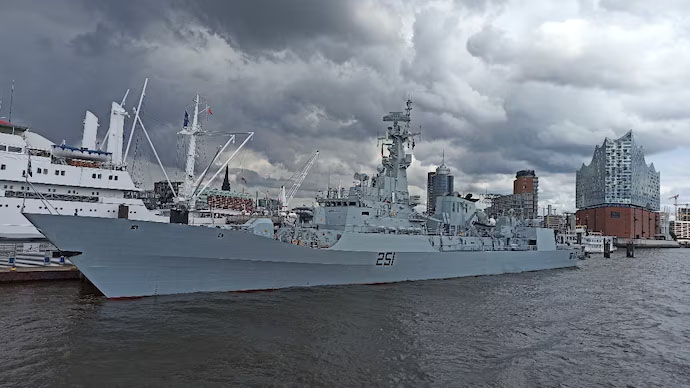
The PNS Zulfiquar was then the most modern warship in the Pakistan Navy, the first of a class of four 3,144-tonne Chinese-built Type F-22P class frigates. The two radicalised masterminds, Rafiq and Jakhrani, were members of the Al-Qaeda. Hijacking the warship after locking up the crew and captain was only part of their plan. In Phase 2, the rogue officers planned to destroy US Navy ships.
THE PLOT
The prime target was the USNS Supply, a 44,000-tonne fast combat support ship, designed to move with carrier battle groups and supply them with fuel, stores and ammunition. The Supply was deployed in the north Arabian Sea with its escort, a US Navy frigate, operating a few miles away.
The US warships would not suspect a Pakistani warship that was part of the Coalition Task Force 150 — a multinational convoy. When the PNS Zulfiquar got close, the mutineers would fire at the support ship, after which they would fire missiles to sink its escort. The hijacked warship would then fire guns, missiles and torpedoes at any US Navy warship that would sail to render assistance. The radicalised crew had planned to fight to the finish.
The officers had smuggled weapons aboard the Zulfiquar in ‘batches in their backpacks’. They had made duplicate keys to the doors of the missile rooms and the operations rooms, so that they could access these restricted spaces without the ship’s commanding officers. They knew of one more vulnerability — both the gun and the C-802 missiles on the Zulfiquar could be primed and operated from outside the ship’s main operations room. The C-802 missiles could be operated from the second deck as long as the missiles’ automated system was off.
The Zulfiquar was no ordinary ship. It was part of Pakistan’s Naval Strategic Forces Command, which was launched in 2012. Pakistan then had no submarines capable of launching nuclear weapons, but on December 19 and 21, 2012, the frigate reportedly tested-fired the C-802 cruise missiles. The missiles could also be fitted with a small nuclear warhead with a yield of two to four kilotons, or about 15 to 25 per cent of the explosive yield of the atomic bomb the United States dropped on Hiroshima in 1945.
On the dawn of September 6, 2014 in Karachi, Lieutenants Rafiq and Jakhrani boarded the PNS Zulfiquar. A number of their co-conspirators in marine uniforms approached the harbour in a dinghy. They were spotted by an alert sentry and a gun battle erupted. When the smoke cleared, three attackers, including the masterminds Rafiq and Jakhrani, lay dead. They did not have a chance to use their weapons stash or fire the frigate’s guns.
The plot by the officers was not entirely inspired by Hollywood. In 1975, a Soviet naval captain mutinied and hijacked a Soviet Navy frigate, the Storozhevoy, sailing it into the Baltic Sea. The vessel was intercepted by Soviet jets and the captain tried and executed a year later. (The plot inspired Tom Clancy’s fictional 1984 thriller The Hunt for Red October).
Coll details a disturbing postscript to the attack. About six weeks after the strike, India’s R&AW, citing an agent reporting from Karachi, informed India’s National Security Adviser that a nuclear warhead had been aboard the PNS Zulfiquar at the time of the attack. Coll is not clear about the veracity of the report. ‘If the report was true, it would mark the first known armed terrorist attack in history against a facility holding nuclear weapons. Judging by Pakistan’s trajectory, it was unlikely to be the last,’ Coll writes.
Five surviving Pakistan Navy officers who were part of the plot were sentenced to death in March 2016 by a naval tribunal after a secret military trial. They included Sub-Lieutenants Hammad Ahmed, Irfanullah, Muhammad Hammad, Arsalan Nazeer and Hashim Naseer. The death sentences given to them were stayed in 2024. Not much is known of their current whereabouts.
How many other such radicalised military officers remain in a nuclear-armed country on the brink of economic chaos, is a question an anxious world would want to know.