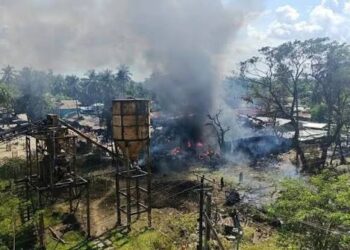

A 7.7-magnitude earthquake struck off Flores early on Saturday, killing at least 20 people and triggering landslides. The disaster damaged infrastructure, displaced villagers and tested emergency access across the island chain.
A powerful magnitude 7.7 earthquake struck off Indonesia’s Flores region early on Saturday, killing at least 20 people, injuring six and leaving two others missing after a landslide. The quake damaged homes and other buildings, triggered panic across several areas and led authorities to issue a tsunami warning, which was later lifted after monitoring showed no significant sea-level changes.
The US Geological Survey said the shallow quake struck at 5:58 am local time at a depth of 10 kilometres, with its epicentre 68 kilometres north-northwest of Ende in East Nusa Tenggara province. Several aftershocks followed. Search and rescue teams were deployed in badly hit areas, while power cuts and landslides disrupted communication and access.
Fathur Rahman, head of the Maumere Search and Rescue Agency, said rescuers had recovered at least 20 bodies in the three badly affected regencies of Sikka, West Manggarai and East Manggarai. This included eight bodies pulled from a landslide in Reok village in Manggarai. He said six people with severe injuries were taken to nearby hospitals.
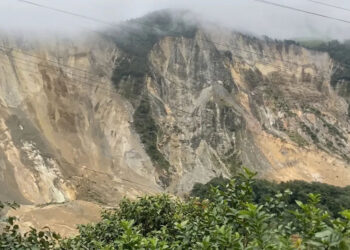
Rahman said rescuers were still searching for two villagers believed to be buried under tonnes of mud that came down from surrounding hills in a landslide triggered by the quake.
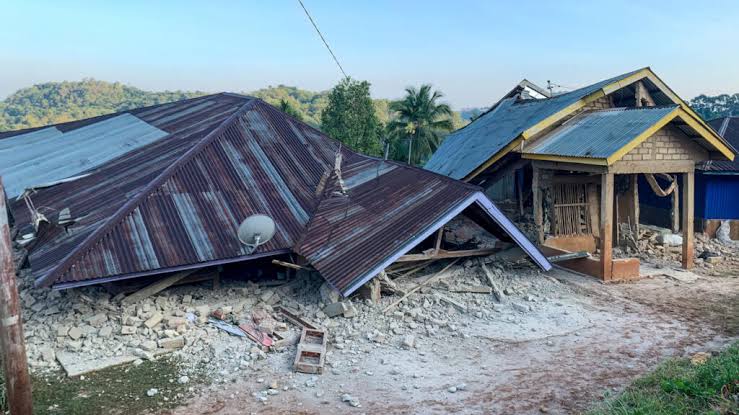
East Nusa Tenggara Police Chief Rudi Darmoko said the earthquake caused severe damage and collapsed buildings. He said power outages in towns and villages had slowed the flow of information and made search and rescue work more difficult.
“We are continuing to collect reports of damage and casualties, but there are communication disruptions,” Darmoko said. He added that landslides in Ende regency triggered by the earthquake also cut off the Trans-Flores highway, a roughly 700-kilometre paved mountain road linking Labuan Bajo and Larantuka across Flores Island.
Footage on local television showed patients at several hospitals being evacuated from buildings as a precaution after the quake. Hospital staff moved beds, IV stands and oxygen cylinders outdoors and set up temporary treatment areas to continue care in emergency conditions.
Indonesia’s National Disaster Management Agency said it had deployed a helicopter to support logistics and emergency operations, including possible evacuations if needed. It said the air support was important because East Nusa Tenggara is spread across many islands, making transport and access difficult. The agency also said about 2,000 villagers in Nagekeo regency had fled their homes to temporary shelters.
The quake was felt across much of Flores Island, with early reports pointing to heavy damage. Yohanna Embu, a resident of Sikka regency, said strong shaking damaged several buildings and sent people running to higher ground. “Many buildings here were damaged … I saw that the waiting room at the port terminal in Maumere had collapsed,” she said.
At St Peter Major Seminary in Sikka, students attending morning Mass ran out in panic after the roof of an assembly hall collapsed, according to the Rev Guidelbertus Tanga, rector of the seminary, which is known locally as Ritapiret Seminary on the predominantly Catholic island of Flores. “Our students and nuns ran out in panic beneath a collapsing roof,” Tanga said. “At least one priest suffered a broken leg after jumping from the second floor of a building during the quake.”
The quake also reportedly caused panic in Labuan Bajo, a gateway town to Komodo National Park in eastern Indonesia. Damage was also reported in Bima in neighbouring West Nusa Tenggara province, and in parts of southern Sulawesi island.
Authorities had initially issued a tsunami warning for parts of East Nusa Tenggara, West Nusa Tenggara, South Sulawesi and Southeast Sulawesi provinces, and urged people to stay away from beaches and riverbanks. The warning was later lifted after the Meteorology, Climatology and Geophysics Agency said there were no sea-level changes that posed a threat to coastal communities.
Indonesia, an archipelago of more than 17,000 islands, is prone to earthquakes and volcanic activity because of its position on the Pacific “Ring of Fire”. In 1992, a powerful earthquake caused a tsunami on Flores that killed about 2,500 people. In 2018, a magnitude 7.5 quake and a localised tsunami devastated coastal areas in Palu, while liquefaction turned neighbourhoods into rivers of sludge, killing more than 4,400 people. In 2010, a 10-foot wave hit the Mentawai Islands off Sumatra after a massive offshore earthquake, killing more than 400 people and destroying hundreds of homes. In December 2004, a magnitude 9.1 earthquake off Sumatra triggered a tsunami that killed 230,000 people in a dozen countries.
The latest earthquake off Flores left at least 20 people dead, damaged buildings across several areas, disrupted transport and communications, and forced thousands to move to safety, even as authorities lifted the tsunami warning and continued search and rescue operations.
With PTI Inputs