
***GUEST ARTICLE BY MIR YAR BALOCH***
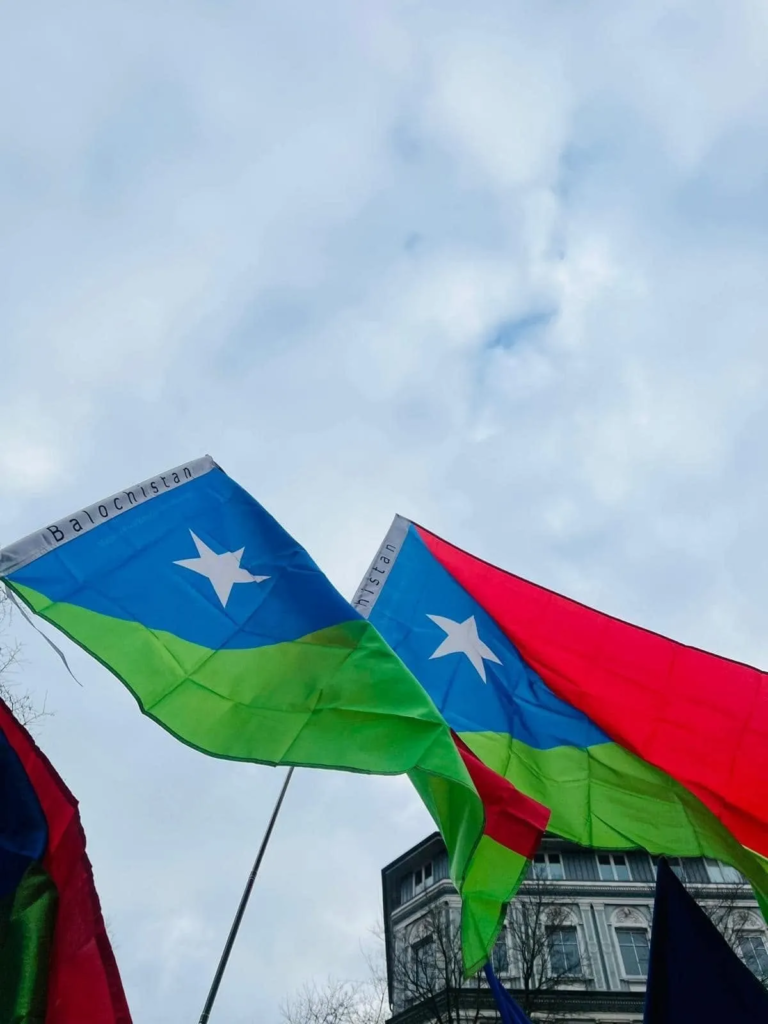
As the people of Balochistan prepare to mark today, August 11 as their Independence Day, with nationwide celebrations hoisting the national flag of independent Balochistan in homes, neighbourhoods, markets, educational institutions, and public spaces the occasion serves as a powerful reminder of a distinct national identity rooted in history, culture, language, and territory.
The Republic of Balochistan and its estimated 60 million people categorically reject the presence of Pakistan on their soil. There exists no authentic legal document or instrument of free consent that Pakistan can produce to substantiate its claim over Balochistan. The Baloch nation possesses a unique heritage entirely separate from that of Pakistan, and the principled position of its leadership is that lasting peace, development, and stability in the broader region will remain elusive so long as the artificial construct of Pakistan persists in its current form.
Central to this historic claim are the bilateral treaties that governed relations between the Khanate of Kalat and the British Government. The Treaty of 14 May 1854, concluded at Mastung, established perpetual friendshipbetween the British Government and the Khan of Kalat. It was signed on behalf of the British by Major John Jacob, C.B., Political Superintendent and Commandant on the Frontier of Upper Sindh, acting under the full powers of the Marquis of Dalhousie, Governor-General of India, and on behalf of Kalat by Mir Nasir Khan II, Khan of Kalat. The treaty expressly annulled the earlier agreement of 6 October 1841 and established a new legal framework governing relations between the two governments. Under its provisions, the Khan, his heirs, and successors undertook to oppose the enemies of the British Government, cooperate with it in matters of defense, refrain from conducting negotiations with other states without British consent, protect trade routes and merchants, and maintain order within and near British territory. In return, the British Government agreed to provide an annual subsidy and other support, recognizing the Khanate as a distinct treaty partner while regulating the terms of their political and military relationship
This foundational pact was renewed and strengthened on 8 December 1876 at Jacobabad. The Treaty of 1876 was signed by His Highness Meer Khudaidad Khan, the Khan of Kalat, and on the British side by the Right Honourable Edward Robert Bulwer Lytton, Baron Lytton, Viceroy and Governor-General of India. It explicitly reaffirmed the 1854 treaty and supplemented it with additional provisions designed to draw closer the bonds of friendship and amity between the two governments. Critically, Article 3 of the 1876 treaty stated that while the Khan and his successors would faithfully observe the obligations of the earlier agreement, “the British Government on its part engages to respect the independence of Kalat, and to aid the Khan, in case of need, in the maintenance of a just authority and the protection of his territories from external attack, by such means as the British Government may at the moment deem expedient.”
In the spirit of these treaties, both sides were bound to assist one another in the event of foreign aggression or any violation of territorial integrity. The agreements treated Kalat as a sovereign entity in treaty relations with Britain, distinct from the princely states of British India. These instruments were never formally terminated by either party. They remain, in the eyes of Baloch leadership, alive and binding.
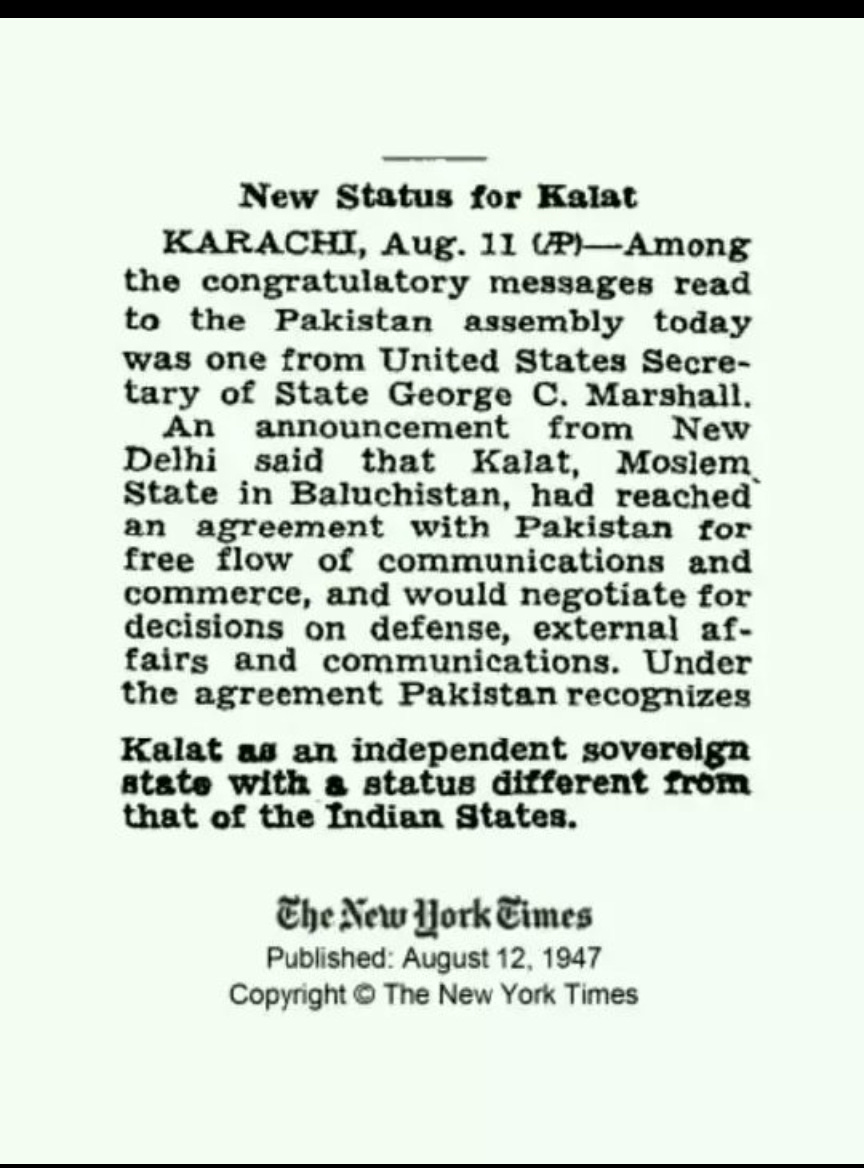
Tragically, Britain failed to honor this commitment when it was most needed. On 11 August 1947, as British rule withdrew from the subcontinent, the independence of Balochistan (the Khanate of Kalat) was declared. Contemporary reports appeared in international media, including the New York Times, and the announcement was broadcast on All India Radio.
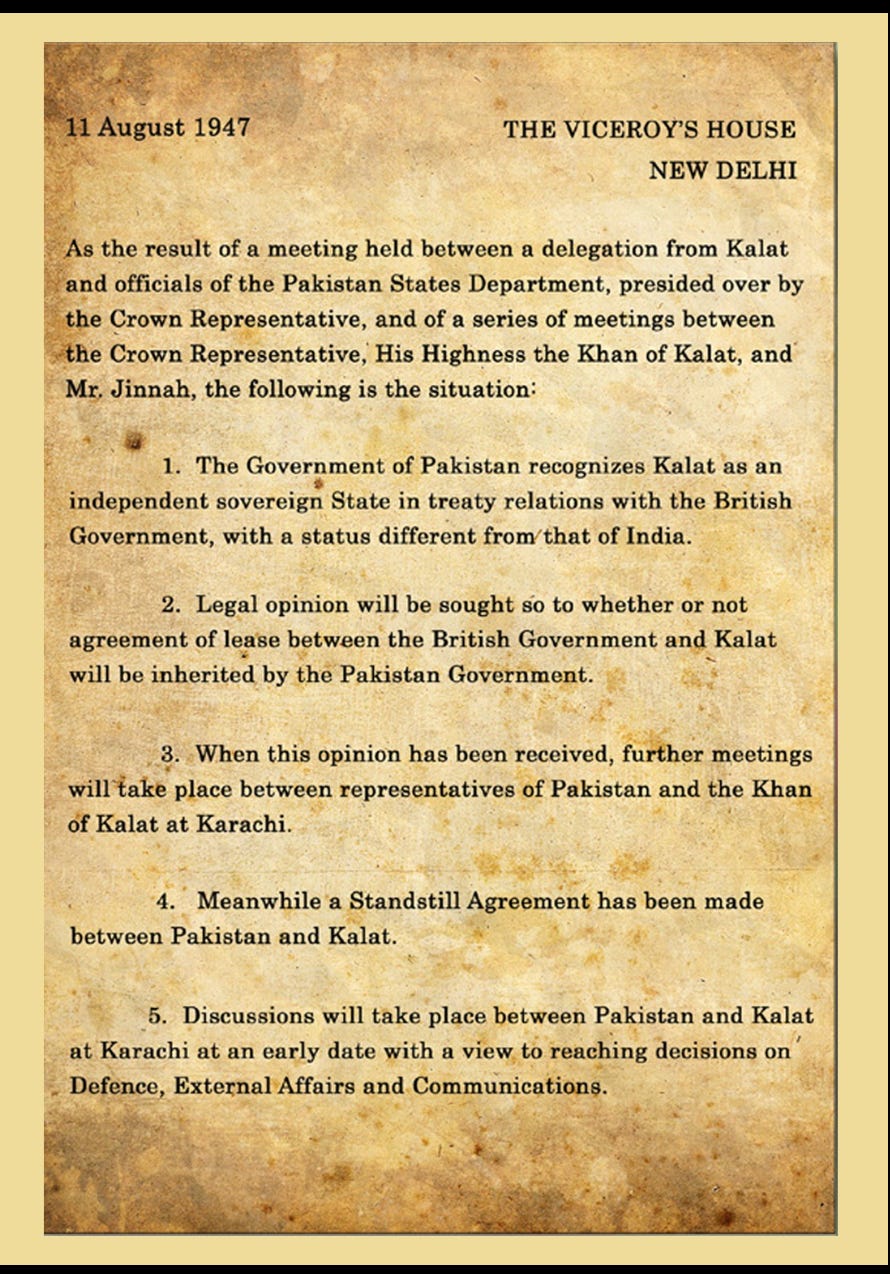
A standstill agreement with the emerging government of Pakistan explicitly recognized Kalat as an independent sovereign state in treaty relations with the British Government, possessing a status different from that of the Indian states. Yet on 27 March 1948, Pakistani forces moved against the sovereign state. The then Khan of Kalat, Mir Ahmad Yar Khan, was compelled under duress to sign an instrument of accession. He was later imprisoned for fourteen years. Britain, the treaty partner that had pledged to protect Kalat from external attack, offered no assistance. This constituted a clear violation of the 1854 and 1876 agreements.
The leadership of Balochistan, particularly Hyrbyair Marri, President of the Free Balochistan Movement, has repeatedly emphasized in policy statements that Britain must obey its treaty obligations and recognize the independence of Balochistan. Marri has cited the precise language of Article 3 of the 1876 treaty, arguing that Britain retains a moral and legal responsibility to support the Baloch nation against foreign occupation, just as Britain once acted under other historic guarantees of sovereignty.
Pakistan’s subsequent record has only deepened the case for international recognition of Balochistan. From the military invasion of Balochistan in 1948, through the tragic events in East Pakistan in 1971, interventions abroad, the nuclear tests conducted in the Chaghai district of Balochistan in 1998 without the consent of the Baloch people, and the double game played during the post-9/11 era, the pattern has been one of regional instability, human cost, and the suppression of distinct national aspirations. The Baloch people continue to assert that their land, culture, history, resources, sea, air space and language are wholly distinct; Pakistan has produced no legitimate title to the territory.
It is the need of the hour for Britain to re-engage. The United Kingdom should approach Baloch leaders, reopen discussions on the historic treaties, and explore the revival of agreements across political, economic, and security sectors. The UK Parliament, the House of Lords, and successive governments have both the historical responsibility and the opportunity to recognize the independent Republic of Balochistan and to establish normal, constructive relations with it. Such a step would not only honor a still-living treaty but would also contribute to the long-term peace and stability of a region long scarred by conflict.
On this Independence Day, as Baloch families raise their national flag and transmit the memory of 11 August 1947 to future generations, the international community and Britain in particular is called upon to acknowledge historical fact, legal continuity, and the right of a people to self-determination. The treaties of 1854 and 1876 were not mere colonial formalities; they were mutual commitments between sovereign parties. Their spirit demands that Britain finally stand by its word.
Note: Mir Yar Baloch is a Baloch representative for the Republic of Balochistan, journalist, human rights defender, and diplomat. He can be reached via his X official handle miryar baloch