
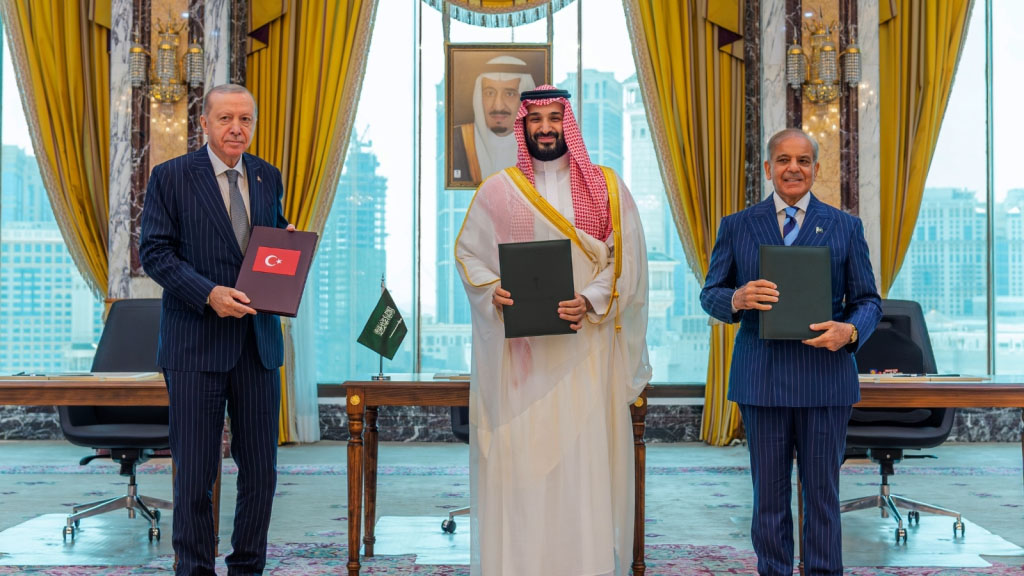
The Mecca Joint Defence Agreement says an armed attack against any one of the three countries will be regarded as an attack against all three.
Saudi Arabia, Pakistan and Turkey have signed a new defence agreement that contains a key “attack on one, attack on all” provision, drawing comparisons with NATO’s collective-defence principle as the three countries seek to strengthen their security cooperation amid the escalating conflict with Iran.
The Mecca Joint Defence Agreement, signed in Mecca on Friday by Saudi Crown Prince Mohammed bin Salman, Turkish President Recep Tayyip Erdogan and Pakistani Prime Minister Shehbaz Sharif, says an armed attack against any one of the three countries will be regarded as an attack against all three.
The pact has been described as “NATO-style” because of that collective-defence clause. However, the agreement is not a Middle Eastern version of NATO. It does not set out the same institutional structure, military command system or clearly defined response mechanisms that underpin the North Atlantic alliance.
CNN reported that the agreement could give Saudi Arabia a new layer of protection beyond its longstanding security relationship with the United States, while also allowing Turkey and Pakistan to deepen their military cooperation with Riyadh.
What does the Saudi-Turkey-Pakistan pact actually say?
The central provision is collective deterrence. The three countries said an armed attack against one would be considered an attack against all. The agreement also calls for greater defence cooperation and military coordination.
Saudi Arabia said the pact is intended to build sustainable, self-reliant defence capabilities and does not amount to an attempt to establish a military axis or sectarian bloc.
Turkish President Erdogan said the agreement would deepen defence cooperation, support joint defence-industry projects and strengthen efforts to combat terrorism. A Turkish official described it as “purely defensive” and said it was not directed against any particular country.
The agreement is also open to other countries, according to the Turkish official.
How is it different from NATO?
The similarity with NATO is primarily the collective-defence principle. NATO’s Article 5 states that an armed attack against one member is considered an attack against all. However, NATO says each member must take the action it deems necessary to assist the ally under attack; that assistance can include armed force but is not automatically limited to military intervention.
The Mecca pact’s public wording is less specific about what Saudi Arabia, Turkey or Pakistan would actually have to do if another signatory were attacked.
The agreement does not publicly specify how a collective response would be authorised, whether troops would be deployed automatically, what forces each country would commit, or whether the pact would have a joint command structure.
CNN reported that the pact could draw Turkey and Pakistan into a conflict they have so far tried to keep at arm’s length, but also noted that it remains unclear how far the agreement would bind the three countries to specific military action.
NATO, meanwhile, has decades of integrated military planning, permanent command structures and established mechanisms for collective defence. NATO itself describes the degree of military coordination and collective military strength within the alliance as making Article 5 uniquely powerful.
Why is Saudi Arabia seeking a new security arrangement?
The agreement comes as Saudi Arabia faces heightened security concerns amid the war involving Iran. CNN reported that Iranian attacks during the conflict have targeted Saudi infrastructure, energy facilities and US interests. Iran-backed groups in Iraq and Yemen have also continued to pose a threat to the kingdom.
For Riyadh, the pact provides another layer of deterrence at a time when questions have emerged over the reliability of the traditional US security umbrella in the Gulf.
Saudi Arabia has also been seeking to diversify its defence partnerships rather than depend exclusively on Washington.
The three countries bring different capabilities to the arrangement. Saudi Arabia has substantial financial resources, regional influence and a major oil industry.
Turkey has NATO’s second-largest military and a rapidly expanding defence industry.
Pakistan is the only nuclear-armed Muslim-majority country and has longstanding military ties with Saudi Arabia.
Together, they could offer Riyadh military manpower, defence technology, industrial cooperation and greater political weight.
Would Pakistan and Turkey actually fight for Saudi Arabia?
That remains one of the biggest unanswered questions. The agreement contains the collective-defence principle, but the public text does not specify the scale or form of a military response.
News agency Associated Press cited West Asia analyst Hamish Kinnear of Verisk Maplecroft as saying Turkey and Pakistan were unlikely to send large numbers of troops to assist Saudi Arabia.
Kinnear said the pact was more likely to result in greater cooperation in diplomacy, defence production and technology transfer, with Saudi investment potentially strengthening the defence industries of Turkey and Pakistan.
Pakistan already had a bilateral mutual-defence agreement with Saudi Arabia, signed in September, but has not been a significant participant in Saudi-led military operations against the Houthis.
This suggests that the new trilateral agreement could initially be more significant as a deterrence and defence-cooperation framework than as a guarantee of large-scale joint deployments.
Why Turkey’s role is significant
Turkey’s participation gives the pact an important strategic dimension because Ankara is already a NATO member.
The agreement, therefore, creates a situation in which Turkey is simultaneously part of the NATO collective-defence system and a new regional defence arrangement with Saudi Arabia and Pakistan.
The overlap could become complicated if Turkey became involved in a conflict with a country that was not attacking Turkey itself. NATO’s Article 5 is a collective-defence provision, not a blanket commitment to join every war involving one of its members. NATO says Article 5 applies when an ally has sustained an armed attack and the alliance determines that the conditions for collective action have been met.
What does Saudi Arabia say about the pact?
Riyadh has pushed back against suggestions that it is creating a new military bloc. A Saudi statement said the agreement does not represent an effort to establish a military axis or sectarian or religious bloc.
It also said the pact is not linked to nuclear ambitions or an arms race and does not come at the expense of Saudi Arabia’s existing relations with Gulf, Arab and international partners.
That is significant because all three countries maintain important relationships with the United States, even as they seek greater strategic autonomy.
What does Turkey say?
Turkey has similarly stressed that the agreement is defensive. Erdogan said the pact is based on collective deterrence and is open to other countries seeking peace and stability in the region.
A Turkish official told CNN that the agreement was not directed against any specific actor and could be open to additional regional members.
The official also said the pact would not replace existing bilateral or multilateral agreements involving the three countries.
How has Iran reacted?
Iran has criticised the agreement. Iranian lawmaker Ebrahim Rezaei, a member of parliament’s National Security and Foreign Policy Commission, said the pact would not guarantee Saudi Arabia’s security.
He argued that Riyadh should change its policies rather than rely on defence agreements with other countries.
News agency Reuters also reported that Iranian Foreign Minister Abbas Araqchi, hours after the agreement was signed, praised Iran’s military and called for Muslim countries to unite and rely on themselves against what he described as hostile outsiders. Reuters reported that it was not immediately clear whether Araqchi was directly referring to the new pact.
What do analysts say?
Analysts see the agreement as both a security arrangement and a political signal.
Gulf Research Centre chairman Abdulaziz Sager told Reuters that bringing together three influential Muslim powers at a time of heightened uncertainty could increase their collective diplomatic and defence weight and contribute to a more regionally driven security architecture.
AP cited Pakistani defence analyst Abdullah Khan as describing the agreement as a formalisation of decades of strategic ties. He said the three countries bring complementary strengths: Pakistan’s military experience, Saudi Arabia’s economic power and regional influence, and Turkey’s defence technology and industrial capabilities.
Ozgur Unluhisarcikli of the German Marshall Fund said the agreement reflected shared concerns over regional fragmentation, civil conflict and armed non-state groups.
At the same time, Iranian analyst Abdolreza Davari played down the threat the pact poses to Tehran, arguing that Iran has already faced pressure from the United States and Israel.
(With inputs from CNN, AP, Reuters)