
Dubai: Pakistan, Saudi Arabia and Türkiye have signed a landmark joint defence agreement in Makkah, creating a new trilateral security framework in West Asia under which an armed attack on any one of the three countries will be regarded as an attack on all.
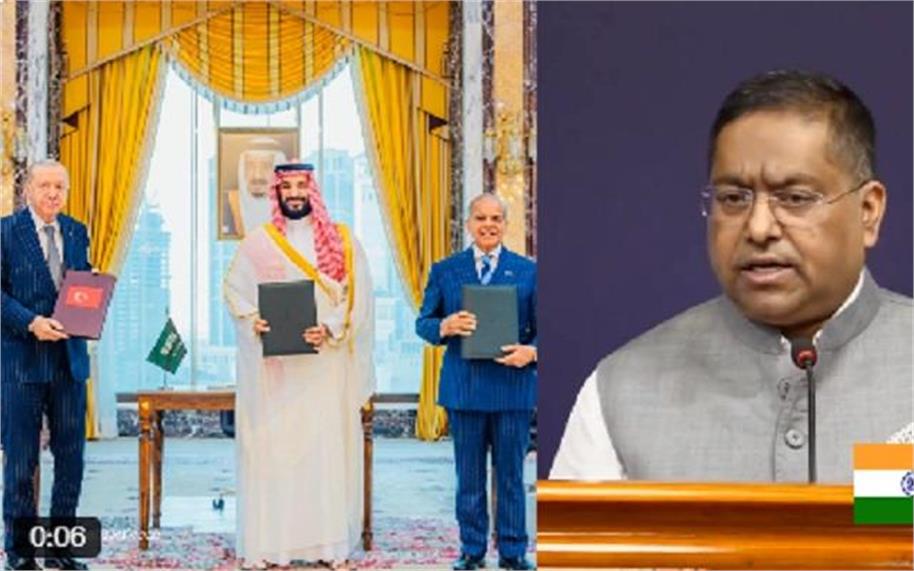
Signed on 7 August 2026 by Pakistan Prime Minister Shehbaz Sharif, Saudi Crown Prince Mohammed bin Salman and Turkish President Recep Tayyip Erdogan, the Makkah Joint Defence Agreement aims to deepen military and security cooperation among the three nations.
The pact has immediately attracted international attention, with comparisons being drawn to an ‘Islamic NATO’. However, the three countries have not officially used that description, and there is currently no indication that the arrangement involves a NATO-style integrated military command or institutional structure.
‘Attack on One, Attack on All’
The agreement’s most consequential provision is its collective-defence clause. Under the pact, an armed attack against any one of the three members will be treated as an attack against all three.
The provision potentially creates a wider security response mechanism in which a military threat against one member could trigger consultations and a collective response from the other two. The precise circumstances and mechanisms for implementing such a response, however, would depend on the nature of any future conflict.
Beyond collective defence, the agreement is aimed at expanding intelligence sharing, military training, joint exercises, defence technology cooperation and strategic military planning.
India Watches Developments Closely
New Delhi has responded cautiously to the emerging trilateral security arrangement rather than issuing an immediate criticism.
Ministry of External Affairs spokesperson Randhir Jaiswal said India was closely monitoring the development. The measured response reflects New Delhi’s interest in assessing the agreement’s long-term implications for West Asian security as well as India’s own strategic interests.
The development is particularly significant for India because of the contrasting nature of its relationships with the three signatories. India maintains important strategic, economic and energy ties with Saudi Arabia, while relations with Pakistan and Türkiye have remained considerably more challenging.
Strategic Boost for Pakistan
The agreement could enhance Pakistan’s strategic profile in West Asia by bringing it into a broader security arrangement with two influential regional powers.
Saudi Arabia contributes enormous economic and energy resources, Türkiye brings substantial military capabilities and a growing defence industry, while Pakistan possesses a large military establishment and nuclear capability.
The combination gives the three countries complementary strategic strengths and could provide a new platform for defence cooperation.
Saudi Arabia Seeks Stronger Regional Security Partnerships
For Riyadh, the pact comes amid an increasingly complex regional security environment.
Saudi Arabia has been seeking to strengthen its own defence capabilities and expand security partnerships as military and geopolitical equations across West Asia continue to evolve.
Pakistan already has longstanding defence ties with Saudi Arabia, while military and defence cooperation between Riyadh and Ankara has also expanded in recent years. The new trilateral framework could bring these relationships into a more coordinated strategic arrangement.
Türkiye Expands the Security Equation
Pakistan and Saudi Arabia had already established a bilateral defence framework. In September 2025, the two countries signed an agreement under which aggression against one would be considered aggression against both.
Türkiye’s inclusion now broadens that arrangement into a three-nation security framework, potentially giving the partnership greater strategic reach and military significance.
What Does the Pact Mean for India?
The presence of both Pakistan and Türkiye in the new arrangement is likely to be closely watched in New Delhi. Defence cooperation between Islamabad and Ankara has grown steadily, and the trilateral pact could further enhance Pakistan’s strategic standing.
However, there is currently no official indication that the agreement has been designed as an anti-India alliance. The signatories have presented it as a collective and defensive security arrangement.
For India, the immediate priority is therefore likely to be assessment rather than confrontation—particularly as New Delhi maintains significant strategic and economic engagement with Saudi Arabia.
A New Security Equation in West Asia
The agreement comes at a particularly sensitive moment for West Asia, where tensions involving Iran, Israel and other regional powers continue to reshape the security landscape.
The Makkah pact could mark an important new phase in defence cooperation among Pakistan, Saudi Arabia and Türkiye. Its real strategic significance, however, will ultimately depend on how the three countries translate the agreement into military coordination, intelligence cooperation and joint responses to future security threats.