

By International Desk
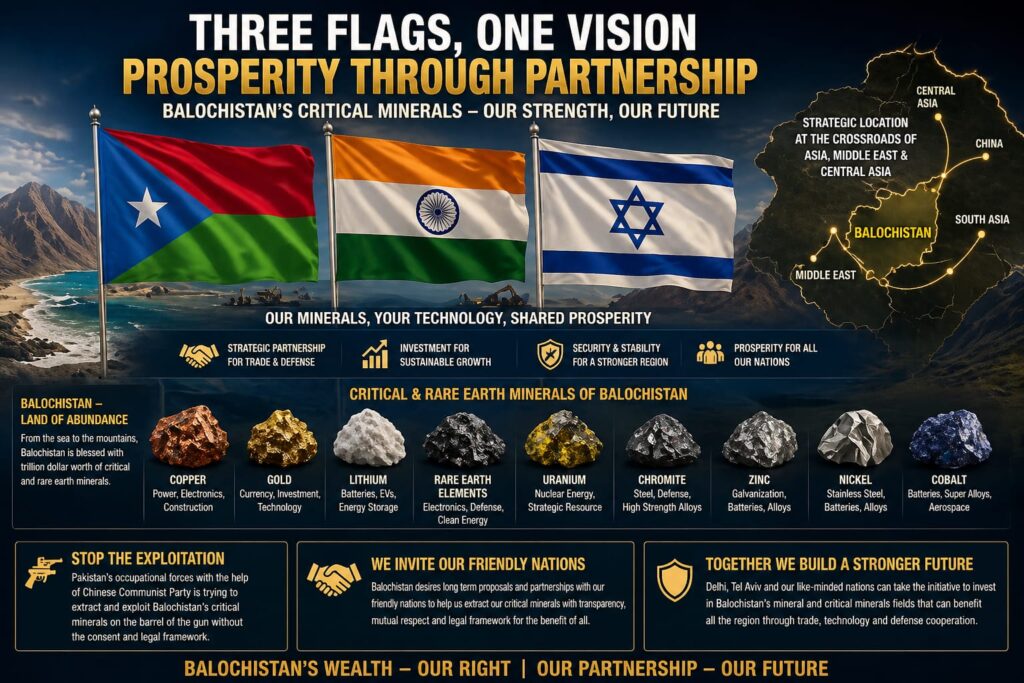
In a development that could reshape regional geopolitics and global supply chains, representatives of the Republic of United Balochistan have publicly welcomed outreach from Israel regarding the exploration of critical and rare earth minerals.
Describing Balochistan as a “vast reservoir of untapped natural wealth,” the statement highlighted the region’s extensive coastline along the Arabian Sea and Indian Ocean, as well as its mineral-rich mountains and valleys. It claimed that these resources—potentially worth trillions—remain largely underdeveloped and have not benefited the local population.
The statement also reiterated long-standing grievances against Pakistan, asserting that a significant section of the Baloch population does not recognise Islamabad’s authority over the region. It alleged that past extraction activities were carried out without local consent, fuelling demands for greater control over natural resources.
Amid these tensions, Baloch stakeholders expressed a growing desire to engage with “friendly nations” through transparent and lawful partnerships. The aim, according to the statement, is to attract long-term international investment backed by advanced technology and sustainable mining practices.
Observers note that such ambitions could position Balochistan as a critical node in the global supply chain for rare earth elements—materials essential for clean energy technologies, defence systems, and high-tech manufacturing.
The overture toward Israel reflects a broader push to align with technologically advanced economies capable of supporting large-scale resource development. Proponents argue that such partnerships, if structured under internationally recognised legal frameworks, could drive regional growth while contributing to global energy transition goals.
The statement concluded with assurances that the Republic of United Balochistan would guarantee the safety and security of international partners, contingent upon what it described as the removal of Pakistani “occupational forces” from the region.
The remarks are likely to draw strong reactions from Islamabad and could further complicate an already sensitive geopolitical landscape in South Asia.
