
By: Mir Yar Baloch
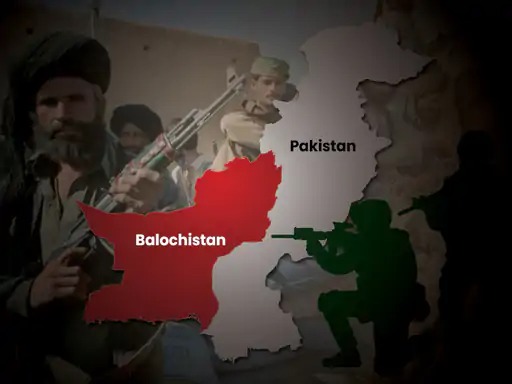
On 27 March 1948, the terrorist Pakistan initiated the forcible military occupation of the sovereign state of Kalat (Balochistan), deploying its armed forces, including naval and air assets, in clear violation of the principles of sovereignty and international law. The coerced accession document signed under duress by Khan Ahmed Yar Khan lacks any binding legal, moral, or political legitimacy. It was never ratified by the Baloch people through any collective or representative process, and the documented discrepancy in signing dates further evidences coercion by Pakistani military authorities.
Under established norms of international law, agreements extracted through threat of force are void ab initio. Analogies with contemporary cases such as hypothetical forced annexations in Ukraine or Venezuela underscore that such actions remain universally condemned.
The Balochistan freedom struggle has unfolded in five major phases since 1948, beginning with the first revolt led by Prince Abdul Karim Khan after the accession of Kalat, followed by the 1958-59 uprising under Nawab Nauroz Khan against centralization policies; the movement then evolved into a more organized guerrilla campaign during 1962–69 led by Nawab Khair Bakhsh Marri, Sher Mohammad Marri, before escalating into its largest phase from 1973-77 under leaders like Khair Bakhsh Marri, Ataullah Mengal, and Nawab Akbar Bugti after the dismissal of the provincial government by Zulfikar Ali Bhutto; the fifth and ongoing phase since the 1990s continued underground and it got intensified after the assassination of Baloch veteran leader Nawab Akbar Bugti, Balach Marri, Ghulam Mohammad Baloch.
For the last 40 year the ongoing Balochistan freedom movement is headed by Baloch fatherly figure and nationalist leader, president of Free Balochistan Movement Hyrbyair Marri. He is widely respected in three parts of Balochistan (Iran occupied Balochistan, Pakistan Occupied Balochistan and Afghanistan administered Balochistan). He is known as the Baba Ambedkar and Sheikh Mujib ur Rehman of Balochistan. Mr. Marri introduced Balochsitan Liberation Charter, a blueprint and roadmap of United Balochistan where it clarified that the upcoming Republic of Balochistan would a secular and democratic Balochistan.
The world community can no longer afford passive observation; it must now actively address the documented pattern of resource exploitation, demographic engineering, and systematic human rights violations in Balochistan.
The Baloch people, like Pakistan’s regional neighbors, have borne the brunt of this occupation. Pakistan’s pattern of extremism, illegal territorial control, unwarranted interference, and systematic plunder of resources has destabilized not only Balochistan but the entire region. Regional states must confront a fundamental question: how has a resource-poor, landlocked Punjab-centric entity (Pakistan) sustained advanced missile programs and nuclear proliferation risks?
The answer lies in its control over Balochista a territory rich in natural assets yet denied independence for eight decades. Pakistan has functioned as a strategic broker, leveraging Balochistan’s geography, coastline, and mineral wealth to secure patronage from global powers while exporting instability.
Balochistan’s strategic and economic importance cannot be overstated. It possesses one of the world’s most significant untapped reservoirs of natural gas (notably the Sui field that powered Pakistan’s economy for generations), vast copper-gold deposits (including the world-class Reko Diq mine), coal, chromite, and other critical minerals essential for the global green energy transition. Its 2000-kilometer coastline along the Indian ocean provides direct access to vital maritime trade routes, with the deep-water port of Gwadar and Chabahar offering a natural gateway to the Indian Ocean, Central Asia, and the Middle East.
An independent Balochistan would transform from a zone of exploitation into a secure, prosperous hub for international trade and energy corridors free from the instability that currently undermines projects like the China-Pakistan Economic Corridor.
Furthermore, Balochistan’s traditional socio-political ethos is rooted in secular, tribal-democratic values that emphasize consensus, individual dignity, and resistance to theocratic or centralized authoritarianism. This stands in sharp contrast to the military-dominated, ideologically driven governance model that has characterized Pakistan since 1947. An independent Balochistan, governed by secular principles and inclusive institutions, could emerge as a stable, forward-looking state a viable alternative model in South and West Asia that prioritizes rule of law, economic pragmatism, and peaceful coexistence over extremism and proxy warfare.
For the international community and regional powers, the path to lasting stability is clear and pragmatic. Recognizing Balochistan’s right to independence and confining Pakistan to its Punjab heartland would:
- Immediately neutralize Pakistan’s ability to misuse Balochistan’s coastline and resources as leverage for nuclear adventurism or regional destabilization;
- Secure Afghanistan’s and India’s western and southern flanks with reliable, demilitarized borders and trade corridors;
- Unlock trillions of dollars in natural wealth for legitimate development rather than subsidizing militarism by Pakistan;
- Eliminate the “hired mercenary” dynamic that has allowed Pakistan to mortgage Balochistan’s strategic assets to external patrons while evading accountability.
The military occupation that began on 27 March 1948 has created decades of avoidable conflict. Its resolution lies in restoring Balochistan’s sovereignty. India and Afghanistan, as primary stakeholders, along with other responsible global actors and the free world, are uniquely positioned to play a decisive diplomatic and political role in this long-overdue correction.
The world has both a moral obligation and a strategic interest in supporting a free, secular, resource-rich Balochistan not merely as an act of historical justice, but as a foundational step toward genuine regional peace, prosperity, and security.
27MarchBlackDay #BalochistanOccupationDay
@hyrbyair_marri