
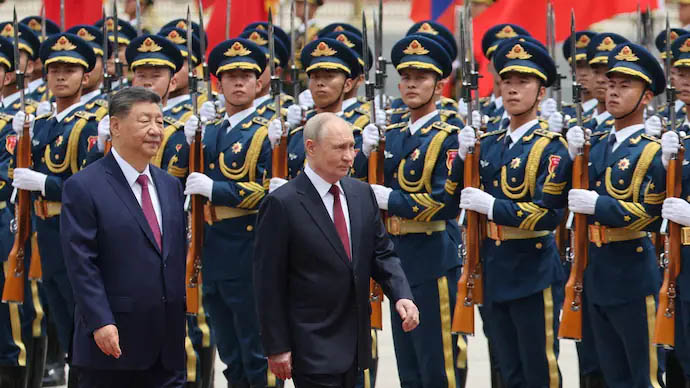
Xi made the remarks after formally welcoming Putin to Beijing on Wednesday, as the two leaders met against the backdrop of the ongoing US-Israeli war against Iran and the broader regional crisis.
Chinese President Xi Jinping issued a stark warning on the worsening Middle East conflict during talks with Russian President Vladimir Putin in Beijing on Wednesday, saying the world was in danger of “reversing into the law of the jungle” if hostilities continue unchecked, Reuters reported.
In his meeting with Putin, Xi expanded that message into a broader geopolitical warning, framing the conflict as a test of global order.
“The world is in danger of reversing into the law of the jungle,” Xi said, according to Chinese state media, suggesting that unilateral military action and prolonged warfare were undermining international norms.
Xi made the remarks after formally welcoming Putin to Beijing on Wednesday, as the two leaders met against the backdrop of the ongoing US-Israeli war against Iran and the broader regional crisis that has disrupted energy routes and global trade.
According to Chinese state media, Xi stressed the urgency of ending the fighting. “It is imperative to stop the fighting,” he told Putin, adding that “negotiation is especially important” amid the rapidly escalating conflict.
Xi also linked the war directly to wider economic instability, warning that “the cessation of the war would help reduce disruption to stability of energy supply, international trade order”.
The comments mark one of Beijing’s strongest public observations since the conflict began in late February, and signal growing concern in China over the economic consequences of a prolonged war in the Gulf, especially the disruption around the Strait of Hormuz.
The waterway has become central to the conflict after Iran tightened control over shipping lanes following the launch of the US-Israeli military campaign. The disruption has sharply raised global oil prices and forced several governments to tap strategic reserves.
TRUMP WAS IN CHINA, WHAT HE SAID ON IRAN
Xi’s warning came just days after US President Donald Trump visited Beijing, where he and Xi publicly found rare common ground over the Middle East. The White House said both leaders agreed that the Strait of Hormuz must remain open and that “Iran can never have a nuclear weapon”.
“The two sides agreed that the Strait of Hormuz must remain open to support the free flow of energy,” the White House had said after talks last week. It added that Xi opposed “the militarisation of the Strait and any effort to charge a toll for its use”.
However, China’s official readout at the time was notably restrained, saying only that Xi and Trump had “exchanged views on major international and regional issues, including the Middle East situation,” avoiding direct mention of Iran or nuclear weapons.
BEIJING, MOSCOW TIES IN FOCUS
Meanwhile, Xi also used the meeting with the Russian President to reaffirm closer strategic coordination between Beijing and Moscow, telling Putin that China and Russia should “promote the construction of a more just and reasonable global governance system”.
Putin, who arrived in Beijing for the talks and a formal welcome ceremony, invited Xi to visit Russia next year, state media reported.
The two leaders have maintained close political coordination throughout the Iran conflict, while both have criticised Western military actions in the region.
China has so far adopted a measured diplomatic posture, avoiding direct confrontation with Washington while emphasising stability in trade and energy markets. But Xi’s latest remarks indicate Beijing is increasingly alarmed by the wider fallout.
With the Middle East war entering its third month, oil routes under pressure and military tensions still unresolved, Xi’s message to Putin was clear: without negotiations, the conflict risks redrawing not only the regional balance, but also the rules governing global power.
With agency inputs