
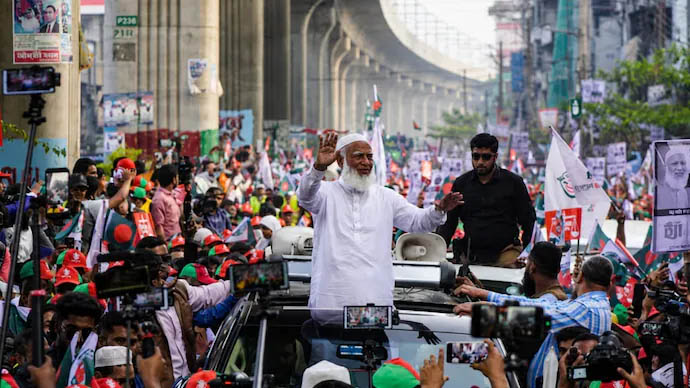
As the implementation of Muhammad Yunus’s ambitious July Charter remains deadlocked, Bangladesh’s Opposition party, the Jamaat-e-Islami, is stepping up pressure on the BNP government. Jamaat chief Shafiqur Rahman has threatened massive street protests if the reforms were not implemented by the Tarique Rahman government.
Bangladesh’s largest opposition party, Jamaat-e-Islami, has threatened street agitations over the July Charter, a reform package introduced by the interim Muhammad Yunus administration whose implementation, he said, has stalled under the BNP-led government.
Jamaat chief Shafiqur Rahman warned the ruling Bangladesh Nationalist Party (BNP) government of PM Tarique Rahman that if it failed to implement the Charter, “there will be no option but to take to the streets,” reported The Daily Star on June 15.
Alongside its threat of street protests, Jamaat is also seeking international backing for the July Charter, with Shafiqur Rahman meeting diplomats from countries including the UK, Denmark and the US, and issuing statements highlighting discussions on the implementation of the reform blueprint.
The Jamaat chief’s remarks came following a meeting held between leaders of the Opposition alliance in Sylhet. Rahman, on Tuesday, doubled down on his warnings, saying that if the issue of the July Charter’s implementation was “not resolved in Parliament, it will be resolved on the streets”.
The July Charter is a wide-ranging package of constitutional, electoral, judicial and administrative reforms that was spearheaded by Muhammad Yunus following the 2024 protests that toppled the Sheikh Hasina government. At its core, the Charter is Yunus’ 84-point roadmap for overhauling Bangladesh’s political and institutional system. Nearly half its proposals require constitutional amendments.
Key points include a bicameral parliament, limits on prime ministerial power, judicial and electoral reforms, the restoration of the caretaker government system, and expanded constitutional protections aimed at reshaping governance and curbing executive dominance. The Charter was signed by most major political parties, including the BNP and Jamaat, in October 2025. Along with the Bangladesh election in February, the July Charter referendum was also put to a vote. It passed with approximately 68% of the vote.
However, since then, the July Charter has been hanging fire as the ruling Tarique Rahman-led government appears to be dithering on its implementation. According to experts, the July Charter occupies uncertain legal ground, as Bangladesh’s Constitution does not explicitly provide for such a framework and the Yunus-led interim administration was not elected by popular vote.
It’s against that backdrop that Jamaat chief Shafiqur has issued the warning of unleashing street protests in Bangladesh. Jamaat is not alone in threatening street action. It’s ally, Bangladesh Khelafat Majlis, had in April launched what it described as a three-month movement to press for implementation of the July Charter. Party leader Maulana Mamunul Haque accused the BNP of taking a contradictory stance.
WILL JAMAAT TAKE TO THE STREETS OVER JULY CHARTER?
Speaking to journalists at the Jatiya Sangsad (Bangladesh’s Parliament building) on Tuesday, Jamaat-e-Islami Ameer Shafiqur Rahman reiterated the party’s commitment to implementing the July Charter and the verdict of the referendum, saying the Islamist party would not back down from what it calls “the people’s mandate”.
“We will not step back from implementing the people’s verdict. If a solution is found in Parliament, the movement on the streets will continue. We will force the government to implement the people’s mandate,” he said. “This demand will be realised, if not today, then tomorrow,” The Daily Star quoted him as saying.
His remarks came a day after he warned that street agitation would become inevitable if the referendum’s outcome was ignored. The referendum he referred to was the vote on implementing the July Charter, which was held alongside Bangladesh’s general election in February.
Following a meeting with leaders of the 11-party Opposition alliance (consisting of several Islamist parties) on Monday, Shafiqur told reporters that disregarding the referendum would leave no alternative but public protests.
“If this verdict is frustrated, no sustainable social order can ever be built in this country. If parliament is curtailed, there will be no option but to take to the streets,” he said.
Shafiqur argued that Bangladeshis overwhelmingly support the July Charter, pointing to the nearly 70% of the country’s voters who backed it in the February referendum. He also accused the ruling BNP of reneging on its pre-election pledge to honour the referendum’s outcome.
“They themselves said all parties would accept the referendum. Now they ask what constitutional basis a referendum has. Three referendums were held after independence — were those unconstitutional?” he said.
IS JAMAAT GARNERING FOREIGN SUPPORT FOR THE IMPLEMENTATION OF THE JULY CHARTER?
Alongside threatening street protests to press for the implementation of the July Charter, Jamaat-e-Islami appears to be seeking international backing for the initiative. Since February, party chief Shafiqur Rahman has held a series of meetings with foreign diplomats, according to local media reports.
In June alone, envoys from the US, the UK and Denmark paid courtesy calls to the Leader of the Opposition, Shafiqur Rahman.
On May 18, Singapore’s Non-Resident High Commissioner to Bangladesh, Derek Loh, met Shafiqur Rahman. According to news agency Bangladesh Sangbad Sangstha (BSS), the discussions included the need for “necessary state reforms through implementation of the July Charter”.
The issue reportedly also featured during a June 11 meeting between Danish Ambassador Christian Brix Moller and Shafiqur Rahman. In a statement issued after the meeting, the Jamaat claimed that Moller had said Denmark was keen to see the full implementation of the July National Charter to advance democratic reforms in Bangladesh. The Danish Embassy, however, has not publicly confirmed the claim.
The July Charter was also discussed at an event hosted by the Danish Embassy on Tuesday. In a Facebook post, the embassy said participants discussed “constitutional reform, the July Charter, and whether elements of proportional representation could help create a more inclusive, pluralistic, and collaborative political culture.”
Besides diplomats from Singapore and Denmark, US Ambassador Brent T Christensen and British High Commissioner Sarah Cooke have also met Shafiqur this month.
WHY IS YUNUS’ JULY CHARTER’S IMPLEMENTATION STALLED?
Although the July National Charter was endorsed by voters in the February referendum and signed by major political parties, its implementation has effectively stalled.
The deadlock centres on the mechanism devised by the interim Yunus regime. The implementation order proposed a Constitutional Reform Council (a body made up of sitting MPs who would act as both lawmakers and constitutional framers). To activate it, newly elected MPs were required to take a second oath committing themselves to implementing the Charter.
The BNP, despite campaigning for the Charter and winning a landslide victory in the February election, refused to participate in this arrangement. Its MPs took the standard constitutional oath but declined the second oath, arguing that they had been elected as parliamentarians, not members of a reform council. The party also questioned the constitutional basis of the proposed body.
At the same time, BNP leaders have publicly reaffirmed their commitment to the Charter, without really acting on it.
On February 17, senior BNP leader Salahuddin Ahmed pledged to implement it “to the letter” and “to the hilt, exactly as it was signed.” BNP Secretary General Mirza Fakhrul Islam Alamgir similarly said that the reforms would be implemented “step by step”.
Later, on April 27, Tarique Rahman assured supporters that “every condition and every line of the July Charter will be passed in Parliament by the BNP.”
However, the Jamaat argues that these assurances ring hollow as the Constitutional Reform Council, the body intended to implement the Charter, cannot function without the participation of BNP lawmakers. As a result, implementation of the July Charter remains largely deadlocked, providing Jamaat-e-Islami and its allies with a potent issue on which to challenge the BNP. Now, will Bangladesh see fresh street protests?