

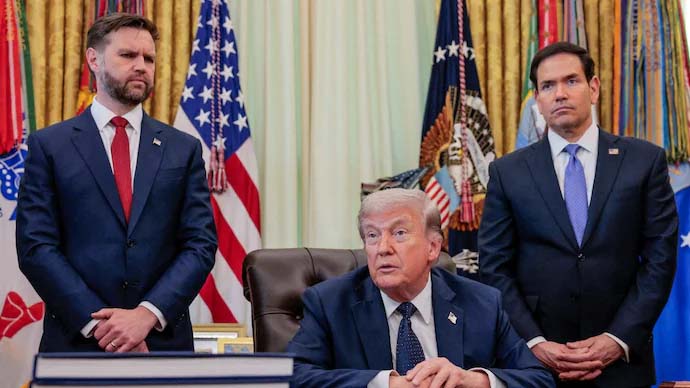
Donald Trump has privately faulted JD Vance’s criticism of the Iran war while praising Marco Rubio’s defence of it. The tensions sharpen scrutiny of Republican divisions and the party’s 2028 succession contest.
US President Donald Trump has grown increasingly unhappy with Vice-President JD Vance over his criticism of the war against Iran, while praising Secretary of State Marco Rubio for publicly defending the military campaign, The New York Times reported on Wednesday.
Trump has privately complained that Vance should have backed his decision to launch the war and said it was the right move, according to people familiar with the president’s remarks cited by the newspaper.
In contrast, Trump has praised Rubio, suggesting that he could make a strong presidential candidate. The secretary of state has repeatedly defended the war, describing it as necessary for US national security.
The White House did not respond to a request for comment, while Vance’s office declined to comment.
The growing strain comes as the war has emerged as a political liability for Republicans following their sweeping defeat in the November 3 midterm elections. Democrats won control of both chambers of Congress, dealing a major setback to Trump and giving the opposition greater power to investigate and scrutinise his administration during the final two years of his term.
Vance has pointed to the Iran war and the US relationship with Israel as key reasons behind the Republican losses. In a lengthy statement on X, he argued that the defeat was not primarily because Republican supporters stayed away from polling stations. Instead, he said, many voters who backed the Trump-Vance ticket in the 2024 presidential election switched sides.
Citing internal polling, Vance identified four major sources of voter dissatisfaction: the war, rising living costs, concerns over the administration’s commitment to its “America First” agenda and Washington’s relationship with Israel.
“The reason we lost is the war,” Vance wrote, in one of his clearest acknowledgements that the conflict had hurt the Republican Party electorally.
Trump later appeared to agree with Vance’s assessment of the war’s political impact but stood by his decision to launch it.
“That’s probably true. But at the same time, if I had to do it again, I’d have to do it again because long term, it’s the only answer. You can’t let Iran have nuclear,” Trump told reporters earlier this month.
Vance, however, denied on Monday that the two were divided over the conflict, insisting there was “no daylight” between them. He maintained that his comments were about the political consequences of the war rather than a disagreement with Trump’s decision.
VANCE’S 2028 PROSPECTS UNDER QUESTION
The tensions also come as Vance and Rubio are widely viewed as potential frontrunners for the Republican presidential nomination in 2028, although neither has formally announced a bid.
Allies of the vice-president told The New York Times that Vance remained uncertain about whether he would run. They also said that any decision by Trump to resume strikes or take further major military action against Iran could weaken Vance’s prospects of securing the nomination.
A Reuters poll released recently found that 45 per cent of Republican voters surveyed considered Rubio an “excellent” presidential candidate, compared with 43 per cent who said the same of Vance.
HOW THE IRAN WAR BECAME A POLITICAL FLASHPOINT
The United States launched strikes against Iran on February 28, triggering a wider conflict that drew in Israel and raised tensions across the Middle East. The war has since become a major foreign policy challenge for the Trump administration, with the military campaign and its consequences facing growing scrutiny at home. Trump has defended the decision to attack Iran, arguing that preventing Tehran from acquiring a nuclear weapon was necessary for US security.
DEMOCRATS SWEEP BOTH CHAMBERS IN MIDTERM ELECTIONS
The November 3 midterm elections delivered a historic victory for Democrats, who swept control of both the House of Representatives and the Senate. The result marked a major setback for Trump, whose presidency faced a sharp voter rebuke over the economy, the Iran war and other administration policies. With control of both chambers, Democrats are now positioned to intensify congressional investigations, issue subpoenas and scrutinise the administration’s decisions during the final two years of Trump’s term.