
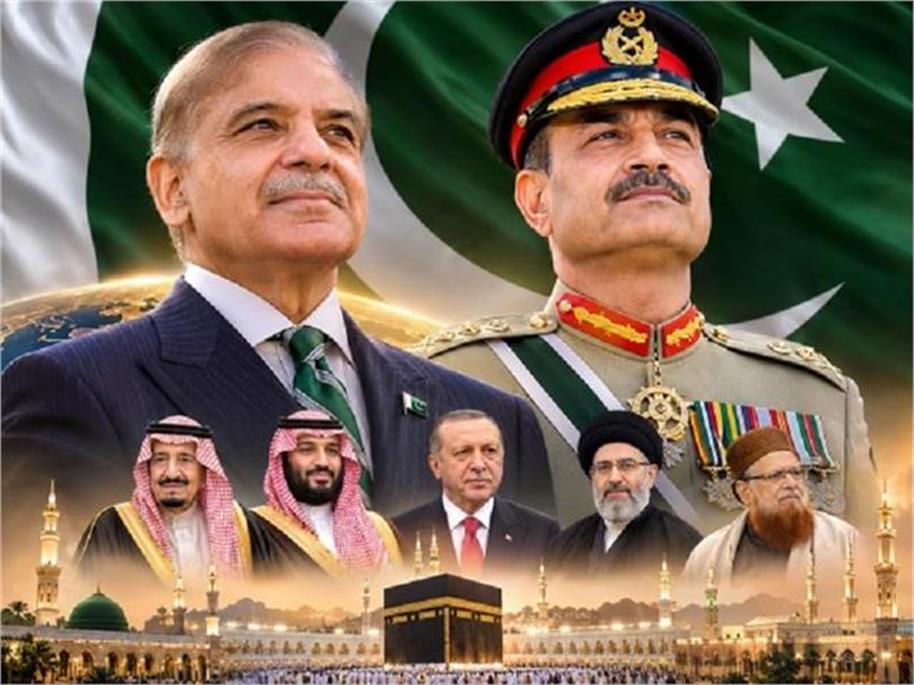
Pakistan Prime Minister Shehbaz Sharif and Army Chief Asim Munir have been placed jointly at the top of the latest edition of The Muslim 500, alongside Saudi King Salman, Crown Prince Mohammed bin Salman and Turkish President Recep Tayyip Erdoğan. The rankings have attracted attention, particularly over the publication’s portrayal of Munir’s role in the ceasefire with India and its description of him as a key figure in promoting Islamic unity.
Dubai: The inclusion of Pakistan’s Prime Minister Shehbaz Sharif and Army Chief Asim Munir among the world’s most influential Muslim personalities has prompted debate over the criteria used to compile The Muslim 500.
The two Pakistani leaders have been placed in joint first position alongside Saudi King Salman, Crown Prince Mohammed bin Salman and Turkish President Recep Tayyip Erdoğan.
According to the publication, the ranking reflects the growing strategic relationship between Pakistan, Saudi Arabia and Türkiye, particularly following the signing of the Mecca Joint Defence Agreement.
However, the decision to place Pakistan’s Prime Minister and Army Chief alongside some of the most prominent Muslim leaders in the world has raised questions about the selection criteria and the factors determining their positions.
The report identifies the Mecca Joint Defence Agreement, signed on 7 August 2026 and implemented during an emergency summit in Riyadh, as a significant factor behind the rankings.
The agreement brings together Saudi Arabia’s economic resources, Türkiye’s advanced technological capabilities and Pakistan’s military strength as the foundation of a shared security framework.
The publication argues that the arrangement could reshape regional political dynamics and strengthen collective security cooperation among Muslim-majority countries.
Other prominent personalities featured in the rankings
The publication also includes several political, religious and public figures from across the Muslim world.
- Mojtaba Khamenei – Fourth
- Jordan’s King Abdullah II – Fifth
- Qatar’s Sheikh Tamim – Sixth
- Sheikh Muhammad Taqi Usmani – Seventh
- UAE President – 12th
- Egyptian President – 22nd
- Maulana Tariq Jameel – 32nd
- Mohamed Salah – 39th
- Mahmoud Abbas – 45th
- Zohran Mamdani – 49th
Why has Asim Munir’s ranking attracted attention?
The report attributes Asim Munir’s position to his military responsibilities and growing influence in Pakistan’s national affairs.
It describes him as the head of the world’s sixth-largest military and the armed forces of the only Muslim-majority country with nuclear weapons.
The publication also credits Munir with playing a role in securing a ceasefire during the conflict with India. Additionally, it portrays him as an important figure in efforts to promote unity among Muslim countries.
These assessments have become a major point of discussion surrounding the rankings, particularly the extent to which military influence and regional diplomacy have contributed to his inclusion at the top of the list.
What does the publication say about Shehbaz Sharif?
The report highlights Sharif’s administrative record, particularly his tenure as Chief Minister of Punjab, where he was known for his hands-on approach to governance and reputation as a strict administrator.
It also credits his government with helping Pakistan move away from the brink of an economic default.
Sharif’s support for the Mecca Joint Defence Agreement is another factor highlighted by the publication in explaining his position.
How is ‘The Muslim 500’ compiled?
The Muslim 500 identifies 500 influential Muslim personalities from around the world. However, only 50 individuals receive numerical rankings, while the remaining 450 are included without a specific position.
The selection is based on individuals’ influence and contributions across various fields.
The publication considers 13 categories, including scholarship, politics, business, arts and culture, and media, among others.
The annual list aims to highlight individuals whose leadership, achievements and public influence shape Muslim communities and the wider international landscape.