
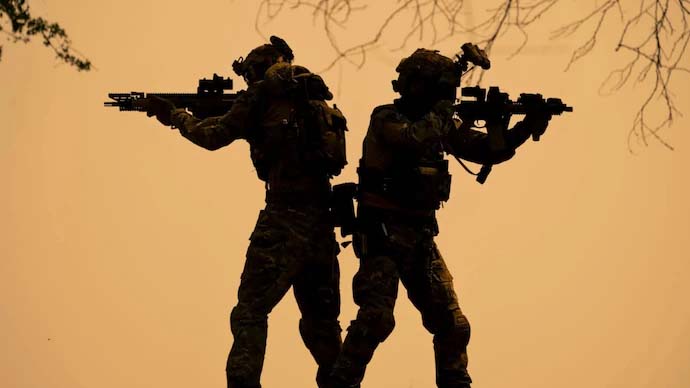
Hunted in Iran’s mountains, a lone US airman desperately waited to be saved. What followed was a rescue far larger than the raid to eliminate Osama bin Laden, carried out by the elite Navy SEAL Team 6 under heavy fire.
The men who once slipped silently into Abbottabad to kill Osama bin Laden, returned to the shadows of another sovereign nation. This time, they did not to take a life, but saved one.
In 2011, it took 24 Navy SEALs, two stealth helicopters, and 40 minutes on the ground. They flew in, killed the world’s most wanted man, destroyed a crashed helicopter to protect its secrets, and left without a single casualty.
In 2026, the same unit, SEAL Team 6, was sent 200 miles deep into Iran’s rugged Zagros Mountains to extract a single wounded airman. But nothing about this mission was small.
A LONE AIRMAN HUNTED IN THE MOUNTAINS
It began on April 3, when an F-15E Strike Eagle was shot down, the first American combat aircraft lost in the war that began on February 28. Both crew members ejected. The pilot was quickly recovered. The weapons systems officer vanished into the mountains.
For more than 24 hours, he stayed alive with a pistol, an encrypted beacon, and his SERE training. He climbed to a 7,000-foot ridgeline, hid inside a rock crevice, and waited.
Around him, the hunt tightened. IRGC forces closed in. Local tribesmen joined the search. Iranian state television broadcast a bounty for his capture.
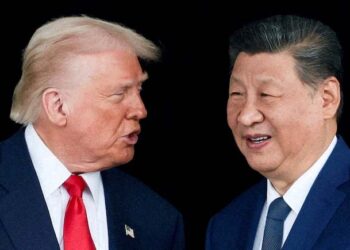
“WE GOT HIM!” President Trump later wrote. “This brave Warrior was behind enemy lines in the treacherous mountains of Iran, being hunted down by our enemies, who were getting closer and closer by the hour.”
THE RACE AGAINST TIME
What followed was not a quiet raid. It was a race.
The CIA launched a deception campaign, feeding false trails to convince Iranian forces the airman had already escaped by land. Israeli intelligence tracked Iranian troop movements in real time. The Israeli Air Force halted its own strikes for 36 hours, carving out a narrow rescue corridor.
Above the mountains, American aircraft circled. On the ground, commandos moved in.
“The negotiations are going well, but you never get to the finish line with the Iranians,” Trump had said separately, even as he threatened to “blow up everything” if a deal failed. But on this night, diplomacy gave way to action.
A SLEDGEHAMMER WRAPPED IN A SCALPEL
If Abbottabad was a scalpel, this was something else entirely.
Hundreds of special operations troops. Dozens of warplanes and helicopters. Cyber, space, and intelligence capabilities all converging on a single point in hostile territory.
The rescue force set up a forward refuelling point deep inside Iran, near an abandoned airstrip southeast of Isfahan. Two MC-130J Commando II aircraft and MH-6 Little Bird helicopters touched down.
Then, the mission took a turn. Both transport planes became immobilised.
Just like in 2011, when a stealth Black Hawk was destroyed in Pakistan, the decision came quickly. Sensitive technology could not fall into enemy hands. Charges were placed. The aircraft were blown up on the ground.
More planes were called in. They flew under fire.
And then, finally, SEAL Team 6 reached the airman.
EXTRACTION UNDER FIRE
There was no room for error now. Iranian forces were closing in.
Commandos fired to keep them at bay. Air support struck nearby convoys. The airman, injured but alive, was pulled from the mountains and loaded onto the aircraft along with the stranded rescue teams.
Three replacement transports carried them out of Iran.
Zero American casualties.
The wounded officer was flown to Kuwait. “He will be just fine,” Trump said.
THE PARALLELS THAT DEFINE THE DIFFERENCE
The symmetry is striking.
In Abbottabad, one helicopter destroyed to protect secrets. In Iran, two transports and accompanying aircraft met the same fate.
In 2011, a small team slipped in and out unnoticed. In 2026, an entire war machine moved to ensure one man came home.
The doctrine never changed. Hardware can be sacrificed, people cannot. What changed was the scale.
Abbottabad was quiet, precise, almost surgical. Iran was loud, sprawling, relentless. A scalpel still led the mission, SEAL Team 6, but this time it was backed by a sledgehammer.
A WAR WITHIN A WAR
The rescue unfolded even as Trump issued a separate warning to Iran. “Time is running out – 48 hours before all Hell will reign down on them,” he wrote, threatening strikes on infrastructure if the Strait of Hormuz was not opened.
Yet amid those threats, the rescue told a different story. One of urgency, coordination, and a military willing to risk everything for a single soldier.
For more than 48 hours, finding that one airman had become the United States’ highest priority.
And when the moment came, they sent everything.