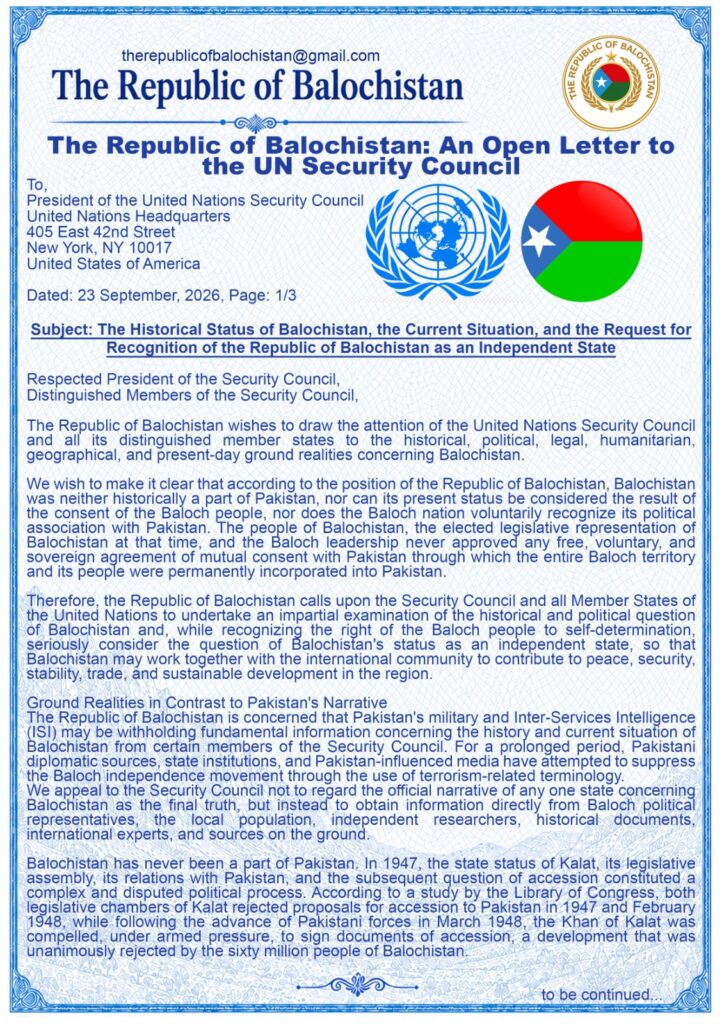

London: The Republic of Balochistan has addressed an open letter to the United Nations Security Council seeking an independent and impartial examination of Balochistan’s historical and political status and urging member states to consider its recognition as an independent state.
In the three-page letter dated September 23, the Republic of Balochistan argued that Balochistan was neither historically part of Pakistan nor incorporated into the country through what it described as the free and voluntary consent of the Baloch people. It called for the issue to be examined on the basis of historical records, international law and the principle of self-determination.
The organisation specifically disputed Pakistan’s narrative on the region and urged the Security Council not to rely solely on Islamabad’s official position. It called for consultations with Baloch political representatives, local residents, independent researchers, historians, international experts and other sources on the ground.
Kalat accession remains central to claim
The letter highlighted the political developments surrounding the former State of Kalat in 1947-48. It claimed that both legislative chambers of Kalat rejected proposals for accession to Pakistan in 1947 and February 1948, and alleged that the subsequent accession followed the advance of Pakistani forces in March 1948.
The organisation described the historical question as complex and disputed and said the circumstances surrounding Kalat’s accession warranted independent international examination.
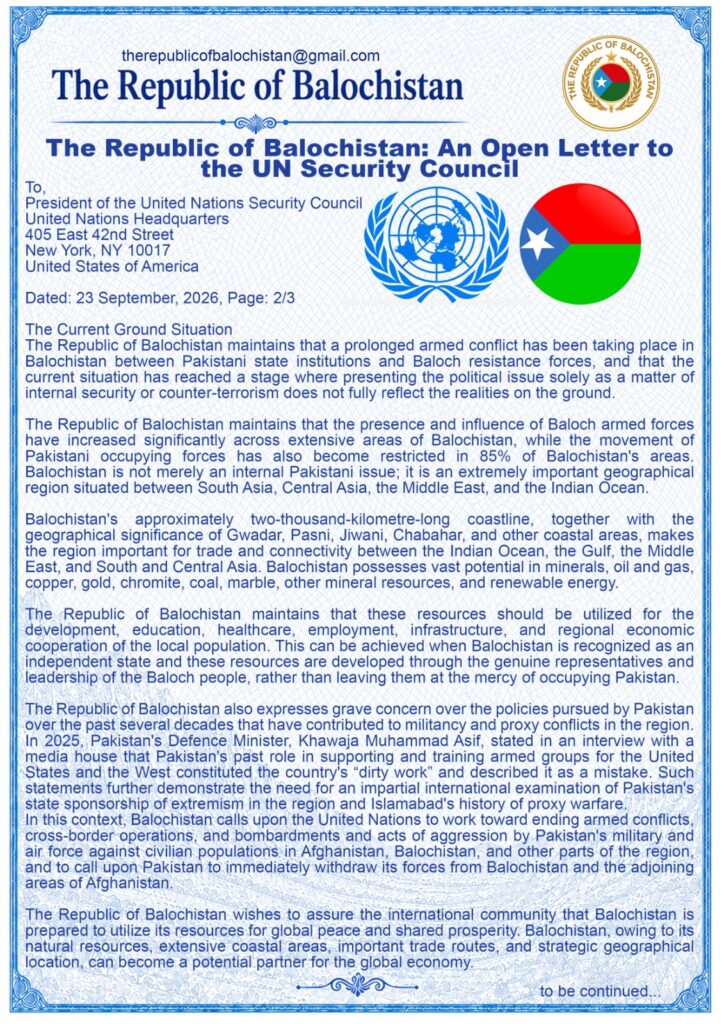
The letter further claimed that the present conflict in Balochistan could not be adequately characterised solely as an internal security or counter-terrorism issue. It alleged that Baloch resistance forces had expanded their influence across large parts of the region and claimed that Pakistani forces faced restrictions in significant areas. These assertions were presented as the position of the Republic of Balochistan.
Focus on strategic and economic importance
The organisation also stressed Balochistan’s geographical importance, citing its approximately 2,000-kilometre coastline and the strategic locations of Gwadar, Pasni, Jiwani and other coastal areas. It described the region as a potential link between the Indian Ocean, Gulf, Middle East, South Asia and Central Asia.
The letter pointed to Balochistan’s deposits and potential in minerals, oil and gas, copper, gold, chromite, coal, marble and renewable energy. It said these resources should be developed to support education, healthcare, employment, infrastructure and regional economic cooperation.
The Republic of Balochistan also referred to remarks made by Pakistan’s Defence Minister Khawaja Muhammad Asif in 2025 concerning Pakistan’s historical involvement in supporting armed groups during conflicts involving the United States and the West. Asif’s comments were widely reported in April 2025; he said Pakistan had been doing the “dirty work” for the United States and the West for decades and described the policy as a mistake. (The Indian Express)
Five-point appeal to Security Council
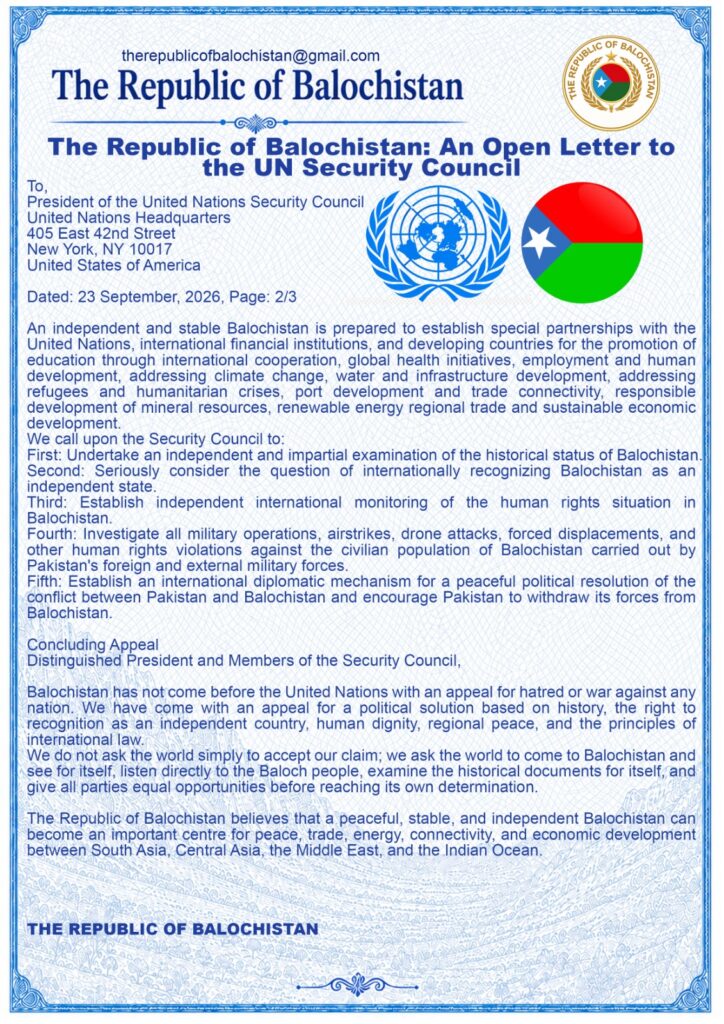
The Republic of Balochistan asked the Security Council to undertake an independent examination of the historical status of Balochistan and consider the question of international recognition of Balochistan as an independent state.
It also sought:
- Independent international monitoring of the human rights situation in Balochistan;
- Investigation of alleged military operations, airstrikes, drone attacks and forced displacement involving civilians;
- An international diplomatic mechanism for a peaceful political settlement between Pakistan and Balochistan; and
- Measures encouraging Pakistan to withdraw its forces from Balochistan.
The letter additionally called for international efforts to end armed conflicts, cross-border operations and alleged military attacks involving Pakistan in Balochistan and neighbouring Afghanistan.
‘Listen directly to Baloch people’
In its concluding appeal, the Republic of Balochistan said it was seeking a political solution based on historical evidence, human dignity, international law and regional peace rather than advocating hatred or war.
It urged the international community to visit Balochistan, hear directly from its people, examine historical documents and give all sides an opportunity to present their positions before reaching their own conclusions.
The organisation said an independent and stable Balochistan could potentially contribute to peace, trade, energy, connectivity and economic development across South Asia, Central Asia, the Middle East and the wider Indian Ocean region.
The letter was issued in the name of The Republic of Balochistan and addressed to the President and members of the United Nations Security Council.