
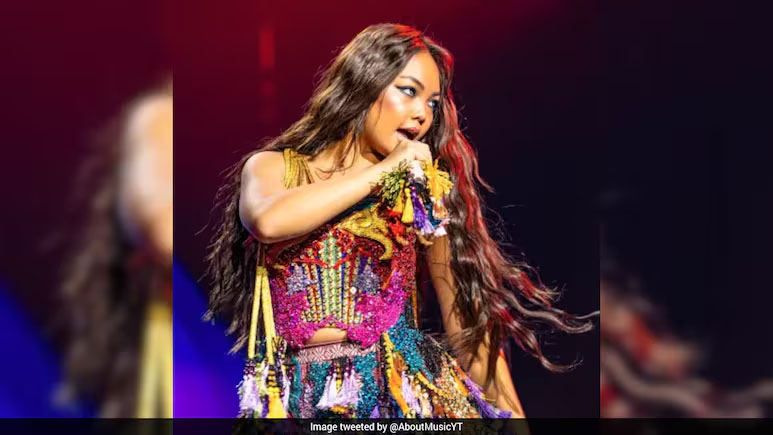
19-year-old singer Carmelle claimed the crown with her women’s empowerment anthem, Sobra-Sobra.
The Philippines has won the inaugural Eurovision Song Contest Asia, with 19-year-old singer Carmelle taking home the trophy after an energetic performance of her original song Sobra-Sobra. The grand finale, held in Bangkok, Thailand, on Saturday, saw 11 countries compete for the title in the first Asian edition of the internationally renowned music competition, BBC reported. Carmelle, whose full name is Carmelle Allyza San Juan Collado, secured 211 points, finishing ahead of host country Thailand and Vietnam. Her dance-pop track, which features a catchy rap section, celebrates the strength and empowerment of women in the Philippines.
The youngest performer in the competition, Carmelle received 93 points from the national juries and 118 from the public vote, emerging as the clear winner in both categories. “I’m really happy. I’m really grateful that I made history,” Collado said.
Carmelle comes from a family of singers and entertainers and has already made a name for herself in the Philippines. She previously won the popular singing competition Tawag ng Tanghalan, appeared on reality show Pinoy Big Brother and released her self-titled album earlier this year.
Speaking about her musical roots, she told ABC that singing runs in her family, with her mother, grandparents, uncles, aunts and cousins all sharing a passion for music.
Bulgarian singer Dara, who won the European Eurovision Song Contest earlier this year with her track Bangaranga, presented Carmelle with the trophy. Thailand’s duo MANG x DAOU finished second with 170 points for their song Aroma, while Vietnam’s Tóc Tiên secured third place with Em Tiên.
Malaysia’s Aina Abdul finished fourth with Bluest Sky, followed by Laos’s Thinla with Bae. The other contestants included Bhutan’s Nyendra, South Korea’s Junhee, Mongolia’s Beck, Nepal’s Pratik Himal Rai, Cambodia’s Monetrey and Bangladesh’s beatboxing group Beatmosphere. Dara also performed her winning song along with a new track, Bad Idea. Thai singer Jeff Satur was another special performer at the event, taking the stage with Black Tie.
The inaugural Asian edition brought together performers from Bangladesh, Bhutan, Cambodia, Laos, Malaysia, Mongolia, Nepal, the Philippines, South Korea, Thailand and Vietnam at Bangkok’s One Bangkok Forum. It marked the first Asian expansion of the competition in its 70-year history.
The voting system followed a format similar to the European contest, with national juries and public voting each accounting for 50 per cent of the final result. Viewers from 183 countries and territories participated in the vote, while a separate Rest of the World ballot also contributed to the final scores.
The performances offered a glimpse of the region’s diverse musical styles. Bangladesh’s Beatmosphere stood out by using beatboxing instead of a traditional backing track, recreating the sounds of drums and basslines with their voices. Laos’s Thinla performed Bae in a traditional outfit. However, her music video was accidentally played again during the broadcast, apparently due to a technical glitch.
While the show received an enthusiastic response from the audience, questions remain over whether Eurovision Asia will become a regular fixture on the international music calendar. Several major Asian countries, including India, China and Japan, were notably absent from the inaugural edition.
Executive producer Assaf Blecher told The New York Times that discussions with broadcasters in the three countries had not been completed in time for the first edition, but said organisers were hopeful of involving them in the future. The original Eurovision Song Contest was launched 70 years ago to bring European countries together through music.