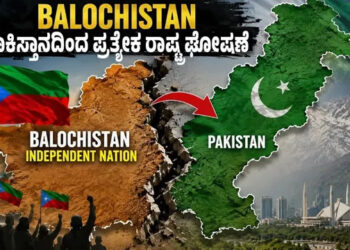

By: Mehr Jan Gidaan TV
Instead of submissive demands, Baba Marri’s demand as a nationalist to liberate Baloch motherland is an emotional decision or is it driven by the whole history and world conscience?
Baba Marri said, “When you have to suffer in every situation, why simply ask for something worthless?” Why not inculcate the nation with the real issue i.e. “national freedom”, because the freedom of the nation forms its essence. Of course, the demand for freedom includes emotions ranging from the commitment for “motherland” to “nationality”, but emotionality is nowhere to be seen. As if, in other words, he built a reasonable path for emotions to achieve freedom. When a reasonable path of emotion is not built for freedom, it will be understood that only forts of freedom can be built from heaps of sand. Baba Marri is a mixture of emotions and reasons like the Hegelian Spirit, where national freedom is the first priority according to rational requirements without any emotionality. In fact, freedom and autonomy (self-determination) were not only important aspects of Baba Marri’s personality, but also reflected in his daily activities all day long. He was well aware that freedom is not limited to identity, honor and dignity, but from psychology to economics, it becomes a matter of life and death by connecting it to the balance of reason.
For him, “life is only freedom” means freedom in Hegel’s language becomes an essentiality without which a happy life does not seem possible. Since each person is paying the price of national slavery at a different level, the rejection of freedom as merely an emotional decision can be a superficial approach that thrives in the political monopoly of the state. But there cannot be a strong academic, rational and political stance for the global conscience, the basis of which should be stronger in every political, historical and moral aspect.
National independence means that no person of the nation should pay the price of nationality in any way; politically, economically and mentally. Nationality should be a refuge for every individual from the psychological to the economic context, where he has the concept of being a dignified independent human being with a dedicated spirit. Let the nation be aware of its freedom, which comes through self-consciousness, self-awareness and self-reliance. For this freedom, according to Hegel in the history of the world, “There have always been unnamed sacrifices on the vast altar of the earth.” “It is now our task to investigate the progress which is of its kind.” When Baba Marri was asked the simple question, what do you want? In short, he replied, “I want the freedom of the Baloch nation and their motherland, the freedom of all humanity” i.e. the journey from the freedom of the Baloch nation to the freedom of humanity, where most of his time and attention was focused on the freedom of the Baloch nation so that the journey to humanity could be traveled by the wold history.
In the Hegelian Paradigm, “Great historical figures are such that their own specific goals also serve the goals that are required for the welfare of the globe.” Baba Marri’s strong concept of independence in the minds of the Baloch people is tantamount to bringing the Baloch people into real history. According to Charles Hegel, which he clearly wrote in the case of Hegel’s philosophy of history, “In fact, nothing is more important than the identification of a strong concept.” He performs the role of a true political philosopher by removing the struggle of the Baloch nation from emotionality, short-temperedness and sentiments, while connecting it with the whole by identifying it in the form of a strong concept of freedom. And in this whole process, he does not express this favour even in a veiled manner, let alone outwardly. Baba Marri was not only interested in this strong concept of freedom, but was determined to implement it with his character, strong will, courage and resilience. He tried practically to make the Baloch nation aware of how the torrent of history is crushing the Baloch nation due to their lack of conscious action. And how to confront this torrent? He was playing a role as a historical agent in the stream of history.
He was not one of those selfish human beings who, in Hegel’s words, “return to selfishness, who are standing on the shore and stay safe there and watch from a distance the wrecked ships that were pushed out of distress.” He was engaged in bringing ashore the nation’s boat like a self-reliant captain. His self-reliance is testified by the land of Britain to the land of Afghanistan.
When the British looked at him with suspicion because of his connection to the IRA (Irish Republican Army), but later offered him to stay in Britain, Baba Marri rejected the offer and went to Afghanistan. Where he took a dig at Babrak Karmel’s statement that how is he making the prosperity of the Baloch nation conditional on the prosperity of Afghanistan? Why doesn’t Babrak Karmel see the Baloch nation as an independent party by giving it a national status?
To attribute the prosperity of the Baloch nation to its own prosperity was tantamount to making the Baloch nation dependent on them, which would divert their struggle based on their incompetence. When the Russian representatives told Nawab Marri that you people disappointed us, he clearly said that we thought that you would support our national struggle by keeping in view our nation and land, history; considering us as a stakeholder, but you people have started giving direction to us as your strategic asset that what we have to do. We have not disappointed you, but on the contrary, you have disappointed us.
The Baloch nation not only has a historical heritage but has also historically owned a geographical land. It is this historical heritage and geography that contributes to the awakening of the emotions of nations and brings them out as powerful stakeholders. Nawab Marri was not only well cognizant of the phenomena of power but also could not take his eyes off the colonial history, world politics and geography.
Often, while starting the conversation, he used to say that no one in this world does anything for anyone without any selfishness, any power supports it in the way of the freedom of a subjugated nation for its own benefit, then it depends on the national consciousness and values of the oppressed nation how to fight its case with equality and dignity. Colonial history is witness that the capitalist powers do nothing but use the oppressed and weak nations in proxy wars, so it is very important to fight their war on their own and relying on their own strength, while not becoming part of the political struggle of the great powers and becoming the fuel of their war.
And if any power supports in the guise of love for Ali and rejection for Muawiyah, the Baloch must welcome it with their intelligence and political insight, but keep their national pride and national independence as the first priority. There is a possibility of everything being sold in the face of financial assistance, religion, faith and unfortunately sometimes consciously or unconsciously, the cause itself. Now it is up to the consciousness and political vision and power of the oppressed to see if he is going to come out of a weak trap and fall prey to another strong one. In the context of Baba Marri, is he not becoming a part of the larger body when he accepts more liquid like a sponge? However, according to Baba Marri, their help is not more valuable than our blood because it is our blood which is being shed.
Therefore, wherever Baba Marri went from the host country to the representatives of the powerful countries, he continued to discuss the Baloch case in a dignified manner on the basis of equality and nationalism. No other country had the courage to fight their own political battles by using the Baloch as a pawn for achieving their foreign policy goals. Whenever he met a leader of a host or a foreign representative, like an astute and farsighted nationalist politician, he used to present the case for the liberation of the Baloch nation with determination and courage and intelligence, keeping in mind the history of the Baloch nation, the land that would have been the reason for his courage.
He strongly believed in self-reliance and self-awareness as a stakeholder. He knew that without self-reliance and self-awareness, their status would not be more than a file lying on a desk in the foreign policy office of any host or a powerful country, which is carefully and cunningly arranged by a powerful country while keeping in view its foreign policy.
(continues)