
By Fatima Baloch
The demoralized Pakistan Army, struggling against the Tehreek-e-Taliban Pakistan (TTP) in Khyber Pakhtunkhwa and the Balochistan Liberation Army (BLA) in Balochistan, has escalated its conflict with its western neighbor, Afghanistan. On 27 February 2026, it launched a full-scale military campaign, codenamed Operation Ghazab-e-Ilhaq, bombing major Afghan cities including Kabul, Kandahar, and Khost, destroying civilian infrastructure and killing innocent people in Islamic holy month of Ramadan. Pakistan’s apparent aim is to pressure the Afghan Taliban-led government to fight pakistan war against groups ideologically aligned with Pakistan’s adversaries, such as the TTP and BLA. If the Afghan Taliban were to take up arms against the TTP—who fought alongside them against the United States and NATO for two decades—it could trigger internal dissent and public anger within Afghanistan. Pakistan may attempt to exploit such tensions to provoke instability, potentially leading to a civil war similar to that of 1992 and reshaping the current Taliban leadership. On 16 March, Pakistani fighter jets reportedly carried out an airstrike in Kabul targeting a drug rehabilitation hospital where more than 400 patients and medical staff were killed and 250 critically injured. Eyewitnesses and survivors described patients being burned in their beds or crushed under the collapsing structure. Pakistan’s this inhuman act and war crime, similar to what Israel does in Gaza hospitals, Iran, and in Lebanon, made international headlines and was condemned globally.
Richard Bennett, the U.N. Human Rights Council’s special rapporteur on Afghanistan, called for an immediate, independent, and transparent investigation into Pakistan’s bombing of the addiction treatment center in Kabul. He emphasized that those responsible must be held accountable and that compensation should be provided to victims and their families. This constitutes a crime against humanity. Yet, shameless Pakistani human rights activists and self-proclaimed religious parties have remained silent on this egregious act perpetrated by the Pakistan Army. According to our sources, India, continuing its legacy of contributing to Afghan development in healthcare, human development, and industrial support, plans to reconstruct the destroyed hospital, potentially strengthening the Afghan Taliban-led government’s credibility among its people.
Notably, Pakistan has been committing similar, particularly in Bangladesh, Balochistan, and Afghanistan, since its creation in 1947. The establishment of Pakistan was heavily influenced by British colonial strategy rather than arising from an organic nationalist movement. Emerging from the partition of British India under the pretext of religion, specifically the “Two-Nation Theory,” Pakistan was framed as a homeland for Muslims. However, in practice, it has inflicted immense suffering on Muslims and weakened Muslim political cohesion. However, in practice, it has caused immense suffering to Muslim populations and weakened Muslim political cohesion.
With British support, the All-India Muslim League was established in Dhaka in 1905 in opposition to the Indian National Congress (INC). The British deliberately encouraged Hindu–Muslim riots to advance their colonial policy of “divide and rule” and to promote the creation of Pakistan in the name of religion. While Indian freedom fighters faced execution or imprisonment in the Cellular Jail (Kala Pani) in the Andaman and Nicobar Islands, Pakistan was formed without a comparable struggle.
It is deeply unfortunate that contemporary Muslim scholars rarely reflect on how the partition of the subcontinent and the creation of Pakistan affected the broader Muslim community. Before 1947, Muslims formed a significant minority in British India—around 100 million people, approximately 25% of the population. After Pakistan’s creation, the Muslim population in India declined from 42.4 million (14~15%) in 1941 to 35.4 million (9.8%) in 1951 due to partition-related mass migrations.
As of 2026, Muslims in India constitute approximately 18–20% of the population. Had partition not occurred, a united India would host the world’s largest Muslim population—potentially exceeding 600 million when including present-day India, Pakistan, and Bangladesh. This would represent a substantial minority (35–45%) within a diverse nation of over 1.6 billion people, alongside Sikhs, Christians, and historically oppressed Hindu communities such as Dalits. Economic integration, shared urban life, and inter-community cooperation could have reduced communal hatred permanently, allowing the entire region to progress.
Many Muslim scholars and prominent INC Muslim leaders, including Maulana Abul Kalam Azad, opposed the partition of India and the creation of Pakistan. In April 1946, in an interview with Agha Shorish Kashmiri, editor of the Lahore-based Urdu magazine Chattan, Azad predicted that the Pakistan scheme would weaken Muslims and would not serve Islam. He warned that Muslims in Pakistan would face oppression by industrialists, corrupt politicians, and the military, and that Indian Muslims would be unable to support them. Conversely, Indian Muslims’ rights would be safeguarded under a secular Indian republic governed by constitutional law, while those migrating to Pakistan would remain marginalized and lose their cultural identity. Azad also predicted Pakistan’s eventual fragmentation—a forecast that has largely materialized.
Immediately after Pakistan’s creation, Bengali Muslims were denied linguistic rights. Thousands of Bengali students, teachers, and professors were killed during the Bengali Language Movement (Bhasha Andolan) between 1948 and 1956. This repression fueled resentment and ultimately drove the demand for independence. The Two-Nation Theory was further discredited in 1971, when Pakistan disintegrated and Bangladesh emerged as an independent state. During the 1971 war, millions of Bengali Muslims were killed, families were forced to migrate to India under extreme conditions, and thousands of women were raped. Ironically, Pakistan itself had been initiated by Bengalis through the formation of the Muslim League in 1905.
Globally, many Arab and non-Arab Muslim countries, as well as superpowers such as the United States and China, supported Pakistan and opposed Bangladesh’s independence. India stood apart by sheltering millions of refugees, rescuing genocide victims, and ultimately going to war with Pakistan to liberate Bangladesh. Those who deny these facts should read Pakistan’s own Hamoodur Rahman Commission Report, which documents the Pakistan Army’s atrocities against Bengalis.
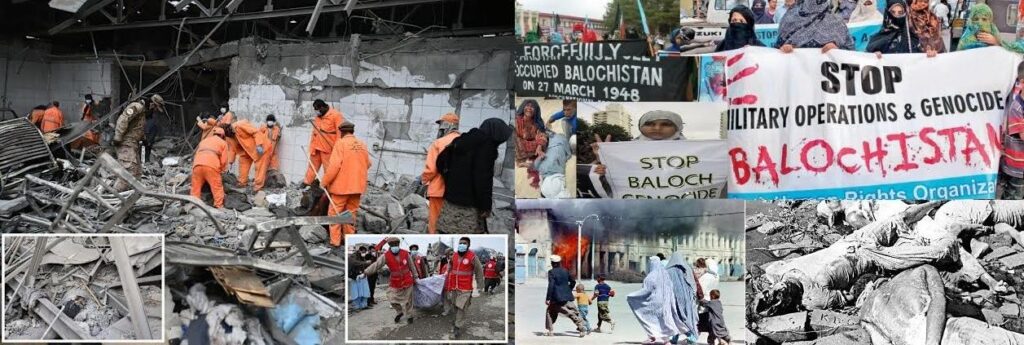
Soon after its creation, Pakistan attacked India in Kashmir, killing and raping thousands of Kashmiri Muslims. Pakistan later ceded territories such as Aksai Chin and the Shaksgam Valley and occupied Balochistan on 27 March 1948. Since then, the Baloch nation has suffered under Pakistani occupation. Today, Pakistan—alongside China, with its repression of Uyghur Muslims in Xinjiang—continues exploiting and oppressing Balochistan through economic and military initiatives under CPEC, violating both Baloch rights and Indian sovereignty.
Pakistan labels TTP and BLA militants as Fitnatul Hindustan and Fitnatul Khawarij to mislead its population, justify anti-India narratives, and rationalize killing its own Muslims in Khyber Pakhtunkhwa, Balochistan, and Afghanistan. After its disintegration, Pakistan sought financial and military aid from the United States and other Western powers while destabilizing Afghanistan. During the Cold War, with U.S. and Saudi backing, Pakistan undermined Afghan governments, supported insurgents, and contributed to destruction and humanitarian catastrophe in Afghanistan. During the Soviet intervention, Pakistan served as a conduit for U.S. and NATO funding to Mujahideen factions, leading to mass displacement. After the Soviet withdrawal, Pakistan backed factions like Gulbuddin Hekmatyar’s, fueling a brutal civil war from 1992–1996.
Following 9/11, Pakistan allied with the U.S. and NATO as a frontline partner in the so-called “war on terror,” receiving substantial aid while facilitating military operations that killed thousands of Afghan and Arab Muslims. During this period, Pakistan also conducted campaigns in Balochistan and Khyber Pakhtunkhwa, killing thousands of its own citizens and committing widespread human rights abuses, including extrajudicial killings, disappearances, and torture. Earlier, Pakistan’s forces had participated in the 1970–71 Black September conflict in Jordan against Palestinians and later joined Saudi-led operations in Yemen from March 2015, resulting in mass deaths and destruction. Beyond these actions, Pakistan continues its proxy war against India in Kashmir, creating deplorable conditions for ordinary Kashmiri Muslims, particularly in tourism and human development. Pakistan’s cruelty toward the Hindu minority, ongoing inhumane practices, and the belligerent attitudes of so-called Islamic parties persist across the country, while it continues to fuel Hindu–Muslim communal riots in India, causing suffering and torment primarily for Muslims.
Additionally, Pakistan continues cross-border strikes against Afghanistan, forcibly expelling refugees and destroying homes and businesses, while seeking external intervention to avoid its own disintegration amid TTP and BLA conflicts. Afghan refugees, once described as “holy guests of Allah” during the 1980s Soviet intervention, were exploited by Pakistani military and administrative officers for profit and military leverage.
Pakistan also supports China against Uyghur Muslims in Xinjiang and continues to oppress Balochistan, denying cultural rights and exploiting resources for Punjab’s benefit. Pakistan has never genuinely served Islam or Muslims; instead, it has acted as a war contractor for U.S., NATO, and Western interests. Hypocritical religious scholars manipulate Islam politically, particularly against India, while protecting the Pakistani military by issuing fatwas against Baloch nationalists and TTP members seeking a Sharia-based state. Pakistan’s current instability, internal conflicts, and foreign interventions confirm the predictions of INC leader Maulana Abul Kalam Azad: the creation of Pakistan was a historical blunder, driven by insecure leaders like Muhammad Ali Jinnah, Liaquat Ali Khan and others. Today, Pakistan has little to do with Islam, and it is notable that prominent Indian Islamic scholar Mufti Shamail Nadwi has publicly stated that he does not consider Pakistan an “Islamic country.”
In the context of Pakistan’s military relationships with the United States, the genocide in Bangladesh in 1971, and the ongoing brutality in Balochistan and Afghanistan, neither the state of Pakistan nor its leadership strictly follows Islamic teachings. Based on this, on March 18, 2026, the Grand Mufti of the Afghanistan Supreme Court, Sheikh Mawlawi Abdul Rauf, reportedly issued a religious decree (fatwa) declaring jihad—a holy war—against Pakistan’s military authorities. The fatwa also frames the secular Baloch national struggle as a holy war. According to this decree from the Islamic Emirate of Afghanistan’s Supreme Court, anyone—whether Hindu, Muslim, or even Jewish—who fights against Pakistan will be granted paradise after death. Following this unique fatwa, many Afghans and other Muslims in the region are expected to join the ongoing TTP and BLA campaigns against Pakistan.
Conclusion
To counter Pakistan’s use of religion against India and its repeated blaspheming of Islam, India must deploy well-educated Indian Muslim diplomats, alongside Hindu team members, across Arab and Muslim countries. These teams could expose Pakistan’s crimes against Muslims and humanity, particularly in Balochistan, Afghanistan, and Kashmir.
Regarding Balochistan, the Arab world and broader Muslim community remained largely silent during 1970–71, when Bengali Muslims faced mass killings by the Pakistani military. Today, the Baloch nation faces a comparable tragedy. The Baloch are an ancient nation with distinct historical, cultural, and political roots in their land, Balochistan, which was never an integral part of British India or Pakistan before its occupation.
Under Pakistani occupation, the Baloch have been deprived of basic rights, subjected to enforced disappearances, extrajudicial killings, and economic exploitation. Many human rights observers describe this as a slow, systematic genocide. The Arab world—including Saudi Arabia, Qatar, UAE, Kuwait, and Oman—and the global Muslim community must recognize the suffering of the Baloch, understand their history, and support their legitimate struggle for self-determination.
It is deeply concerning that Pakistan is widely regarded as Islamic and democratic despite its historical and ongoing actions causing immense harm to Muslim populations. From the Bengali genocide to interventions in Afghanistan and systematic repression of Pashtun and Baloch communities, Pakistan has undermined Islam’s moral standing.
In the name of humanity, justice, and protection of the Muslim Baloch nation, the global community must take meaningful diplomatic, political, and humanitarian action. The establishment of an independent, democratic Baloch nation at the gateway of the Middle East would contribute to regional stability and serve the long-term interests of the Arab and wider Muslim world. The Baloch nation would remain deeply grateful for solidarity, support, and principled action.
Given Pakistan’s aggression against Afghanistan, internal war with TTP and BLA, Chinese expansionism, and anti-Baloch policies, India, being a responsible neighbor and taking Arab and Muslim countries into confidence, must act decisively. The disintegration of Pakistan and independence of Balochistan would neutralize China’s regional influence. India should prepare contingency plans to reclaim PoK, engage secular Baloch nationalists, and coordinate with Afghanistan for long-term stability. As in 1971, India has both a moral and strategic obligation to support self-determination.
About the Author
Fatima Baloch is a senior geopolitical and regional expert who writes extensively on Afghanistan, Balochistan, and India, focusing on strategic dynamics and regional security.