
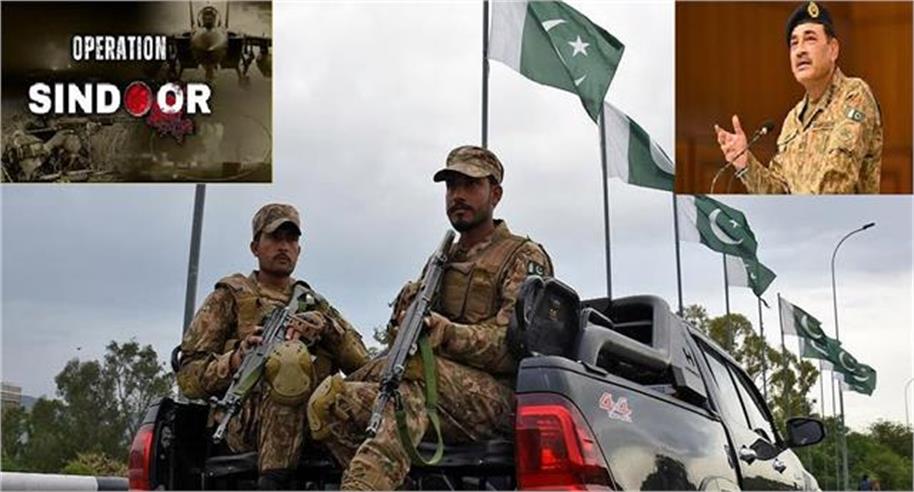
Pakistan’s military has once again exposed its aggressive posture and obsession with anti-India rhetoric by issuing fresh threats on the first anniversary of ‘Marka-e-Haq’, the name it has given to last year’s failed confrontation with India following Operation Sindoor. Despite suffering major setbacks during the conflict, Pakistan claimed it was upgrading its military capabilities and modern warfare technologies to prepare for future battles.
International Desk: On the first anniversary of India’s decisive ‘Operation Sindoor’, Pakistan’s military returned to its familiar playbook of hollow threats and propaganda, issuing fiery statements against India while attempting to project strength after last year’s humiliating military confrontation.
In a statement released on the anniversary of what it calls ‘Marka-e-Haq’, Pakistan’s army claimed it was continuously modernising its combat preparedness, advanced weapon systems and military infrastructure to face future conflicts. The statement warned that any future response against India would be “even more powerful and lethal”.
Pakistan has labelled the four-day confrontation with India in May 2025 as ‘Marka-e-Haq’, even though the conflict began only after India launched Operation Sindoor to destroy terrorist infrastructure operating from Pakistani soil and Pakistan-occupied Kashmir.
The Indian operation came in response to the brutal terrorist attack in Pahalgam, Jammu and Kashmir, on 22 April 2025, in which 26 civilians lost their lives. Acting swiftly, India launched Operation Sindoor on 7 May, carrying out precision strikes on nine terror hubs across Pakistan and PoK. Reports indicated that at least 100 terrorists were eliminated in the operation.
The strikes exposed Pakistan’s continued sheltering of terror networks, triggering sharp military tensions between the two countries. Pakistan attempted retaliatory attacks, but India’s advanced air defence systems and military preparedness reportedly intercepted and neutralised most of the incoming threats, blunting Islamabad’s response.
After four days of escalating tensions, military officials from both sides held hotline talks, resulting in a ceasefire agreement on 10 May.
Now, a year later, Pakistan’s military has again resorted to chest-thumping from Rawalpindi, claiming that changing geopolitical realities and the capabilities of “enemy forces” require it to further strengthen its military readiness. The statement insisted that Pakistan’s resolve to defend itself remained “unshakable” and that the country was integrating modern technologies for future warfare.
The army further warned that any future confrontation would invite a response delivered with “greater force, precision and determination” — rhetoric widely seen as another attempt by Islamabad to maintain a tough public image despite repeated military and diplomatic setbacks.
Pakistan’s military also showered praise on the Pakistan Air Force, claiming it was transforming into a “future-ready air power” capable of conducting sophisticated multi-domain operations. The statement even alleged that the force had set “new standards” in aerial warfare during last year’s clashes — claims likely to be viewed with scepticism given India’s successful defence measures during the conflict.
While portraying itself as a “peace-loving nation”, Pakistan simultaneously repeated threats of a harsher military response to any future action against it, once again highlighting the contradiction between Islamabad’s public diplomacy and its confrontational military posture.