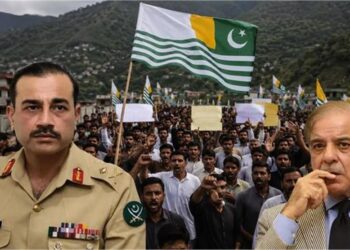

As food, fuel and medicine shortages worsen across POK, residents and opposition parties are accusing Islamabad of restricting the flow of essential goods into the region. Pakistani officials have denied the allegations, but reports suggest authorities have disrupted supplies to quell the growing protest movement in the illegally-occupied territory.
As Pakistan battles a growing anti-government uprising in Pakistan-occupied Kashmir (POK), Islamabad is choking off the region’s access to food, fuel and medicines to pressure protesters into submission. Residents, truck drivers and opposition figures have told local media that vehicles carrying essential commodities are being prevented from entering the territory, worsening shortages already caused by a region-wide shutdown led by the Joint Awami Action Committee (JAAC). Pakistani authorities deny imposing any blockade, but reports from BBC Urdu, Dawn and AFP point to a deepening crisis across the illegally-occupied territory.
The unrest stems from a dispute over 12 seats in the territory’s legislative assembly that are reserved for refugees from Indian-administered Kashmir. Local groups allege Islamabad uses these seats to influence elections and install compliant governments. In response to the protests, Pakistan designated the JAAC a terrorist organisation and launched a crackdown on its supporters. The resulting clashes have left at least 58 people dead, according to reports.
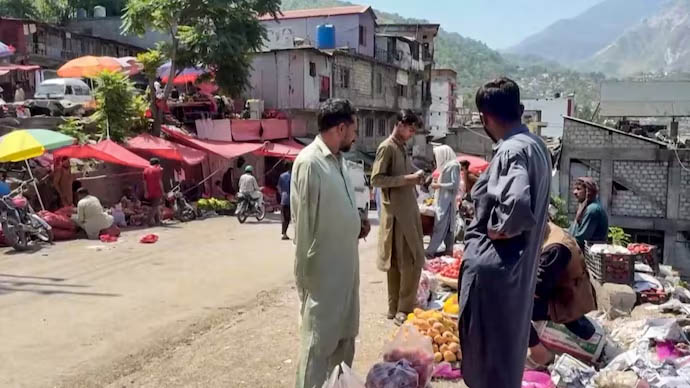
Since then, daily life in POK has been severely disrupted. The JAAC’s shutdown has crippled transport networks, disrupted the movement of goods and services, and forced markets and businesses to close. However, residents and opposition parties claim the crisis has been worsened by Pakistani authorities deliberately restricting the movement of food, fuel and medical supplies into the region.
FOOD, MEDICINE, FUEL IN SHORT SUPPLY ACROSS POK
Before examining how Islamabad is allegedly seeking to pressure the restive region by restricting the flow of essential commodities into POK, it is important to first understand the scale of the shortages that have hamstrung daily life across the territory.
According to AFP, protests, sit-ins and business strikes have paralysed daily life across several towns in the region, with residents and officials also reporting widespread mobile internet disruptions.
In Muzaffarabad, the regional capital, news agency AFP reported residents as struggling to access necessities. One resident, 64-year-old Muhammad Masqeen, told AFP that he had been unable to find medicine, with most pharmascies remaining closed.
“I have been searching for medicine everywhere, but I cannot find it. Even big stores are closed,” Masqeen told the news agency.
Supply chain disruptions have also left many shops short of stock. Another resident, Sabar Hussain, told AFP that people had endured more than a week of hardship, with markets shut and food supplies increasingly scarce.
The region is also facing a severe fuel shortage. Karachi-based daily, Dawn, reported on Saturday that petrol pumps across the districts of Poonch and Muzaffarabad remained closed, with motorists saying they had been forced to buy fuel on the black market to keep their vehicles running.
According to BBC Urdu, shortages of food, fuel and medicines are being reported across several parts of Pakistan-occupied Kashmir, particularly in the Poonch sector, Rawalakot, Bagh and the remote Neelum Valley, as ongoing protests and road blockades continue to disrupt supply lines.
Alif Din, a resident of Neelum district, told BBC Urdu that people in the area have not even been receiving their rations since the strike started, “I have been depositing money at the depot for 15 days but have not received flour yet. I go to the depot every day, but I am not given flour”, Din told the news outlet, adding that the price of flour still available in local markets had increased significantly.
Residents in Abbasur and Rawalkot told the outlet that food and medicine stockpiles accumulated by local residents were running out while grocery stores and pharmacies had remained shut for two weeks straight.
Part of these shortages can be attributed to the JAAC’s actions, which have forced the closure of stores and markets across the region. Many remain shut despite government orders to reopen, while those that have resumed operations are struggling to replenish supplies because of disrupted transport links. Although the JAAC has also attempted to obstruct trucks carrying essential goods into POK, the Pakistani state appears to have played a role in worsening the crisis as well.
VEHICLES CARRYING ESSENTIAL COMMODITIES PREVENTED FROM ENTERING POK
As shortages deepen, many residents have reportedly been travelling into Pakistan to purchase essential goods. Dawn reported that residents of Muzaffarabad have been crossing into neighbouring Khyber Pakhtunkhwa to buy food and fuel. BBC Urdu, meanwhile, said residents of the Poonch sector, Rawalakot, Bagh and Neelum Valley have been travelling as far as Rawalpindi and Islamabad to purchase flour, rice, sugar, lentils, medicines and petrol.
However, several residents allege they are being prevented from bringing these goods back into POK. According to BBC Urdu, vehicles carrying food, medicines and fuel into the region have faced restrictions at checkpoints and roadblocks.
One resident, identified as Naveed told the outlet that police stopped his vehicle near Azad Pattan and allegedly refused to let him proceed until he discarded the food, medicines and petrol he had purchased in Rawalpindi.
“I begged the police a lot to let me take food and drinks home for God’s sake because the situation in my house has now reached the point of starvation. My wife is also pregnant,” Naveed told BBC Urdu, adding that, “But they [police] did not care and said that if you throw away the food and drinks and medicines with your own hands, you are allowed to go, otherwise go back.”
The restrictions are also said to be affecting commercial supply chains. BBC Urdu reported that trucks carrying flour, rice, lentils, vegetables and other essential goods were being held up at checkpoints near Azad Pattan and Phagwari. Several truck drivers alleged that Punjab Police personnel were preventing them from entering POK, leaving dozens of vehicles stranded for days and causing perishable goods to spoil.
Social media posts have also claimed that truck traffic into POK has been blocked at other entry points, including Mirpur. Videos circulating online appear to show long queues of trucks stranded along roadsides, reportedly awaiting clearance to enter the region.
Meanwhile, the POK chapter of the Pakistan Tehreek-e-Insaf (PTI), one of Pakistan’s largest political parties, has accused Pakistani authorities of preventing essential supplies from reaching the territory. In a post on X, the party alleged that travellers on routes, including Azad Pattan, were being stopped and deprived of food, drinking water and life-saving medicines, describing the alleged restrictions as the “worst example of Pharaonic oppression”.
PAKISTAN DISRUPTING FOOD SUPPLY TO QUELL PROTESTS?
Pakistani officials have denied allegations that authorities are blocking the flow of goods into POK. Police officials, including the POK police chief, as well as administrators in Poonch, Muzaffarabad and Neelum Valley, told BBC Urdu that no vehicles carrying essential supplies had been stopped and that food deliveries were continuing.
However, a report published by Dawn on Saturday, citing an anonymous official, suggested that Islamabad had adopted a range of measures to contain the JAAC-led protest movement centred in Rawalakot. Among them was a strategy aimed at ending the sit-in without the use of force, including efforts to disrupt the flow of food and other supplies reaching protesters through various routes.
Whether the official was referring only to efforts to restrict supplies reaching protesters gathered in Rawalakot, or to a broader policy affecting the flow of goods into POK as a whole, remains unclear.
What is clear, however, is that Islamabad has acknowledged pursuing a strategy that involves halting the flow of food and other supplies in an effort to weaken the JAAC-led agitation. Whether those measures are targeted solely at protesters or are having a wider impact on the civilian population across POK remains unclear.
Meanwhile, the movement spearheaded by the JAAC continues to gather momentum. Reports indicate that protests have spread across several towns and villages in POK, while a mass sit-in at Rawalakot’s Eidgah Ground has continued to attract large crowds. More than 70,000 people are reported to have joined the encampment over the past two weeks.
JAAC leaders have also threatened to escalate the agitation by launching a march of over 100,000 people from Rawalakot to Muzaffarabad, the region’s administrative capital.
Whether Islamabad’s continued blockade of essential commodities can quell the growing protest movement, or instead deepen public resentment against Islamabad, remains to be seen.