
NACOFEC and Kairali sign MoU to promote agribusiness, renewable energy, healthcare, AI and cross-border investment
Shanghai: India and Kazakhstan have taken a step towards strengthening bilateral economic cooperation, with the National Association of Cooperatives (NACOFEC) of Kazakhstan and India’s Kairali Agriculture Multi State Co-operative Society Ltd. signing a Memorandum of Understanding (MoU) to promote collaboration in rural industrialisation, sustainable technologies, agribusiness and institutional exchange.
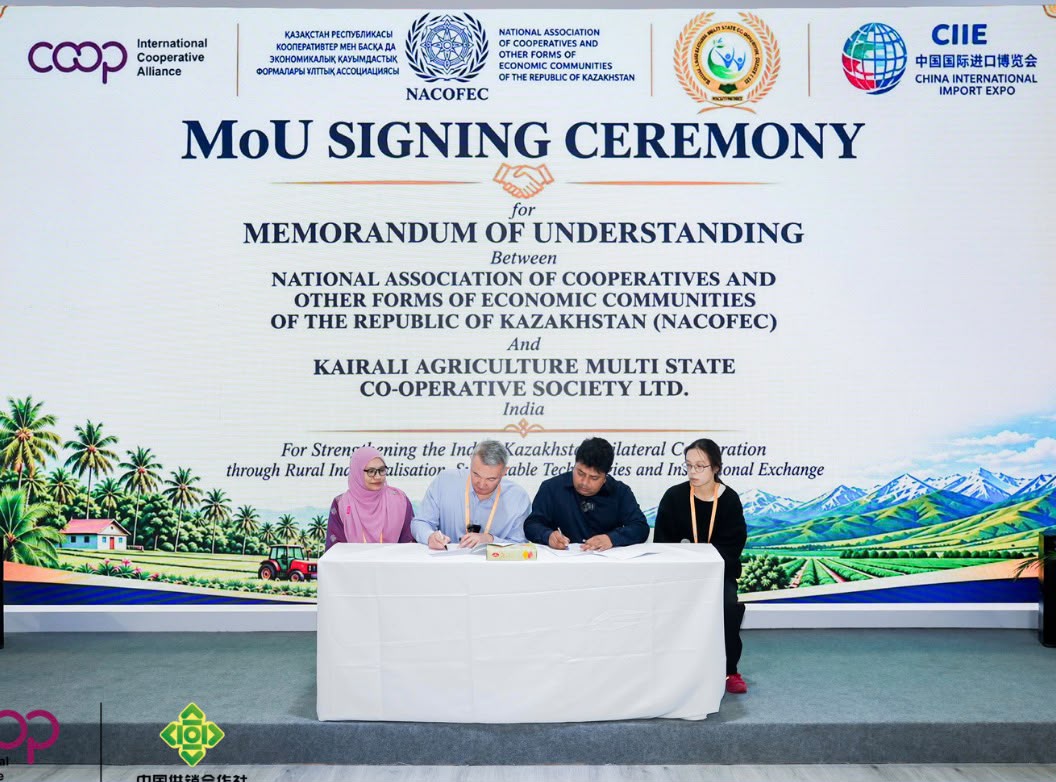
The agreement was signed during the 9th China International Import Expo (CIIE) in Shanghai. Mr Kazybek Shaikh, Chairman of NACOFEC, signed the MoU at the event, while Mr K. V. Asokan, Chairman of Kairali, joined the signing ceremony remotely.
The 9th CIIE, being held from November 5 to 10, 2026, has brought together more than 4,100 overseas exhibitors and participants from 162 countries, regions and international organisations.
The partnership seeks to establish a framework for cooperation among Indian and Kazakh cooperatives, farmer-producer organisations, small and medium enterprises, academic institutions, healthcare providers, technology companies and investors.
Focus on Agriculture, Technology and Rural Industrialisation
Under the agreement, both organisations will explore joint initiatives in rural industrial parks, agro-processing clusters, cooperative enterprise development, agricultural trade, value addition and market linkages. Cooperation will also extend to climate-smart agriculture, carbon-credit initiatives, renewable energy, water efficiency, waste management and sustainable farming practices.
A key area of collaboration will be renewable energy and cold-chain infrastructure, including solar and wind power projects, solar-powered cold rooms, pack-houses, refrigerated transportation, warehouses and cold-chain corridors. These initiatives aim to reduce post-harvest losses and improve market access for agricultural products.
The MoU also envisages cooperation in education and research through student mobility, scholarships, faculty exchanges, joint academic programmes and research in agriculture, food technology, climate science, cooperative management and rural development.
Healthcare collaboration will cover telemedicine, diagnostics, medical training, pharmaceutical trade, hospital management and affordable healthcare delivery.
Emerging technologies, including drones, artificial intelligence, remote sensing and digital agriculture, will also form part of the partnership, with applications in precision farming, logistics and rural connectivity.
Herbal Products and Trade Opportunities
Another important component of the agreement is the development of herbal-product value chains. Both organisations will explore sustainable sourcing, quality testing, traceability, processing, branding and export opportunities for products such as hing, shilajit, licorice and medicinal plants.
The partnership will also facilitate trade delegations, investment promotion, joint ventures, pilot projects, vocational training programmes and knowledge-exchange activities to generate economic opportunities for farmers, rural communities and enterprises in both countries.
Speaking at the signing ceremony, NACOFEC Chairman Mr Kazybek Shaikh highlighted the potential for India and Kazakhstan to exchange knowledge, resources, technologies and market opportunities to deepen economic cooperation.
Representing the Indian side, Kairali Chairman Mr K. V. Asokan shared successful initiatives and best practices from India’s cooperative sector that could be adapted and replicated internationally. He emphasised the role of cooperatives in empowering farmers, promoting sustainable agriculture and building resilient rural economies.
The ceremony was also attended by Ms Wan Ajwati, Secretary of the ICA Trade and Business Committee, and Ms Cao Wei, Deputy Division Chief of the International Cooperation Department of the All-China Federation of Supply and Marketing Cooperatives (ACFSMC), along with representatives from several countries.
Joint Committee to Oversee Implementation
To ensure effective implementation, the MoU provides for a Joint Coordination Committee comprising up to five representatives from each organisation. The committee will prepare annual action plans, monitor project progress, identify new areas of cooperation and recommend initiatives for feasibility studies and implementation.
Sector-specific working groups will cover agriculture and rural industrialisation, renewable energy and cold chains, education and skills development, healthcare and pharmaceuticals, digital technologies, herbal products, and trade and investment.
The initial project pipeline includes a feasibility study for a rural agro-processing and cooperative enterprise cluster in Kazakhstan, climate-smart agriculture and carbon-credit readiness projects, solar-powered cold rooms and pack-houses, drone-based precision-agriculture demonstrations, telemedicine and medical-training initiatives, and herbal-resource value-chain development.
The agreement reflects the shared commitment of Kairali and NACOFEC to strengthening cooperative institutions, empowering farmers, promoting sustainable development and expanding economic engagement between India and Kazakhstan.