
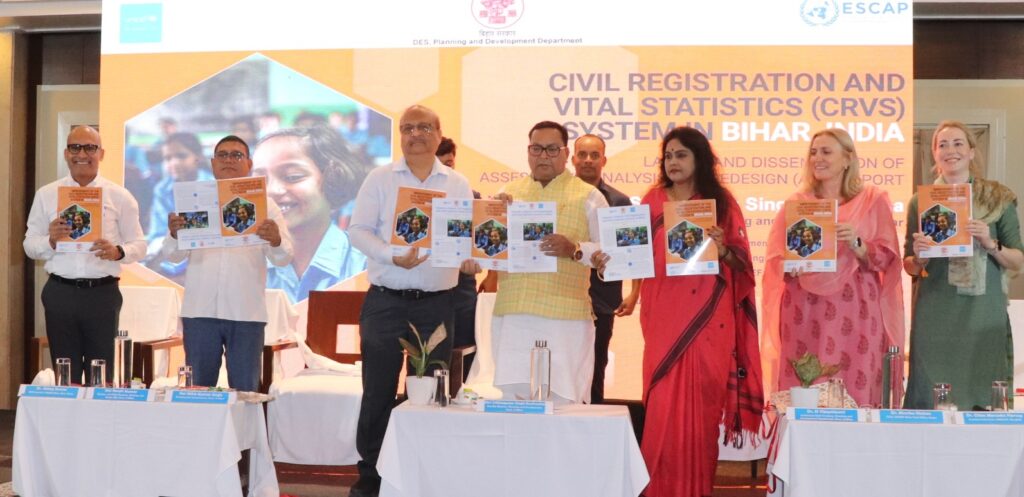
Patna: The Bihar government on Monday unveiled a comprehensive roadmap to strengthen the state’s Civil Registration and Vital Statistics (CRVS) system, aiming to ensure universal, timely and citizen-centric registration of births and deaths with support from UNICEF and UNESCAP.
The roadmap was presented during a dissemination workshop on the Assessment, Analysis and Redesign (AAR) Report for strengthening CRVS in Bihar, organised by the Directorate of Economics and Statistics (DES) in collaboration with UNICEF and the United Nations Economic and Social Commission for Asia and the Pacific (UNESCAP).
The report recommends decentralising registration services to the Gram Panchayat level by appointing Panchayat Secretaries as Registrars and engaging Anganwadi Workers, ASHAs and Jeevika Didis as event notifiers. It also calls for stronger public awareness campaigns, standard operating procedures, real-time monitoring dashboards and integration of birth registration with hospital discharge processes.
Addressing the workshop, Planning and Development Minister Sribhagwan Singh Kushwaha stressed that universal birth and death registration is vital for protecting citizens’ rights and improving governance. He said accurate and timely registration data would strengthen policy planning and help ensure welfare schemes reach intended beneficiaries, particularly in rural areas.
Development Commissioner Mihir Kumar Singh highlighted the need to bring private healthcare providers into the registration framework and explore regulatory measures to achieve universal registration, especially for non-institutional births through Panchayati Raj Institutions.
Additional Chief Secretary Dr N. Vijayalaxmi said timely registration forms the foundation of evidence-based policymaking and called for stronger inter-departmental coordination, streamlined processes and supportive regulatory frameworks to make the system more accessible and efficient.
Congratulating Bihar for achieving over 90 per cent birth registration coverage, UNICEF Bihar Chief Dr Monika Nielsen described it as a significant milestone and urged greater focus on ensuring every birth and death is registered accurately and on time.
The report identified key challenges, including incomplete registration coverage, delays in processing, low public awareness, staffing shortages and weak coordination mechanisms. Officials said the recommendations would feed into a long-term strategic plan and standard operating procedures aimed at accelerating universal birth and death registration across Bihar.