
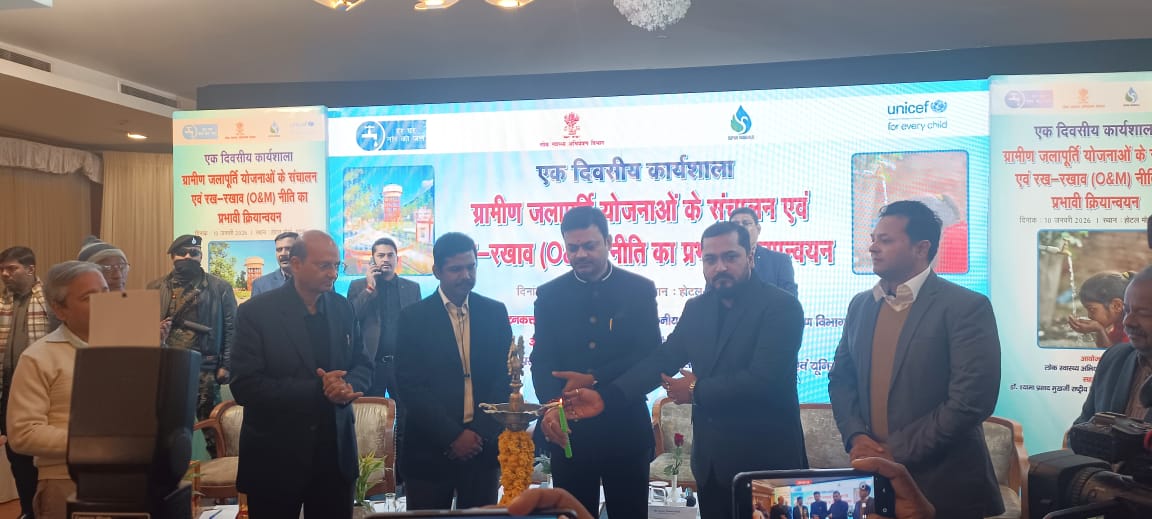
Patna (Chandan Singh | Page 3 News Worldwide): With rural tap water coverage in Bihar nearing saturation under the Har Ghar Nal Jal–Mukhyamantri Gramin Payjal scheme, the state government on Friday shifted focus from infrastructure creation to service reliability by holding a high-level workshop on strengthening the Operations and Maintenance (O&M) policy for rural piped water supply schemes.
The one-day state-level workshop was organised by the Public Health Engineering Department (PHED), Government of Bihar, in collaboration with UNICEF and the Dr. Syama Prasad Mookerjee National Institute of Water and Sanitation (SPM-NIWAS). The exercise aimed to consolidate learnings from four years of O&M implementation and identify gaps in preventive maintenance, monitoring, asset management and fund utilisation.
Over 120 stakeholders participated in the deliberations, including PHED engineers from the headquarters and districts, members of Ward Implementation and Management Committees (WIMC), Gram Panchayat representatives, O&M agencies, community leaders, development partners and sector experts.
Inaugurating the workshop, PHED Minister Sanjay Kumar Singh said the success of the Har Ghar Nal Jal scheme would now be measured by the reliability of water services rather than the number of connections provided. He noted that the department conducts periodic reviews and closely monitors field-level performance, urging officials and partner institutions to translate discussions into tangible improvements in service delivery.
Belsand MLA Amit Kumar Ranu praised the implementation of the scheme and stressed the need to further enhance service quality, calling for workshop recommendations to be converted into concrete action on the ground.
Providing a national perspective, Priyatu Mandal, Joint Secretary and Director, SPM-NIWAS, Kolkata, said that while household tap connections had largely been achieved, ensuring the quality of drinking water was now the key priority. He commended Bihar’s progress and emphasised the need to benchmark operations against national standards.
Special Secretary, PHED, Sanjeev Kumar highlighted the growing credibility of the Centralised Grievance Redressal System, noting that increased public usage reflected rising confidence in institutional mechanisms. He said data-driven monitoring and inter-departmental coordination were improving the efficiency of responses to citizen complaints.
Engineer-in-Chief-cum-Special Secretary, PHED, Nityanand Prasad said that consolidating all rural piped water supply schemes under PHED had strengthened planning coordination and implementation. Emphasising accountability, he said all issues would be addressed strictly as per standard operating procedures.
The workshop featured technical sessions on Bihar’s O&M policy framework, national best practices, district-level experiences from water quality–affected and non-affected areas, and challenges related to billing, manpower and fund utilisation. Post-lunch sessions brought in field perspectives from engineers, pump operators, contractors, WIMC members and elected representatives, followed by discussions on functionality monitoring, grievance redressal, MIS-based grading, IoT-enabled monitoring and divisional control rooms. Key challenges such as electricity dues, honorarium payments and Gram Panchayat-level repair mechanisms were also examined.
The exercise is expected to result in practical policy refinements based on ground realities, aimed at ensuring consistent maintenance practices, clearer performance norms and a more dependable rural water supply system.
The workshop was attended by UNICEF India WASH Specialist Manish Wasuja, UNICEF Bihar WASH Specialist Prabhakar Sinha, Prof. Gopal Naik of IIM Bangalore, senior PHED officials, contractors’ representatives and elected local leaders. The programme concluded with a vote of thanks by Daya Shankar Prasad, Chief Engineer (South Bihar), PHED.