
In the decades before and after the Wong lawsuit, immigrants from China, Japan and India fought an immigration system that tried to keep people like them from entering the United States and from becoming American citizens.
It came as no surprise that the discussion of birthright citizenship at the Supreme Court this week focused on the landmark 1898 precedent set by Wong Kim Ark, which ruled that a child born in San Francisco to Chinese parents was a citizen.
But notably peppered throughout the oral arguments Wednesday were many references to lesser-known cases: Fong Yue Ting. Lau Ow Bew. Yick Wo. Bhagat Singh Thind.
Each of these names refers to an Asian immigrant at the center of a Supreme Court case in the late 19th century or early 20th century.
In the decades before and after the Wong lawsuit, immigrants from China, Japan and India fought an immigration system that tried to keep people like them from entering the United States and from becoming American citizens. Taken together, the cases reflect a body of case law, beyond that of Wong Kim Ark, that has shaped the American immigration system for more than 100 years.
“The reason why there are so many cases involving Asian immigrants or the children of Asian immigrants,” said Amanda L. Tyler, a constitutional law professor at the University of California, Berkeley, “is because immigration law in this country for a very long time was incredibly unreceptive to Asian immigration and naturalization.”
The web of federal immigration restrictions was so comprehensive that, throughout the first half of the 19th century, there were relatively few Asians in the United States. Starting in 1882, virtually all Chinese people were barred from entering the country, and by the 1930s, that had broadened to cover most people from Asia. Asian immigrants also faced bans on becoming naturalized citizens.
During this era, many Asians turned to their communities for help in challenging these laws, said Gabriel J. Chin, a law professor at the University of California, Davis.
The powerful Chinese Consolidated Benevolent Association, a group of family and hometown organizations also known as the Six Companies, hired high-profile white lawyers to work on these cases. Led by wealthy Chinese merchants, the association was motivated not just by a desire to protect its community, but also to preserve its access to Chinese labor.
All told, Chinese immigrants filed more than 10,000 lawsuits at the local, state and federal levels during the period of exclusion, historians say.
“Because of the economic and political importance of Chinese immigration, high-quality U.S. citizen lawyers were hired to litigate cases large and small,” Chin said.
In 1886, the Six Companies helped find lawyers for Lee Yick, the owner of Yick Wo laundry in San Francisco, after he was arrested for violating a local law requiring permits for all laundry businesses in wooden buildings. While neutral on its face, the law was disproportionately used to target Chinese laundry owners.
Lee prevailed under the 14th Amendment’s equal protection clause. The decision became a landmark civil rights case because it extended equal protection to noncitizens.
In 1892, the organization also won a case for Lau Ow Bew, an affluent Chinese merchant in San Francisco who was detained and blocked from reentering the country by U.S. customs officials because he lacked a required certificate proving that, as a merchant, he was exempt from federal Chinese exclusion laws.
And the next year, they lost a case for a Chinese laborer in New York City named Fong Yue Ting, who had been arrested and faced deportation for not having a mandatory residence certificate that required the corroboration of at least one white witness. The ruling affirmed the broad scope of federal power to regulate immigration.
Several years later, the Six Companies hired some of the same lawyers to defend Wong Kim Ark.
As Chinese people were increasingly shut out of the country, U.S. immigration and naturalization laws began to target the growing numbers of immigrants from Japan, and later, India.
In 1922, the Supreme Court ruled that Takao Ozawa, a Japanese immigrant, was not white within the meaning of the Naturalization Act of 1790 — which restricted who could become an American to “free white persons” — and was therefore ineligible to become a citizen. Even though Ozawa was Christian, spoke English fluently and, as he argued, had skin that was lighter than even some white people, he was not Caucasian, the court said.
The next year, in an infamous case mentioned by Justice Sonia Sotomayor on Wednesday, the court shifted its reasoning. Bhagat Singh Thind, who had immigrated from India and fought in the U.S. Army during World War I, argued that he was technically Caucasian and so was qualified to become a naturalized citizen. But the court said he was not actually white as understood by the “common man.”
The ruling led the government to strip citizenship retroactively from Thind, his lawyer and more than 50 other naturalized citizens of Indian heritage.
The court decisions in Thind and Ozawa were ultimately rendered obsolete by Congress, which passed a series of laws lifting naturalization restrictions under a broader effort to improve geopolitical ties during World War II and the Cold War. But some immigration cases involving Asians, most notably Wong Kim Ark, remain the controlling precedent in U.S. immigration law.
“Many Asian plaintiffs helped to set precedent with immigration cases,” said Bethany Li, executive director of the Asian American Legal Defense and Education Fund. “Asian American history is immigration history.”
In 1965, Congress passed landmark legislation that fully abolished immigration quotas based on national origin, opening the door to an unprecedented influx of immigrants from Asia, among other regions.
Today, a vast majority of the 24.8 million Asians in America arrived in the last half-century or are descendants of those post-1965 immigrants. As of last year, they made up 7% of the population and were the country’s fastest-growing racial group.
If the Supreme Court eliminates near-universal birthright citizenship, a right affirmed by Wong Kim Ark’s landmark victory, there could be a disproportionate effect on Asians who are in the country lawfully, according to a new study.
But some advocacy groups say that galvanizing Asian American communities around the issue has been a challenge, in part because many were not directly affected by that early period of discrimination and because that history is not widely taught in schools.
Many Americans of Asian heritage do not even see themselves as Asian Americans.
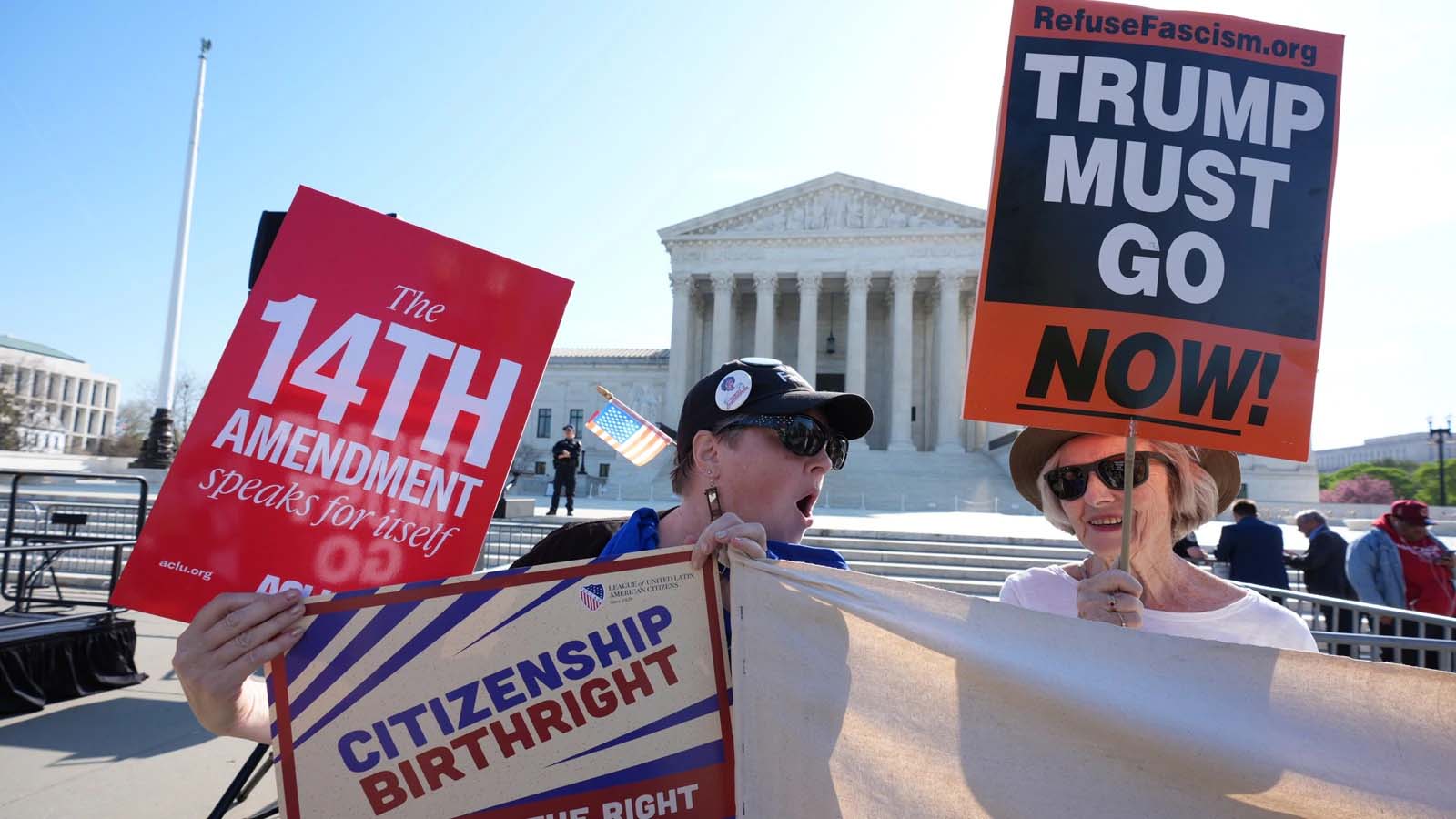
“Some Asian Americans think, ‘Well, you know that’s about undocumented people, it’s not about us,’ but the reality is, ‘No, we’re all in this together,’” said Aarti Kohli, executive director of the Asian Law Caucus, which was among the groups challenging President Donald Trump’s executive order on birthright citizenship.
Gene Wu, who was born in China and moved to Texas as a child in the 1980s, recalled learning only the most basic facts about Asian American history in school.
Now a Democratic state lawmaker in Texas, he has tried to fight laws in several states restricting land purchases by Chinese citizens and companies on national security grounds.
Throughout 2023, he held weekly workshops for concerned participants, mostly Chinese Americans, that outlined the history of anti-Asian laws in the United States, including alien land laws, which effectively prohibited Asian immigrants in the early 20th century from buying farmland and, in some cases, homes.
“When they hear all this, they are floored,” Wu said. “They had no idea.”