
Pakistan is making a sham bid to claim the pre-Islamic cultural and civilisational heritage of the Indian subcontinent. However, a concerning amount of Pakistan’s military hardware, especially its missiles, are named after Turkic and Afghan conquerors who plundered the region for centuries.
Most things that Pakistan’s civilian-military hybrid regime does are duplicitous in nature. So is its bid to highlight its pre-Islamic heritage, especially the legacy of the Indus Valley Civilisation. It has focused on building that narrative, especially after India put the Indus Waters Treaty in abeyance in April 2025. This attempt to embrace the ancient Indic heritage is exposed by an awkward contradiction: many of Pakistan’s weapons, especially its missiles, are named after foreign conquerors remembered for invading and plundering the Indian subcontinent.
Modern Pakistan traces its origins to the Two-Nation Theory, which held that Hindus and Muslims could not coexist in a single state. The Partition of 1947 created Pakistan, which later embraced a hardline Islamic identity under General Zia-ul-Haq, recasting its history around the Islamic conquest of Sindh in the 8th century CE. The attempt to highlight itself as the centre of the pre-Islamic Indus Valley Civilisation is to claim a share of the Indus waters.
Pakistan has long sought to anchor its national identity in the legacy of Arab, Afghan, and Turkic conquerors who crossed the Hindu Kush and established dynasties across large parts of the Indian subcontinent. For decades, its textbooks have taught that Pakistan’s history began with Muhammad bin Qasim’s conquest of Sindh in 712 CE. Many of these rulers, who rose to power through conquest and plunder, have been glorified by the Pakistani state through the names of its missiles, tanks, and warships.
This naming convention also serves a psychological purpose. By invoking rulers who conquered much of what is now India, Pakistan symbolically positions its weapons against its principal adversary.
Yet the territory that now forms Pakistan, which was part of India, has a continuous history stretching back thousands of years. From the Indus Valley Civilisation, it became home to the early Vedic culture in the Sapta Sindhu region and the influential Gandhara culture, making it a cradle of major South Asian traditions long before the modern state came into being.
As Islamabad increasingly seeks to reclaim this heritage, an obvious question arises: Can Pakistan celebrate the region’s ancient past while continuing to honour those remembered for invading and plundering it by naming its weapons after them?
HOW DOES PAKISTAN NAME ITS MISSILES AND OTHER WEAPONS?
Different countries have different traditions when naming the weapons that equip their armed forces. The US, for instance, often names its tanks and armoured vehicles after historic military commanders and generals, such as the M4 Sherman, M46/M48 Patton, and M1 Abrams.
India, by contrast, frequently draws from mythology, epics, and Sanskrit terms—for example, the Agni series of ballistic missiles (named after the fire god), Prithvi (Earth), Akash (Sky), the Arjun and Bhishma tanks (after Mahabharata warriors), and the fighter jet Tejas (radiance).
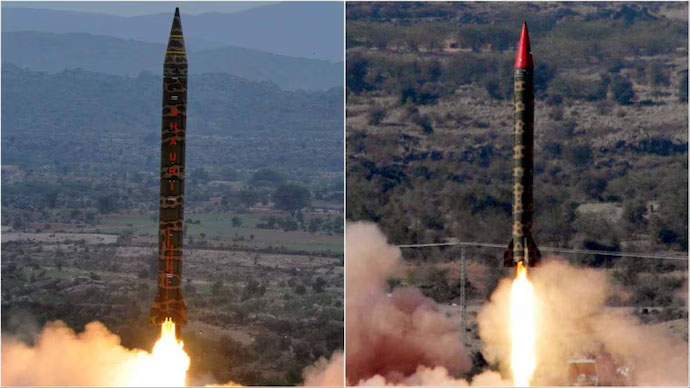
Pakistan, meanwhile, has named most of its major weapons systems after figures from Islamic history. Several of its missiles commemorate foreign conquerors who invaded the Indian subcontinent.
The Hatf-II Abdali honours Ahmad Shah Durrani, the Afghan ruler who invaded India repeatedly in the 18th century.
The Hatf-III Ghaznavi commemorates Mahmud of Ghazni, the Turkic ruler based in present-day Afghanistan who launched repeated raids into India, including the 1025 sack of the Somnath Temple.
The Hatf-V Ghauri is named after Muhammad of Ghor, whose victory at the Second Battle of Tarain in 1192 paved the way for the establishment of the Delhi Sultanate.
The Hatf-VII Babur takes its name from Babur, the Central Asian ruler who founded the Mughal Empire after conquering northern India.
The Taimoor cruise missile is named after Timur (Tamerlane), the 14th-century Turco-Mongol conqueror who brutally sacked Delhi in 1398.
NAMES OF PAKISTANI WEAPONS INSPIRED BY ARABIC TERMINOLOGY, HISTORY
Beyond naming weapons after conquerors, Pakistan also draws heavily on Arabic terminology and early Islamic history to imbue its arsenal with martial and religious symbolism. The entire Hatf missile series and the Anza air-defence systems are named after Arabic words for weapons (lance and short spear) associated with the Prophet Muhammad, while the naval frigate Zulfiqar is named after his legendary sword.
Furthermore, the Al-Khalid and Al-Zarrar tanks honour early Arab generals, while the Ra’ad (thunder) cruise missile references the 13th Surah of the Quran.
This ideological framing extends far beyond weapons systems. Pakistan’s military media wing, DG ISPR, also regularly employs seventh-century Islamic theological terminology, such as Fitna al-Khawarij and Fitna al-Hindustan, to describe militants in Khyber Pakhtunkhwa and Balochistan as “Indian proxies.”
The same historical references have also shaped military operations. For example, Pakistan’s 1965 infiltration into Kashmir was codenamed Operation Gibraltar, after the eighth-century Muslim conquest of Spain, and involved formations named the Ghaznavi, Babur, and Khalid forces.
By consistently drawing names from Islamic history, theological concepts, and foreign conquerors, Pakistan’s military vocabulary has largely sidelined the Hindu, Buddhist, and Sikh traditions that also shaped the land it now occupies. For a state that has historically rooted its identity in those who conquered the region, there has been little incentive to celebrate those who preceded them.
WILL PAKISTAN CHANGE NAMES OF WEAPONS TO RECLAIM INDIC ROOTS?
Pakistan now appears to be making a bid to reclaim the subcontinent’s civilisational heritage that it long neglected. Moving beyond a historical narrative centred almost exclusively on Muhammad bin Qasim’s eighth-century conquest of Sindh, it is using documentaries, tourism campaigns, and international outreach to project the Indus Valley Civilisation as an inseparable part of its national identity.
Yet this cultural pivot reveals a striking contradiction. Even as Pakistan seeks to embrace an Indic civilisational identity, it continues to honour medieval conquerors who invaded the region by naming some of its most important missiles after them. Names of other weapons are inspired by Arabic history or terminology. Yet others from Prophet Muhammad’s weapons. They all have Islamic, not Indic, connections.
This tension was laid bare by Pakistan’s Defence Minister Khawaja Asif. In an interview with Samaa TV, Asif argued that Pakistan’s history extends well beyond the advent of Islam, stating, “Ashoka was part of it. Chandragupta Maurya was also part of it. Kanishka was part of it too. We were taught about Jainism and Buddhism and their history… I am not any less of a Pakistani if I am proud of my heritage.”
Asif had previously denounced Mahmud of Ghazni, the conqueror commemorated by Pakistan’s Hatf-III missile, arguing that Ghazni did not spread Islamic values but invaded India simply to “steal and plunder” before returning home with his spoils.
Will Islamabad’s attempt to reclaim the subcontinent’s Indic roots eventually extend to renaming its weapons? Probably not.
The naming of strategic weapons remains the exclusive preserve of the Pakistan Armed Forces, an institution largely insulated from the rhetoric of civilian politicians such as Khawaja Asif, and led by Field Marshal Asim Munir, who has spent much time and energy Islamising the force. Munir is the first chief of Pakistan’s armed forces who is also Hafiz e Quran. Under him, Pakistan’s military has increasingly resorted to the use of Islamic terminology, including naming the attack on India in May 2025 Operation Bunyan-un-Marsoos.
Pakistan’s highly Islamised military establishment is unlikely to reconcile with the hybrid regime to hype up its Indic civilisation. Therefore, whenever Pakistan tries to make the false attempt of trying to embrace its pre-Islamic roots, its missiles, named after Islamic invaders, will shoot down the narrative. What’s in a name? Well, Pakistan knows.