
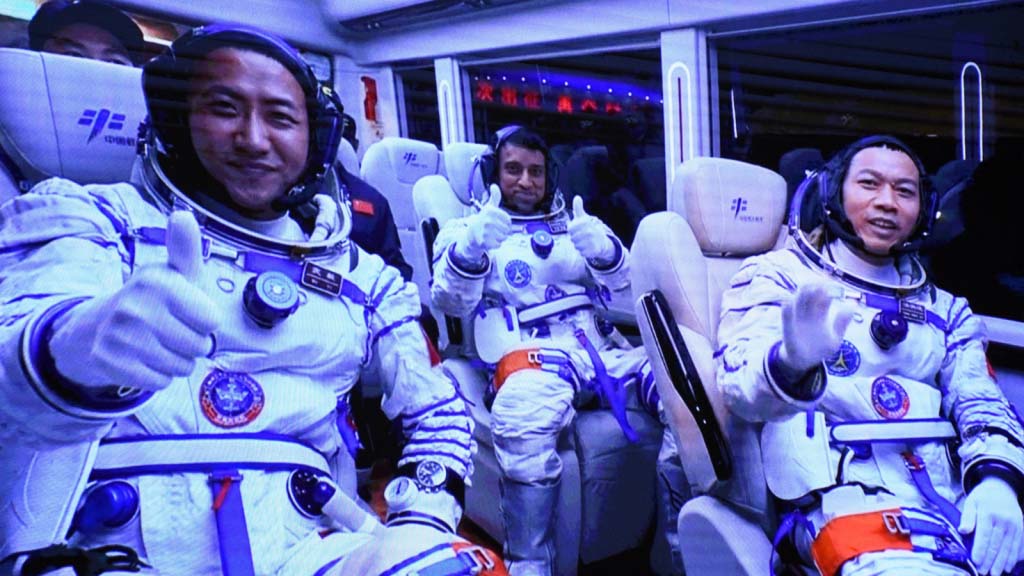
Pakistan’s first astronaut, Muhammad Zeeshan Ali, has reached China’s Tiangong space station with a specially prepared menu of more than 100 halal food varieties, including butter chicken, beef nihari and lamb korma.
Butter chicken, beef nihari, lamb korma and curried chickpeas are among more than 100 halal food varieties prepared for Pakistan’s first astronaut aboard China’s Tiangong space station. For Muhammad Zeeshan Ali, who has become the first Pakistani to travel into orbit, the specially curated menu brings familiar flavours to an otherwise extraordinary journey into space, China’s state broadcaster CGTN reported.
CGTN shared details of the menu, which was prepared to accommodate Ali’s dietary requirements and food preferences. The selection includes more than 100 varieties, with the dishes made in accordance with halal requirements, news agency Anadolu Agency reported.
Ali, a 40-year-old former Pakistan Air Force pilot, entered the space station Wednesday, November 25, with two Chinese astronauts after the Shenzhou-24 spacecraft docked with Tiangong. The three-member crew reached the station at 2:35 pm Beijing time, roughly six hours after lifting off from the Jiuquan Satellite Launch Centre in northwest China aboard a Long March-2F rocket, news agency Reuters reported.
Ali is serving as a payload specialist and is expected to spend five to 10 days in space. He is accompanied by mission commander Tang Hongbo and flight engineer Wu Yi. The incoming crew was welcomed by three astronauts from the Shenzhou-23 mission already aboard the station.
The two crews, comprising six astronauts, are also expected to share a special dinner in orbit. The customised menu was prepared after researchers studied Pakistani food habits, culinary traditions and nutritional requirements. Chen Junli, a researcher at the China Astronaut Centre, reportedly said the meals were designed to provide adequate energy and nutrition while remaining light and easy to digest, particularly during the astronauts’ initial days in space.
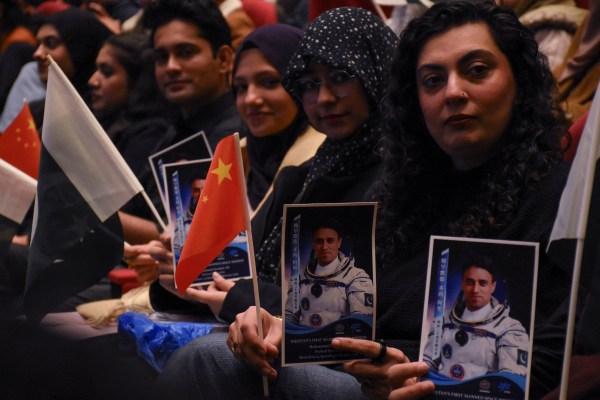
People pose with the photos of Pakistani astronaut Muhammad Zeeshan Ali as they watch the launch of the Shenzhou-24 spacecraft mission to China’s Tiangong space station. (REUTERS)
Pakistan celebrates historic space mission
Ali’s arrival marks two milestones – he is the first Pakistani to travel into orbit and the first foreign astronaut to board China’s Tiangong space station.
The launch was watched with excitement in Pakistan, particularly at the country’s Space and Upper Atmosphere Research Commission (SUPARCO) headquarters in Islamabad, where scientists, students and space experts gathered to follow the mission.
Speaking to CGTN, Adan Ather, a space sciences student at the Institute of Space Technology, said watching the launch was an emotional moment.
“I am very proud, it feels unreal, when the launch was happening, I was getting goosebumps, actually!” he said, adding that joining the space sciences programme had inspired him to dream of travelling to space one day.
Professor Najam Abbas Naqvi, chairman of the National Center of GIS and Space Applications at the institute, described the mission as a landmark achievement for Pakistan’s space agency and its partnership with China.
Pakistan Prime Minister Shehbaz Sharif also welcomed the development, saying the mission represented the aspirations of the country’s 240 million people, particularly its younger generation, scientists and researchers, Reuters reported.
What will Pakistan’s astronaut do in space?
Ali will work alongside the Chinese astronauts on scientific experiments during his stay aboard Tiangong. Dr Amjad Ali, director general of Space Application and Research at SUPARCO, told CGTN that the Pakistani astronaut would take part in four experiments, primarily involving material science, life sciences and biosciences.
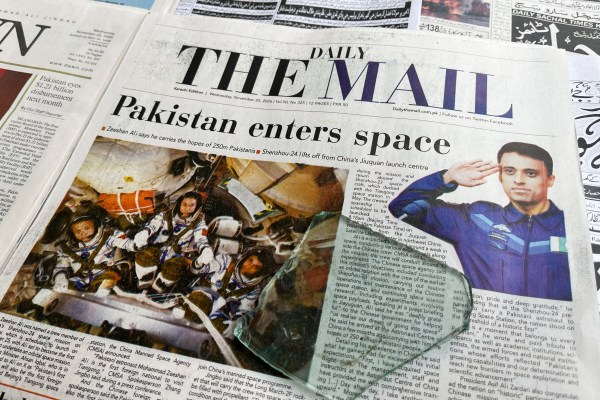
A newspaper featuring photographs of Pakistani astronaut Muhammad Zeeshan Ali and reporting on the launch of the Shenzhou-24 spacecraft mission to China’s Tiangong space station is displayed at a newspaper stand in Karachi, Pakistan, November 25, 2026. (REUTERS)
One of the experiments will examine how self-healing carbon fibre composites can automatically repair small cracks in spacecraft, the report added. Such research could help scientists develop materials better suited to the demands of space missions.
Ali underwent seven months of training in Beijing before the flight. His preparation included intensive Chinese-language classes, learning Chinese songs and reading poetry, as well as practising calligraphy and playing table tennis, Reuters reported.
China-Pakistan space cooperation
The mission builds on decades of space cooperation between the two countries, which dates back to the early 1990s. China has launched Pakistani satellites, while a Pakistani-built rover is expected to take part in a Chinese lunar mission around 2028, Reuters reported.
Pakistan’s Development Minister Ahsan Iqbal said he hoped the flight would pave the way for further collaboration, including the possibility of a joint lunar mission.
The mission also comes as China seeks to expand international participation in its space programme. Its Tiangong station has been fully operational since late 2022 and can accommodate up to six astronauts during crew handovers.
Chinese astronaut Zhu Yangzhu is expected to remain aboard Tiangong for a year to help researchers study how the human body adapts to prolonged stays in space.
China aims to send astronauts to the Moon by 2030 and establish a lunar research base with Russia by 2035. T
(With inputs from agencies)