
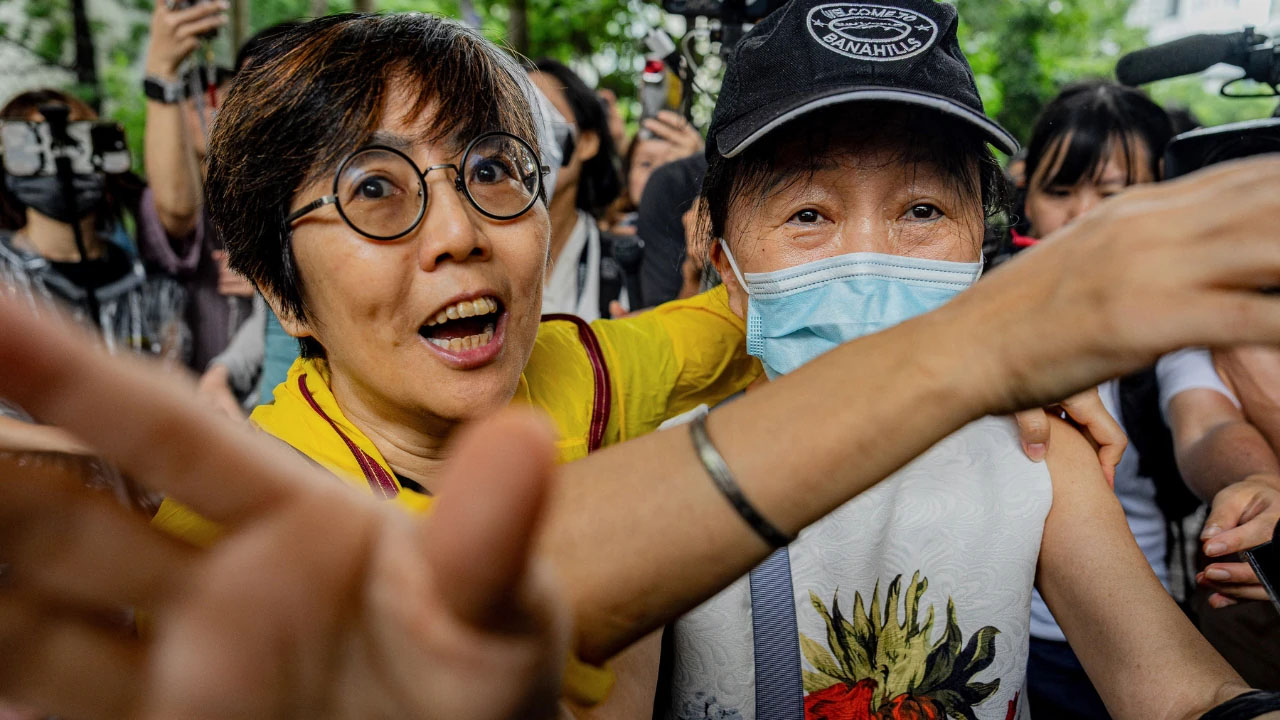
Hong Kong activist Tang Ngok-kwan continues to quietly mark the 1989 Tiananmen crackdown as two former vigil organisers were convicted under the national security law. The case deepens fears that public remembrance and civil freedoms in Hong Kong are steadily shrinking.
Hong Kong activist Tang Ngok-kwan still quietly marks Beijing’s 1989 Tiananmen Square crackdown, even as public remembrance of the event has faded in the city and some of his fellow campaigners have been jailed. On Friday, two of his former colleagues and their vigil-organising group were convicted under a Beijing-imposed national security law, in what many observers say is another sign of shrinking freedoms in Hong Kong.
Tang, 58, said he was not convinced by the court’s reasoning and felt wronged on behalf of those convicted. “After the alliance was convicted, I feel that whenever people bring up the alliance, there’ll be a sense of wariness around it,” he told The Associated Press.
Tang still visits places where Hong Kong once publicly remembered the June 4, 1989 crackdown, which remains a political taboo in mainland China. At Victoria Park, where tens of thousands once gathered for what had been the only large-scale public commemoration of the crackdown in China, he bowed on the eve of the anniversary and read out a list of the victims in a low voice. He also sometimes returns to two university campuses where commemorative sculptures once stood, though most traces of them have disappeared.
Government-approved judges on Friday found two of Tang’s former colleagues guilty along with the Hong Kong Alliance in Support of Patriotic Democratic Movements of China, the group that had organised the annual candlelight vigil for three decades. The pair were ruled to have incited others to overthrow the leadership of China’s Communist Party through unlawful means. They face a maximum prison term of 10 years.
Tang was a young man when he joined marches in Hong Kong in May 1989 in support of student-led pro-democracy protests in Beijing. He said he did not sleep on the night of June 3-4, when tanks rolled into the heart of Beijing to crush the protests. Hundreds, and possibly thousands, were killed. Soon afterwards, some alliance members and others sympathetic to the protesters helped wanted activists get to safety. Tang said he has long felt a moral burden because he believes Hong Kong’s support may have left the students with no easy way out in 1989, and that sense of responsibility kept the alliance’s core volunteers working quietly for years.
Authorities banned the annual vigil in 2020, citing public health risks during the COVID-19 pandemic. Weeks later, Beijing imposed the national security law, saying it was needed to restore stability after the mass protests of 2019. In 2021, the alliance came under growing pressure after a mainland Chinese official criticised those chanting “end one-party dictatorship”, without naming the group. Police later sought details of the alliance’s operations and finances, alleging links to pro-democracy groups overseas and accusing it of being a foreign agent.
The alliance refused to cooperate and told reporters in September 2021 that the request was an “abuse of power”. Tang said he knew by then that he would be jailed for not handing over the information, and recalled feeling frightened when he saw a large number of reporters at the venue. “It really feels like everyone is watching how you die and then coming to see you off on your way,” he said.
Days later, Tang was arrested along with several other core members over the refusal to provide information. The alliance’s chair and vice-chairs, Lee Cheuk-yan, Chow Hang-tung and Albert Ho, were later charged under the security law. The group voted to disband soon afterwards, and two commemorative statues and one relief were removed from university campuses in late 2021. In 2023, Tang, Chow and another core member were each sentenced to four-and-a-half months in prison for failing to provide information. Tang’s jail term overlapped with the 35th anniversary of the crackdown, and he said he marked it by running 35 laps barefoot. Their convictions were quashed by Hong Kong’s top court in 2025, after they had already served their terms.
The legal fight involving the vigil organisers did not end there. The trial of Lee and Chow began in January, and Tang became a regular in the public gallery. Ho pleaded guilty, a move that typically leads to a reduced sentence. Even before the trial, public remembrance had become politically sensitive. Police took away some people who tried to mark the anniversary near the former vigil site, and after pandemic restrictions ended, an annual carnival was held in Victoria Park on each anniversary.
Tang said police on Friday would not let him enter court if he insisted on carrying what they called “sensitive” material, including bookmarks bearing the words “vindicate June 4”. He also said he has repeatedly walked between a subway station and the trial court to remember the years Lee and Chow spent in custody while awaiting trial, noting that there are 64 steps from the station exit, a number that echoes June 4. He said, jokingly, that his eye for such details was “pathological”. “When there’s nothing concrete you can do, the only option, to put it bluntly, well, it’s just another kind of way to balance your psychology,” he said. Tang’s quiet acts now stand in place of the public commemorations that once defined Hong Kong’s remembrance of the crackdown.
With PTI Inputs